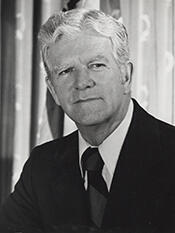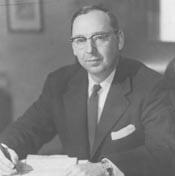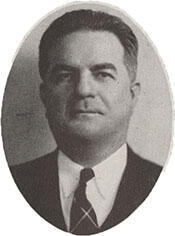
Winder Russell Harris (December 3, 1888 – February 24, 1973) was an American journalist, civil servant, and Democratic politician who served as a U.S. Representative from Virginia during the early years of the Second World War. He was born in Wake County, North Carolina, in an area that is now part of Raleigh. Harris attended the public schools and then pursued further studies at St. Mary’s College, now Belmont Abbey College, in Belmont, North Carolina, laying the educational foundation for his later work in journalism and public service.
Harris began his professional career in journalism, serving in various editorial positions on newspapers in North Carolina and Virginia from 1908 to 1918. This early period in the press exposed him to regional and national political issues and helped establish his reputation as a capable editor and commentator. In 1918 he moved into civil service at the national level, joining the staff of Universal Service in Washington, D.C., where he worked from 1918 to 1925. During this time he gained experience in national and international affairs, culminating in his service as assistant secretary to the American delegation to the International Narcotics Congress in Geneva, Switzerland, in 1924 and 1925, a role that reflected growing U.S. engagement in international regulatory efforts.
After his work in Geneva, Harris returned to journalism and became managing editor of the Virginian-Pilot in Norfolk, Virginia, a position he held from 1925 to 1941. Over these sixteen years he played a significant role in shaping public discourse in southeastern Virginia, overseeing coverage of economic, political, and social developments during the interwar period and the onset of World War II. His prominence in Virginia’s journalistic and civic life helped pave the way for his entry into electoral politics as a member of the Democratic Party.
Harris was elected as a Democrat to the Seventy-seventh Congress on April 8, 1941, in a special election to fill the vacancy caused by the resignation of Representative Colgate W. Darden Jr. In that 1941 contest he defeated Independent Democrat Norman P. Hamilton, Independent Maurice S. McCarty, and Prohibitionist Andrew J. Dunning Jr., winning 49.17 percent of the vote. He was re-elected unopposed in 1942 to the Seventy-eighth Congress. Thus, Winder Russell Harris served as a Representative from Virginia in the United States Congress from 1941 to 1945, contributing to the legislative process during two terms in office. His service in Congress occurred during a significant period in American history, as the nation mobilized for and fought in World War II. As a member of the House of Representatives, Harris participated in the democratic process and represented the interests of his Virginia constituents during this critical era. He served until his resignation on September 15, 1944.
Following his departure from Congress, Harris resumed a career that combined public affairs and organizational leadership. He became vice president of the Shipbuilders’ Council of America in Washington, D.C., a position he held until his retirement from that post on December 31, 1958. In this capacity he was involved with the shipbuilding industry during the postwar years, a period marked by both military and commercial expansion of the American fleet. He also played an important role in local governance and urban development, serving as vice chairman of the Board of Commissioners of the Alexandria Redevelopment and Housing Authority from September 1955 until his resignation from that body in November 1961, reflecting his continued engagement in public service at the municipal level.
Harris remained active in journalism even in his later years. He served as editor of the Alexandria Journal, the Arlington Journal, and the Fairfax County Journal-Standard, regional newspapers in Northern Virginia, until his retirement in March 1966. Through these editorial roles he continued to influence public opinion and civic life in the fast-growing communities surrounding the nation’s capital. He resided in Alexandria, Virginia, during this period and until his death.
Winder Russell Harris died on February 24, 1973, in Alexandria, Virginia. He was interred in Oakwood Cemetery in Raleigh, North Carolina, returning in death to his native state. His family’s tradition of public service continued into the next generations; his grandson, David S. Bill III, became a rear admiral in the United States Navy.
Congressional Record