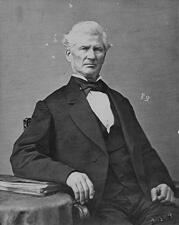
Willis Benson Machen (April 10, 1810 – September 29, 1893) was an American politician who served as a Democratic U.S. Senator from Kentucky from 1872 to 1873. His brief tenure in the United States Senate occurred during the turbulent Reconstruction era, when he represented the interests of his Kentucky constituents and contributed to the legislative process during one term in office.
Machen was born on April 10, 1810, in Caldwell County, Kentucky, an area that later became part of Lyon County, to Henry Ballenger Machen and Nancy Tarrant Machen. He attended the common schools of the region and from an early age engaged in agricultural work. He pursued further education at Cumberland College in Princeton, Kentucky, and afterward returned to agricultural pursuits near Eddyville. In addition to farming, he worked at the Livingston iron forge, gaining experience in local industry. With a partner he opened his own iron-related business, but the venture failed and nearly ruined him financially. Machen eventually repaid his debts and turned to building turnpikes, but an injury forced him to abandon that occupation as well.
After his injury, Machen studied law and was admitted to the bar in 1844. He quickly built up a substantial legal practice, which in turn helped launch his political career. He entered public life as a delegate to the Kentucky constitutional convention of 1849, participating in the revision of the state’s fundamental law. He was elected to the Kentucky Senate in 1854 and later served in the Kentucky House of Representatives in 1856 and again in 1860, establishing himself as a prominent Democratic figure in state politics on the eve of the Civil War.
During the Civil War, Machen aligned with the Confederacy. When a group of secessionist Kentuckians organized a Confederate government for the state, he was chosen president of the Kentucky Confederate legislative council. He represented Kentucky’s 1st congressional district in the First Confederate Congress, serving on the Accounts and Ways and Means Committees. Re-elected to the Second Confederate Congress, he also worked in the quartermaster and commissary departments. In total, he served in the Confederate Congress from February 22, 1862, until its dissolution in April 1865. At the close of the war, fearing reprisals for his Confederate service, Machen fled to Canada; his third wife and daughters Minnie and Marjorie joined him there. In 1869 President Ulysses S. Grant issued him a pardon, enabling his return to Kentucky. Friends urged him to run for governor, but questions about his eligibility led him to decline. On July 9, 1872, Kentucky’s delegates to the Democratic National Convention in Baltimore, Maryland, placed his name in nomination for Vice President of the United States, and he received one electoral vote.
Machen’s service in the United States Congress began later that year. On September 22, 1872, Governor Preston H. Leslie appointed him to the United States Senate to fill the vacancy caused by the death of Senator Garrett Davis. When the Kentucky legislature reconvened, the Kentucky Senate formally elected him to the seat on January 21, 1873, over Republican Tarvin Baker by a vote of 104 to 18. He served as a Democratic U.S. Senator from September 27, 1872, to March 3, 1873. During this significant period in American history, in the midst of Reconstruction, Machen participated in the democratic process at the federal level and represented Kentucky’s interests in the Senate, though his tenure was too brief to establish a major legislative record.
Following his congressional service, Machen resumed his agricultural interests in Kentucky. He jointly owned several iron furnaces in Lyon County, and one of these furnaces was the site where William Kelly developed his process for making steel rails, an important innovation in American industrial history. In 1880 Machen was appointed to the Kentucky Railroad Commission, where he served one full term, contributing to the regulation and development of the state’s growing rail network. After completing his service on the commission, he retired to Mineral Mound, his 1,000‑acre estate on the Cumberland River near Eddyville, where he raised tobacco and managed his lands. The property later became the site of Mineral Mound State Park.
Machen’s personal life was marked by three marriages and a large family. On December 28, 1835, he married his first wife, Margaret Aurelia Lyon, daughter of U.S. Representative Chittenden Lyon and granddaughter of U.S. Representative Colonel Matthew Lyon. They had at least six children: a daughter, Mary J. Machen (1838–1854), and five sons, Edward Chittenden Machen (1840–1845), Henry Lyon Machen (1843–1893), Edward C. Machen (1846–after 1887), Willis Benson Machen Jr. (1849–1851), and Willis Benson Machen III (1851–1852). Margaret died in 1852, and later that year Machen married his second wife, Eliza N. Dobbins. They had three children: a son, John S. Machen, and two daughters, Mary E. Machen and Elizabeth Machen. He was again widowed in 1859. On September 10, 1859, he married his third wife, Victoria Theresa Mims, daughter of John Harrison Mims and Caroline Hanson (Cresap) Mims. They had eight children, at least three of whom died in childhood: sons Frank P. Machen, Willis B. Machen IV (1872–1903), and Albert Sidney Machen (1875–1876), and daughters Minerva Buckner “Minnie” Machen (later Sayre) (1860–1958), Maggie Davis Machen (1862–1864), Caroline Mims Machen (1874–1874), and Marjorie Lee Machen (later Rieke) (1881–1913), as well as Charles Victor Machen. Through his daughter Minnie, who married Anthony D. Sayre, Machen was the maternal grandfather of Zelda Sayre Fitzgerald, though he died before her birth.
In his later years, Machen continued to reside at Mineral Mound until his health declined. He died on September 29, 1893, at the Western Asylum in Hopkinsville, Kentucky. He was interred in Riverview Cemetery in Eddyville, Kentucky. His former estate on the Cumberland River, later transformed into Mineral Mound State Park, stands as a geographic reminder of his long association with western Kentucky and his varied career in law, agriculture, industry, state politics, the Confederate Congress, and the United States Senate.
Congressional Record