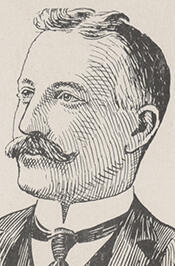
William Joseph Wynn (June 12, 1860 – January 4, 1935) was an American machinist and politician who served as a U.S. Representative from California for one term from 1903 to 1905. A member of the Democratic Party and elected as a Union Labor Democrat, he represented a San Francisco–area district during a significant period in American political and labor history, contributing to the legislative process over a single term in the United States House of Representatives.
Wynn was born on June 12, 1860, in San Francisco, California, to Irish immigrant parents. He was educated in the public schools of San Francisco, reflecting the city’s growing urban character in the late nineteenth century. After completing his schooling, he entered the machinist’s trade as an apprentice, acquiring technical skills that would shape his early career and align him with the city’s industrial and working-class communities.
Following his apprenticeship, Wynn worked in the principal manufacturing establishments of San Francisco, gaining practical experience in the industrial sector at a time when organized labor and urban industry were becoming increasingly influential in California politics. His background as a machinist and his familiarity with the concerns of working people helped form the basis of his later political identity and his association with labor-oriented political movements.
Wynn’s formal political career began at the municipal level. He served as a member of the San Francisco Board of Supervisors from January 8, 1902, to March 4, 1903. In this role, he participated in the governance of a rapidly expanding city, engaging with issues of local administration, infrastructure, and public services. His service on the Board of Supervisors provided him with experience in public office and increased his visibility within both Democratic and labor circles in San Francisco.
Building on his local service, Wynn was elected as a Union Labor Democrat to the Fifty-eighth Congress, serving as a Representative from California from March 4, 1903, to March 3, 1905. As a member of the House of Representatives, he participated in the democratic process at the national level and represented the interests of his San Francisco constituents during a period marked by debates over labor rights, economic regulation, and urban reform. His election on a Union Labor Democratic ticket reflected the era’s complex alliances between traditional party structures and emerging labor organizations.
During his congressional tenure, Wynn became notable for his opposition to Abe Ruef, the powerful Union Labor political boss who exerted considerable influence over San Francisco politics. Wynn’s resistance to Ruef’s control led to a rupture with the Union Labor organization, and he subsequently lost the party’s nomination in 1904. Although he retained the Democratic ballot line in the general election, the loss of Union Labor support weakened his position, and he was defeated by Republican candidate Everis A. Hayes, bringing his congressional service to a close after a single term.
After leaving Congress, Wynn returned to private life in San Francisco and entered the insurance business, in which he remained engaged for the rest of his career. He continued to be active in civic and fraternal affairs and was a member of the Native Sons of the Golden West, an organization dedicated to preserving the history and heritage of California. William Joseph Wynn died in San Francisco on January 4, 1935. He was interred at Holy Cross Cemetery in Colma, California, closing a life that spanned the transformation of San Francisco from a post–Gold Rush city to a major American urban center and that combined industrial labor, local governance, and national legislative service.
Congressional Record