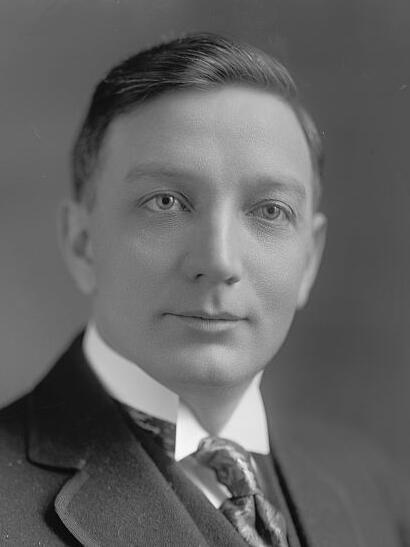
William Frederick Waldow (August 26, 1882 – April 16, 1930) was an American businessman and Republican politician from Buffalo, New York, who served one term as a United States Representative from New York’s 42nd congressional district from 1917 to 1919. Over the course of his public career, he held local, county, and national offices and participated in the legislative process during a significant period in American history.
Waldow was born in Buffalo, Erie County, New York, on August 26, 1882, the son of Gustav R. Waldow and Caroline W. Waldow. He attended the common schools of Buffalo, receiving a basic public education that prepared him for a skilled trade. After leaving school, he worked as an apprentice plumber, gaining practical experience in the building trades. He subsequently established himself as a plumbing contractor, entering the business community in Buffalo and laying the foundation for his later involvement in public affairs.
Waldow’s political career began at the municipal level. Active in Republican politics, he was elected to the Buffalo board of aldermen, on which he served from 1912 to 1913. His work in city government brought him into closer contact with party leaders and local constituents, and he advanced within the Republican organization. From 1916 to 1918 he was a member of the New York Republican State Committee, participating in the broader direction of party policy and candidate selection at the state level.
In 1916, Waldow was elected as a Republican to the 65th Congress from New York’s 42nd congressional district. He served in the United States House of Representatives from March 4, 1917, to March 3, 1919, a single term that coincided with the United States’ entry into World War I and major debates over national policy. As a member of the House of Representatives, William Frederick Waldow participated in the democratic process and represented the interests of his constituents in western New York. During his term, he served on the Committee on Insular Affairs, which had jurisdiction over matters relating to the United States’ overseas territories and possessions. A member of the Republican Party, Waldow contributed to the legislative process during his one term in office. In 1918 he was an unsuccessful candidate for reelection to the 66th Congress.
After leaving Congress in 1919, Waldow returned to Buffalo and resumed his former business pursuits in the plumbing and contracting field. He also expanded his activities in local finance and civic life. He was appointed to the board of directors of the East Side Share Corporation and the East Side National Bank, reflecting his growing role in the city’s commercial and financial sectors. In addition to his professional responsibilities, Waldow was active in fraternal and social organizations. He was a member of the Independent Order of Odd Fellows, the Humboldt Club, and the Buffalo Trap and Field Club, affiliations that connected him to a broad network of civic and political leaders.
Waldow remained engaged in Republican politics after his congressional service. In 1920 he served as a delegate to the Republican National Convention, participating in the nomination process for the party’s national ticket. Later that year he was elected sheriff of Erie County, New York, as the successful Republican nominee. He held the office of sheriff from 1921 to 1923, overseeing law enforcement and the administration of the county jail during his term.
William Frederick Waldow died in Snyder, New York, on April 16, 1930. He was interred at Forest Lawn Cemetery in Buffalo, New York.
Congressional Record