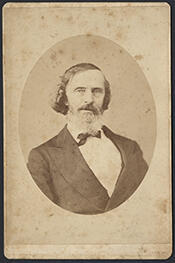
William Henry Wadsworth (July 4, 1821 – April 2, 1893) was a U.S. Representative from Kentucky whose congressional service spanned the Civil War era and the late nineteenth century. Born in Maysville, Mason County, Kentucky, he spent his early years in that river town on the Ohio River, where he attended local town and county private schools. His upbringing in Maysville, a commercial center with strong ties to both the Upper South and the free states across the river, helped shape his later political identity as a Unionist during a period of intense sectional conflict.
Wadsworth pursued higher education at Augusta College in Bracken County, Kentucky, one of the earliest Methodist colleges in the United States, from which he graduated in 1841. After completing his collegiate studies, he read law and was admitted to the bar in 1844. He commenced the practice of law in his native Maysville, building a professional reputation in the local courts and becoming a prominent member of the bar. His legal career provided the foundation for his entry into public life and state politics.
Wadsworth’s political career began in the Kentucky General Assembly, where he served as a member of the Kentucky State Senate from 1853 to 1856. In this role he participated in state legislative affairs during a decade marked by growing national tensions over slavery and states’ rights. By 1860, as the Union faced an impending crisis, he aligned himself with the Constitutional Union Party, which sought to avert secession and preserve the Union. That year he served as a presidential elector on the Constitutional Union ticket, supporting the national candidacy of John Bell and Edward Everett.
With the outbreak of the Civil War, Wadsworth emerged as a staunch Unionist. He was elected as a Unionist to the Thirty-seventh and Thirty-eighth Congresses, serving in the U.S. House of Representatives from March 4, 1861, to March 3, 1865. Representing Kentucky during one of the most critical periods in American history, he participated in the legislative process as the nation grappled with secession, war, and the beginnings of Reconstruction. During his tenure, he cast a recorded “nay” vote on the Thirteenth Amendment to the Constitution, which abolished slavery, reflecting the complex political and social currents in a border state like Kentucky. He was not a candidate for renomination in 1864, concluding this initial period of congressional service at the close of the Thirty-eighth Congress.
In addition to his legislative duties, Wadsworth took on a military-related role during the Civil War. He served as an aide to Union General William “Bull” Nelson, holding the rank of colonel, and was present at the Battle of Ivy Mountain (also known as Ivy Creek or Ivy Mountain) in eastern Kentucky. In this capacity he contributed to the Union war effort in a border region where loyalties were divided and military control was contested. His dual experience as both legislator and military aide underscored his commitment to the preservation of the Union.
After the war, Wadsworth continued to serve the federal government in a diplomatic and quasi-judicial capacity. In 1869 President Ulysses S. Grant appointed him United States commissioner to Mexico under the Treaty of Washington for the adjustment of claims. In this role he participated in the adjudication of claims between the United States and Mexico, part of a broader postwar effort to resolve outstanding international disputes and stabilize relations with neighboring republics. His appointment reflected the confidence placed in his legal expertise and judgment at the national level.
Wadsworth later returned to elective office in the post-Reconstruction era. A member of the Republican Party by this time, he was elected as a Republican to the Forty-ninth Congress and served from March 4, 1885, to March 3, 1887. This second period of congressional service, two decades after his first, placed him in the midst of debates over economic policy, veterans’ issues, and the evolving role of the federal government in a rapidly industrializing nation. He served one term and was not a candidate for renomination in 1886, after which he again resumed the practice of law in Maysville.
In his later years, Wadsworth continued his legal work and remained a respected figure in his hometown. He died in Maysville, Kentucky, on April 2, 1893. He was interred in Maysville Cemetery, closing a life that had encompassed service in state government, two distinct periods in the U.S. House of Representatives, military service during the Civil War, and diplomatic responsibility in the postwar settlement of international claims.
Congressional Record