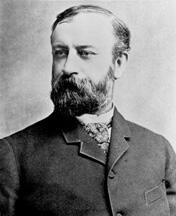
William Freeman Vilas (July 9, 1840 – August 27, 1908) was an American lawyer, politician, cabinet officer, and United States Senator. A prominent Bourbon Democrat, he represented the state of Wisconsin in the United States Senate for one term from 1891 to 1897 and served in the cabinet of President Grover Cleveland as the 33rd Postmaster General and the 17th Secretary of the Interior. Over the course of his public career, he became a leading figure in Wisconsin and national Democratic politics and later an important benefactor of higher education in his adopted state.
Vilas was born in Chelsea, Orange County, Vermont, on July 9, 1840, the son of Esther Greene (Smilie) Vilas and Levi Baker Vilas, a lawyer and politician. His family was active in Democratic politics; his grandfather, Nathan Smilie, was a Democratic politician who ran for Governor of Vermont in 1839. In 1851, when William was still a boy, the Vilas family moved west to Madison, in what was then a growing center of political and educational life in Wisconsin. The move placed him in the community that would remain his home for the rest of his life and the base of his legal and political career.
Vilas pursued higher education at the University of Wisconsin in Madison, from which he graduated in 1858. He then studied law at Albany Law School in Albany, New York, completing his legal education in 1860. After his admission to the bar, he returned to Wisconsin to practice law, establishing himself in Madison. His legal training and growing reputation as an able attorney provided the foundation for his later prominence in state and national affairs, and he became closely associated with the University of Wisconsin and the civic life of Madison.
A committed Democrat in a state often dominated by Republicans, Vilas emerged as a leading Bourbon Democrat, aligned with the conservative, pro–gold standard, and limited-government wing of the party. His political abilities and party loyalty brought him to national attention during the administration of President Grover Cleveland. Cleveland appointed him Postmaster General of the United States, making Vilas the 33rd Postmaster General. In that capacity, he oversaw the federal postal system during a period of expansion and modernization. Cleveland later transferred him to the Department of the Interior, where Vilas served as the 17th Secretary of the Interior. In that role he was responsible for federal land policy, Native American affairs, and the administration of public resources, participating in the broader debates of the era over land management and the scope of federal authority.
In 1891, Vilas was elected as a Democrat to the United States Senate from Wisconsin, serving a single term until 1897. His tenure in the Senate coincided with a significant period in American history marked by economic change, debates over monetary policy, and shifting party alignments. As a member of the Senate, William Freeman Vilas contributed to the legislative process and represented the interests of his Wisconsin constituents, participating in the democratic process during a time of intense national discussion over tariffs, currency, and federal economic policy. He remained identified with the Bourbon Democratic position, favoring sound money and limited federal intervention, and his six years in the Senate capped his formal national political career.
Beyond his public offices, Vilas maintained a close relationship with the University of Wisconsin and the city of Madison. He became one of the university’s most significant benefactors, and at his death in 1908 he left a bequest of $30,000,000 to the institution, a gift that had a transformative impact on its development and stature. In recognition of his contributions, Vilas Hall on the University of Wisconsin–Madison campus bears his name. His influence is also commemorated more broadly in the region: Vilas County in northern Wisconsin, as well as the towns of Vilas, Colorado, and Vilas, South Dakota, are named in his honor, reflecting the reach of his reputation beyond his home state.
In his personal life, Vilas married Anna M. Fox, who had been born in the territory of Wisconsin. The couple had several children and experienced profound personal losses. Their younger son, Levi Baker, died in early childhood. Their elder daughter, Nellie, died in 1893, and their older son, Henry, died in 1899 at the age of 27 from complications related to diabetes. William and Anna were survived by their younger daughter, Mary Esther. These family tragedies occurred alongside Vilas’s public responsibilities and philanthropy, marking a private life shaped by both prominence and sorrow.
William Freeman Vilas died on August 27, 1908, in Madison, Wisconsin. At the time of his death he was widely recognized for his service as a lawyer, cabinet officer, United States Senator, and civic leader, as well as for his extraordinary benefaction to the University of Wisconsin. He was interred at Forest Hill Cemetery in Madison, Wisconsin, a resting place for many of the state’s leading figures. His legacy endures in the institutions and communities that bear his name and in the historical record of Wisconsin and national politics in the late nineteenth century.
Congressional Record