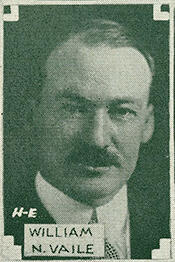
William Newell Vaile (June 22, 1876 – July 2, 1927) was an American lawyer, military veteran, and Republican politician who served five terms as a U.S. Representative from Colorado from 1919 until his death in 1927. Over the course of his decade in the House of Representatives, he contributed to the legislative process during a significant period in American history, representing the interests of his Colorado constituents and playing a visible role in debates over immigration and social policy.
Vaile was born in Kokomo, Indiana, on June 22, 1876, and was of English descent. In 1881 he moved with his parents to Denver, Colorado, where he was raised and educated. He attended the public schools in Denver and later enrolled at Yale University, from which he graduated in 1898. His early life in Colorado, combined with an elite Eastern education, helped shape his later career at the intersection of Western regional concerns and national politics.
During the Spanish–American War, Vaile served as a private in the First Regiment of the Connecticut Volunteer Field Artillery from May 19, 1898, to October 25, 1898. After his brief wartime service, he turned to the study of law. He attended the University of Colorado in 1899 and then continued his legal education at Harvard Law School in 1900–1901. He was admitted to the bar in 1901 and began practicing law in Denver, establishing himself within the city’s professional and civic circles.
From 1901 to 1916 Vaile served as counsel for the Denver & Rio Grande Railroad, a major regional railroad whose legal affairs placed him at the center of important economic and transportation issues in the Rocky Mountain West. He also held public office at the county level, serving as County Attorney for Jefferson County, Colorado, from 1911 to 1914. On June 14, 1914, he married Kate Rothwell Varrell. Vaile first sought national office as a Republican candidate for Congress in 1916 but was unsuccessful in that campaign. That same year he again entered military service, serving on the Mexican border from June 28 to December 1, 1916, as a second lieutenant in the First Separate Battalion, National Guard of Colorado, during the period of heightened tensions along the U.S.–Mexico border.
Vaile was elected as a Republican to the Sixty-sixth Congress and to the four succeeding Congresses, serving from March 4, 1919, until his death on July 2, 1927. His tenure in Congress thus spanned the post–World War I era and much of the 1920s, a time marked by debates over economic policy, social change, and America’s role in the world. He served as chairman of the Committee on Expenditures in the Department of the Treasury during the Sixty-eighth Congress, from March 4, 1923, to March 3, 1925, overseeing aspects of federal fiscal oversight. Among his notable legislative initiatives, he co-sponsored the Cummins–Vaile Bill, introduced on April 8, 1924, which was the first birth control bill to reach debate in the United States Congress, reflecting emerging national discussions over reproductive rights and public health.
A noted restrictionist on immigration, Vaile became a prominent supporter of the United States Immigration Act of 1924, also known as the National Origins Act, Johnson–Reed Act, or Immigration Quota Act of 1924. The legislation limited the number of immigrants who could be admitted from any country to 2 percent of the number of people from that country who were already living in the United States according to the 1890 census. These quotas, which remained in place with only minor alterations until the Immigration and Nationality Act of 1965, had the intended effect of shifting immigration dramatically from Southern, Central, and Eastern Europe to Northern and Western Europe. Vaile defended these policies in Congress, arguing that the United States had been fundamentally shaped by northern European and particularly Anglo-Saxon settlers and asserting that “we are not going to surrender it to somebody else or allow other people, no matter what their merits, to make it something different,” a statement recorded in the Congressional Record on April 8, 1924 (p. 5922). His views and speeches made him a central figure in the restrictionist movement of the 1920s.
In addition to his legislative work, Vaile engaged in literary and civic pursuits. In the fall of 1925 he published a novel, The Mystery of Golconda, which dealt with life in the mining camps of the Rocky Mountains, drawing on the regional setting he knew well. He was active in numerous organizations, including the University Club of Denver, the Cactus Club, Masonic orders, the Spanish War Veterans, the Denver Civic and Commercial Association, and the Denver School League, reflecting his broad involvement in professional, fraternal, and community affairs.
On July 2, 1927, while still in office, Congressman Vaile died of a sudden heart attack as he was traveling by car with friends and family to Grand Lake near Rocky Mountain National Park for the Fourth of July holiday. His death brought an abrupt end to his fifth consecutive term in the House of Representatives. He was interred in Fairmount Cemetery in Denver, Colorado, and is listed among the members of the United States Congress who died in office between 1900 and 1949.
Congressional Record