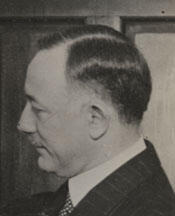
William Irving Sirovich (March 18, 1882 – December 17, 1939) was an American physician, banker, and Democratic politician from New York who served as a Representative in the United States Congress from 1927 until his death in 1939. Over the course of seven consecutive terms, he contributed to the legislative process during a significant period in American history, representing the interests of his New York constituents in the House of Representatives.
Sirovich was born on March 18, 1882, in York County, Pennsylvania, to Hungarian-Jewish immigrants Jacob and Rose Sirovich (née Weinstock). In 1888, when he was still a child, the family moved to New York City, where he was raised. He attended the public schools of New York City and went on to graduate from the College of the City of New York in 1902. He continued his education at the Columbia University College of Physicians and Surgeons, from which he received his medical degree in 1906.
After completing his medical training, Sirovich commenced the practice of medicine in New York City in 1906. Alongside his medical work, he developed a parallel career as a lecturer, editor, and playwright, with several of his plays produced on Broadway. He also became deeply involved in civic and educational affairs. From 1906 to 1926, he served as a member of the fifth district school board in New York City, reflecting his long-standing interest in public education. In 1910 he became superintendent of Peoples Hospital in New York City, a position he held until 1927, overseeing medical services for a largely urban, immigrant population.
Sirovich’s early political activity included two unsuccessful statewide campaigns on the Independence League ticket for New York State Treasurer, first in 1908, when he was defeated by Republican Thomas B. Dunn, and again in 1910, when he lost to Democrat John J. Kennedy. He was appointed in 1913 to a commission to inquire into the subject of widows’ pensions and also served on the State pension commission that year, reflecting his engagement with social welfare and public assistance issues. In 1914 he was appointed a member of the State charities convention. His work in social policy continued when he was appointed commissioner of child welfare in New York City in 1919, a post he held until 1931, during which time he helped shape policies affecting children and families. He was an unsuccessful candidate for election to the Sixty-ninth Congress in 1924, but this defeat did not end his pursuit of national office.
Sirovich was elected as a Democrat to the Seventieth Congress and was subsequently re-elected to the Seventy-first, Seventy-second, Seventy-third, Seventy-fourth, Seventy-fifth, and Seventy-sixth Congresses, serving from March 4, 1927, until his death on December 17, 1939. His service in Congress thus spanned the late 1920s and the Great Depression era, a transformative period in American political and economic life. From the Seventy-second through the Seventy-sixth Congresses, he served as chairman of the Committee on Patents, where he played a role in shaping federal policy on intellectual property and innovation. Throughout his tenure, he participated actively in the democratic process and legislative deliberations, representing his New York district as a member of the Democratic Party.
In addition to his medical and legislative careers, Sirovich was involved in banking and international parliamentary affairs. He served as president of the Industrial National Bank in New York City from 1929 to 1932, a period that coincided with the onset of the Great Depression and the accompanying financial turmoil. In 1931 he was a delegate to the Inter-Parliamentary Union Congress held in Bucharest, Romania, reflecting his engagement with international dialogue among legislators and his interest in global parliamentary cooperation.
William Irving Sirovich died in New York City on December 17, 1939, while still serving in the Seventy-sixth Congress. He was buried at Mount Hebron Cemetery in Flushing, New York. His name appears among the Jewish members of the United States Congress and on the list of members who died in office between 1900 and 1949, and memorial services in his honor were later held in the House of Representatives, commemorating his years of public service.
Congressional Record