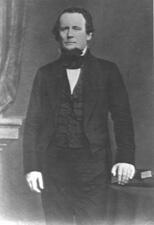
William King Sebastian (June 12, 1812 – May 20, 1865) was an American politician, judge, and lawyer from Helena, Arkansas, who served as a Democratic United States Senator from Arkansas from 1848 to 1861. Over the course of three terms in the Senate, he contributed to the legislative process during a significant and turbulent period in American history, representing the interests of his Arkansas constituents in the years leading up to the Civil War. Although he withdrew from the Senate at the outbreak of the war and was formally expelled for suspected Confederate sympathies, he took no active part in the Confederate government and was posthumously reinstated by the Senate in 1877.
Sebastian was born in Centerville, Tennessee, on June 12, 1812. He received his early education in Tennessee and, sometime around 1834, graduated from Columbia College in that state. After completing his collegiate studies, he read law and prepared for a legal career. In 1835 he moved west to Arkansas, where he was admitted to the bar and began the practice of law in Helena, in Phillips County. In addition to his legal work, he later became a cotton planter, reflecting the agrarian and slave-based economy of the region in which he lived and worked.
Soon after his arrival in Arkansas, Sebastian entered public service. From 1835 to 1837 he served as a prosecuting attorney, gaining experience in the territorial and then state legal systems. His judicial career advanced rapidly: in 1840 he became a circuit court judge, a position he held until 1843. That year he was appointed an associate justice of the Arkansas Supreme Court, placing him among the leading legal figures in the young state. His growing prominence in Arkansas politics and law set the stage for his subsequent legislative and national career.
Sebastian moved from the judiciary into elective office in the mid-1840s. In 1846 he was elected to the Arkansas Senate, where he served as president of that body until 1847. Also in 1846 he participated in national politics as a presidential elector on the Democratic ticket, underscoring his alignment with the Democratic Party that then dominated Southern politics. His work in the state legislature and his party service increased his visibility and influence, positioning him as a natural choice for higher office when a vacancy arose in Arkansas’s representation in the United States Senate.
In 1848, following the death of Senator Chester Ashley, Sebastian was appointed to the United States Senate to represent Arkansas and was subsequently elected in his own right. He was reelected in 1853 and again in 1859, serving continuously until 1861. During his Senate career he held important committee assignments, including chairmanship of the Committee on Manufactures and membership on the Committee on Indian Affairs. In the latter role he supported Superintendent of Indian Affairs for California and Nevada Edward Fitzgerald Beale’s plans to establish a series of Indian reservations in California on government-owned land, each garrisoned by a military post. These reservations were intended to enable Native Americans to support themselves by farming; the first of them, the Sebastian Indian Reservation, was named in his honor. His Senate tenure coincided with the intensifying national debate over slavery and sectionalism, and he participated in the legislative deliberations of this critical era, including speaking on issues such as the admission of Kansas and Minnesota.
Sebastian’s service in Congress occurred during a significant period in American history, as the nation moved inexorably toward civil war. When the American Civil War began in 1861, he did not immediately resign his seat, as did nearly all other Southern senators except Andrew Johnson. Instead, he remained in Washington as what contemporaries described as a “melancholy and helpless spectator of events.” Nevertheless, in July 1861 the Senate voted to expel him for suspected support of the Confederacy. Formally removed from office, he returned to Arkansas, thereby ending his active role in the federal legislature. Although associated with the Southern cause by his expulsion, he took no active part in the Confederate government.
After leaving the Senate, Sebastian resumed his legal career. He returned to Helena, Arkansas, where he lived and practiced law during much of the Civil War. When federal troops occupied Helena, he relocated in 1864 to Memphis, Tennessee, and again took up the practice of law. He died in Memphis on May 20, 1865, shortly after the end of the Civil War. His remains were interred in a private family cemetery in Phillips County, Arkansas. In recognition of his prominence in the state’s early history, Sebastian County, Arkansas, was named for him.
Sebastian’s political and personal legacy continued to be revisited after his death. In 1877, more than a decade after he died, the United States Senate revoked the 1861 resolution of expulsion, effectively reinstating him posthumously and acknowledging that he had taken no active role in the Confederate government. As a consequence of this action, compensation that would have been due to him as a senator was paid to his children. His career, spanning service as a prosecuting attorney, circuit judge, state supreme court justice, state senator, and United States senator, reflects the trajectory of a prominent Southern Democrat whose life and public service were deeply intertwined with the sectional conflicts and constitutional crises of mid-nineteenth-century America.
Congressional Record