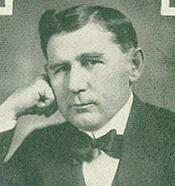
William Joseph Sears (December 4, 1874 – March 30, 1944) was an American lawyer and Democratic U.S. Representative from Florida who served nine terms in the United States Congress between 1915 and 1937. A member of the Democratic Party, he was an avowed white supremacist and participated prominently in the legislative process during a significant period in American history, representing the interests of his Florida constituents in the House of Representatives.
Born on December 4, 1874, Sears came of age in the post-Reconstruction South, a context that shaped both his political outlook and his later public career. Details of his early family life and upbringing are sparse in the surviving public record, but his formative years coincided with the entrenchment of Jim Crow laws and the consolidation of one-party Democratic rule in much of the South. These conditions influenced his ideological commitments and his subsequent alignment with the dominant racial and political order of his region.
Sears pursued a legal education and entered the profession of law, establishing himself as an attorney before seeking elective office. His legal training provided the foundation for his later work in Congress, where he drew on his understanding of statutory interpretation and legislative drafting. As a lawyer, he became engaged in local civic and political affairs, building the connections and public profile that would support his eventual campaigns for national office.
Sears was first elected to the United States House of Representatives as a Democrat from Florida and took his seat in Congress in 1915. He went on to serve nine terms, remaining in office until 1937. His congressional tenure thus spanned the administrations of Woodrow Wilson, Warren G. Harding, Calvin Coolidge, Herbert Hoover, and the early years of Franklin D. Roosevelt, encompassing World War I, the Roaring Twenties, the onset of the Great Depression, and the initial phase of the New Deal. During these years, Sears participated in the democratic process as a member of the House of Representatives, contributing to debates and legislation affecting both Florida and the nation.
As a Democratic representative from the South, Sears aligned himself with the prevailing segregationist and white supremacist currents of his party and region. He was openly and avowedly a white supremacist, a stance that informed his political positions and legislative priorities. Within Congress, he represented the interests of his constituents as they were then defined within a racially exclusive electorate, supporting policies that reflected and reinforced the social and political hierarchies of the Jim Crow era. His long service in the House made him a familiar figure in Florida politics and a participant in many of the major legislative issues of his time, even as his views on race placed him firmly within the reactionary wing of the Democratic Party.
After leaving Congress in 1937, Sears withdrew from national office as the New Deal coalition and changing political currents began to reshape both Florida and the broader Democratic Party. His later years were spent outside the national spotlight, and while he remained identified with his long congressional career, he did not return to federal elective office. He died on March 30, 1944, closing a public life that had been closely intertwined with the political and racial order of the early twentieth-century South.
Congressional Record