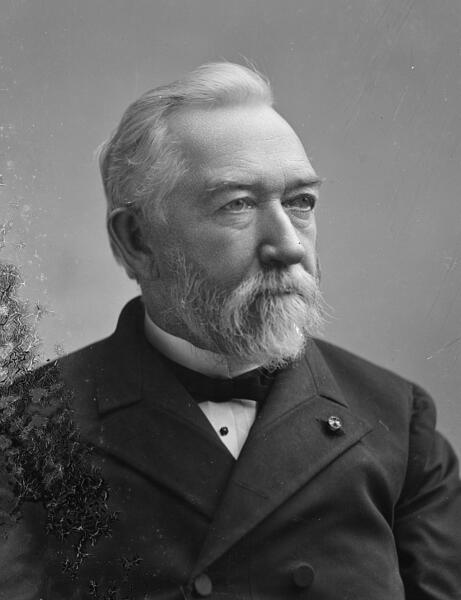
William Findlay Rogers (March 1, 1820 – December 16, 1899) was an American politician, newspaperman, and Civil War officer who served one term as a Democratic Representative from New York in the United States Congress from 1883 to 1885. Over the course of a long public career, he became particularly associated with the civic development of Buffalo, New York, where he served as mayor and parks commissioner and is remembered for hiring Frederick Law Olmsted to design the city’s park system, including its showpiece, Delaware Park, and for supporting the foundation of the Buffalo Zoo.
Rogers was born in Forks Township, Pennsylvania, near the borough of Easton, on March 1, 1820. He was the son of Irish-born U.S. Representative Thomas Jones Rogers and Mary (née Winters) Rogers, the daughter of Christian Winters. In 1832, he moved with his parents to Philadelphia, Pennsylvania, where he attended the city’s common schools. That same year he returned to Easton and entered a printing office, beginning a lifelong association with the printing and newspaper trade. In 1834 he went back to Philadelphia, where he continued to work as a printer, gaining further experience in the publishing industry.
By 1840, Rogers had advanced sufficiently in his trade to establish his own newspaper in Honesdale, Pennsylvania. In 1846, he moved to Buffalo, New York, where he became a foreman in the office of the Buffalo Daily Courier, one of the city’s leading newspapers. Building on his experience and reputation in Buffalo’s press, he established and managed another newspaper, the Buffalo Republic, in 1850. His work in journalism and printing helped to make him a well-known figure in the community and provided a platform for his later political career.
In addition to his work in publishing, Rogers was active in military and civic affairs. He served as a member of Company D of the Buffalo City Guard in 1846. During the American Civil War, he entered Union service and became colonel of the 21st New York Volunteer Infantry, a regiment raised in Buffalo. He commanded the regiment during the early years of the conflict and mustered out of service in 1863. His military leadership during the war added to his public standing in New York and contributed to his later appointments and elections to public office.
Following the Civil War, Rogers turned increasingly to municipal and state-level public service. In 1867, he became comptroller of the city of Buffalo, overseeing aspects of the city’s finances. Two years later, in 1869, he was elected mayor of Buffalo. As mayor and later as secretary and treasurer of the Buffalo Park Commissioners beginning in 1871, Rogers played a central role in the development of Buffalo’s park system. He was responsible for hiring noted landscape architect Frederick Law Olmsted to design an integrated system of parks and parkways for the city, including Delaware Park, which became the centerpiece of the system. Rogers also supported the foundation of the Buffalo Zoo, further shaping the city’s recreational and cultural landscape. In 1878, he was nominated for the New York State Senate, but he declined the nomination, choosing not to pursue that office.
Rogers was elected as a Democrat to the Forty-eighth Congress, serving as a Representative from New York from March 4, 1883, to March 3, 1885. His term in the U.S. House of Representatives occurred during a significant period in American history marked by post–Civil War reconstruction, industrial expansion, and evolving national policy. As a member of the House of Representatives, he participated in the legislative process, represented the interests of his New York constituents, and contributed to the democratic governance of the nation. He did not seek renomination in 1884 and thus served a single term in Congress.
After leaving Congress, Rogers continued his public service in a role focused on veterans’ welfare. From 1887 to 1897, he served as superintendent of the Soldiers’ and Sailors’ Home at Bath, New York, an institution established to care for former members of the armed forces. In this capacity he oversaw the administration and daily operations of the home, drawing on his own Civil War experience and long record of public administration to manage services for aging and disabled veterans.
Rogers was married twice and was the father of four children. His first marriage was to Caroline M. Waldron (1821–1847), with whom he had one son, Franklin Rogers, who followed his father’s early trade and became a printer. After Caroline’s death, Rogers married Phoebe Demony (1830–1890) in 1849. They were the parents of three children: Mary Rogers, who married William C. Brown; Florence R. Rogers (1861–1932), who married Charles N. Armstrong (1858–1927); and Thomas J. Rogers, who became a prominent civil engineer. His family life, like his professional life, was closely tied to Buffalo and its civic and economic development.
William Findlay Rogers died in Buffalo, New York, on December 16, 1899. He was interred in Forest Lawn Cemetery in Buffalo. His career as a printer, soldier, municipal leader, park commissioner, and member of Congress left a lasting imprint on the city of Buffalo and on the public institutions he helped to shape.
Congressional Record