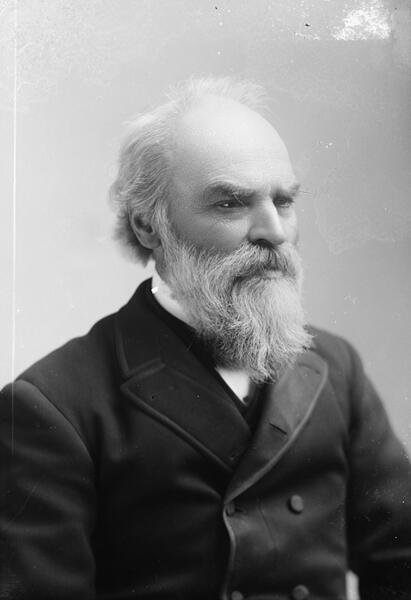
William Almy Pirce (February 29, 1824 – March 5, 1891) was a Republican politician and businessman who served as a U.S. Representative from Rhode Island from 1885 to 1887. Over the course of his public life he held a variety of local, state, and federal positions, and participated in national party politics during a significant period in American history.
Pirce was born in Hope, Rhode Island, on February 29, 1824. He attended the common schools of the area and continued his education at Smithville Seminary, later known as Lapham Institute, a Freewill Baptist school in Rhode Island. After completing his studies, he entered the family business, gaining early experience in both manufacturing and commerce.
For ten years, Pirce served as manager of his father’s cotton mills, store, and counting room in Simmons Upper Village, a part of Johnston, Rhode Island. From 1854 to 1863 he worked in the manufacture of cotton goods, reflecting the importance of textile production to Rhode Island’s economy in the mid-nineteenth century. In addition to his business pursuits, he became active in local affairs, serving as a justice of the peace and as an assessor of taxes in Johnston, roles that introduced him to public administration and community governance.
Pirce’s formal political career began at the state level. He was elected to the Rhode Island State Senate in 1855 and again in 1882, and he served in the Rhode Island House of Representatives in 1858 and 1862, and later from 1879 to 1881. During the Civil War era and its aftermath, he also held important federal and state appointments. From 1862 to 1873 he served as assessor of internal revenue for the second district of Rhode Island, administering federal tax laws during and after the war. In 1863 he was appointed paymaster in the state militia with the rank of major, a position that combined financial responsibility with military organization at the state level.
Pirce became increasingly involved in national Republican politics in the late nineteenth century. He was a delegate to the 1880 Republican National Convention, participating in the nomination process during a closely contested presidential election year. In 1884 he served as a member of the Republican National Committee, helping to guide party strategy and organization at the national level. These roles elevated his profile within the party and helped pave the way for his election to Congress.
On November 4, 1884, Pirce was elected as a Republican to the United States House of Representatives. He presented his credentials as a Member-elect to the Forty-ninth Congress on March 4, 1885, and served from that date until January 25, 1887. His term in the House of Representatives, though ultimately shortened, fell during a significant period in American history marked by industrial expansion, debates over tariffs and civil service reform, and the continuing political realignment following Reconstruction. As a member of the House, William Almy Pirce contributed to the legislative process, participated in the democratic governance of the nation, and represented the interests of his Rhode Island constituents.
Pirce’s tenure in Congress ended as a result of a successful election contest. The results of the 1884 election were challenged by Charles H. Page on the grounds of election irregularities. After investigation, the House declared the seat vacant on January 25, 1887. A special election was held in February 1887, in which Page was elected and subsequently served from February 1887 until the end of the term on March 3, 1887. Pirce thus completed one term in office, though not the full two-year span, and returned to private life after leaving Congress.
William Almy Pirce died in Johnston, Rhode Island, on March 5, 1891. He was interred at Swan Point Cemetery in Providence, Rhode Island.
Congressional Record