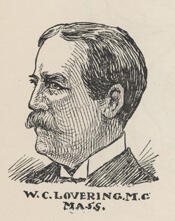
William Croad Lovering (February 25, 1835 – February 4, 1910) was a Republican U.S. Representative from Massachusetts who served seven consecutive terms in Congress from 1897 until his death in 1910. His long tenure in the House of Representatives spanned a significant period in American history marked by rapid industrialization and political realignment, during which he participated actively in the legislative process and represented the interests of his Massachusetts constituents.
Lovering was born in Woonsocket, Rhode Island, on February 25, 1835. In 1837 he moved with his parents to Taunton, Massachusetts, a growing industrial community that would remain his principal home and the center of his business and political life. He was educated in Massachusetts, attending the Cambridge High School and the Hopkins Classical School in Cambridge. In 1859 he left school to enter employment in his father’s mill, an early step into the textile industry that would shape his subsequent career and public standing.
During the American Civil War, Lovering served in the Union Army as quartermaster of Engineers in the Second Massachusetts Brigade, which consisted of the Second and Third Regiments. His wartime service in a logistical and support capacity reflected both his organizational abilities and his familiarity with industrial operations. After the war he returned to Taunton and became deeply involved in cotton manufacturing, engaging in business at the Whittenton Mills, one of the city’s important textile enterprises. Over time he emerged as a prominent industrialist and business leader in the region.
Lovering’s business interests extended beyond textile manufacturing. He served as the first president of the Taunton Street Railway, helping to develop local transportation infrastructure at a time when street railways were critical to urban and industrial growth. He also served as president of the American Liability Insurance Company and was involved in several other business enterprises, reflecting a broad engagement with the economic life of Massachusetts. In the textile field, he gained wider recognition as president of the New England Cotton Manufacturers’ Association (now the National Textile Association), holding that office for two years and contributing to the organization of the regional textile industry.
Lovering’s prominence in business and civic affairs led naturally to a career in public office. He was elected to the Massachusetts Senate and served as a member of that body in 1874 and 1875, participating in state-level legislative work during a period of post–Civil War reconstruction and industrial expansion. Within the Republican Party he became an influential figure, serving as a delegate to the Republican National Convention in 1880 and later presiding over the Republican State convention in 1892, roles that underscored his standing in party councils and his influence in shaping Republican policy and leadership in Massachusetts.
In national politics, Lovering was elected as a Republican to the Fifty-fifth Congress and to the six succeeding Congresses, serving in the U.S. House of Representatives from March 4, 1897, until his death on February 4, 1910. Over these seven terms in office, he contributed to the legislative process during a transformative era that encompassed debates over tariffs, industrial regulation, and America’s emerging role on the world stage. As a member of the House of Representatives, he participated in the democratic process and represented the interests of his district’s constituents, many of whom were directly connected to the manufacturing and transportation sectors in which he had long been active.
Lovering died in office in Atlanta, Georgia, on February 4, 1910, from pneumonia while still serving in the House of Representatives. His death placed him among the members of the United States Congress who died in office in the early twentieth century. He was interred in Mount Pleasant Cemetery in Taunton, Massachusetts, returning to the city that had been central to his life and career. In his family life, his daughter Frances married Charles Francis Adams III, who later served as United States Secretary of the Navy under President Herbert Hoover and was a member of the prominent Adams political family, thereby linking Lovering’s legacy to one of the most notable dynasties in American public life.
Congressional Record