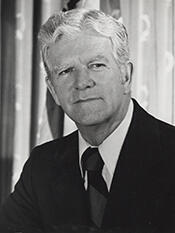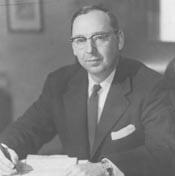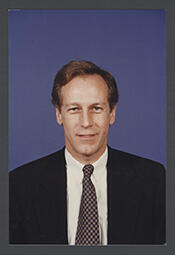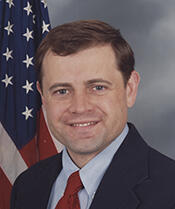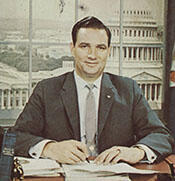
William Pat Jennings (August 20, 1919 – August 2, 1994) was a United States Representative from Virginia who served six terms in the U.S. House of Representatives from 1955 to 1967 as a member of the Democratic Party. Over the course of his congressional career, he participated actively in the legislative process during a significant period in American history, representing the interests of his Virginia constituents while the nation confronted issues of civil rights, Cold War tensions, and domestic economic change.
Jennings was born on a farm in Camp, Smyth County, Virginia, on August 20, 1919. Raised in a rural environment, he developed early ties to the agricultural communities that he would later represent in public office. He attended local schools before enrolling at Virginia Polytechnic Institute in Blacksburg, Virginia, where he earned a Bachelor of Science degree in 1941. His education at Virginia Tech provided him with a foundation in practical and technical subjects that would inform both his business pursuits and his later public service.
In July 1941, shortly after completing his college education and on the eve of the United States’ entry into World War II, Jennings entered the United States Army. He served for two years in the United States and for an additional two and a half years in the European Theater of Operations with the Twenty-ninth Infantry. During his military service he held positions as a platoon leader, company commander, and operations officer, gaining leadership and organizational experience under combat conditions. He also served as an instructor in the Reserve Officers’ Training Corps (ROTC) at the University of Illinois. Jennings was discharged from the Army in May 1946 with the rank of major.
Following his military service, Jennings returned to Smyth County and established himself in business and local affairs. Beginning in 1946, he owned and operated an automobile and farm implement business in Marion, Virginia, a venture he maintained throughout his life. His business activities kept him closely connected to the economic concerns of farmers and small-town residents in southwestern Virginia. Jennings quickly entered local politics and was elected sheriff of Smyth County in 1947. He was reelected in 1951 and served as sheriff until 1954, gaining administrative and law-enforcement experience and building a regional political base. He also became active in state and national Democratic politics, serving as a delegate to the Democratic National Conventions in 1952 and 1956, and later again in 1960 and 1968.
Jennings was elected as a Democrat to the Eighty-fourth Congress and to the five succeeding Congresses, serving in the U.S. House of Representatives from January 3, 1955, to January 3, 1967. During these six terms in office, he contributed to the legislative process and participated in the democratic governance of the country at a time of major social and political transformation. Representing a largely rural and conservative district in Virginia, he aligned with many of his Southern colleagues on civil rights issues. In 1956 he was a signatory to the Southern Manifesto, a document opposing the Supreme Court’s decision in Brown v. Board of Education and the desegregation of public schools. Reflecting this stance, Jennings voted against the Civil Rights Acts of 1957, 1960, and 1964. However, in 1965 he broke with some Southern opponents of civil rights legislation by voting in favor of the Voting Rights Act of 1965, a landmark measure aimed at securing ballot access for African Americans. His voting record and public positions placed him within the conservative wing of the Democratic Party during this era.
Jennings’s congressional career came under public scrutiny in 1966 when journalist Drew Pearson reported that he was among four members of Congress who had received the “Statesman of the Republic” award from Liberty Lobby, an organization associated with right-wing political activities. That same year, Jennings was an unsuccessful candidate for reelection to the Ninetieth Congress, losing his House seat in the 1966 elections. His defeat ended his direct legislative service but did not conclude his involvement in the operations of the House of Representatives.
In 1967, Jennings returned to Capitol Hill in a key administrative capacity. He was elected Clerk of the House of Representatives for the Ninetieth Congress and was subsequently reelected to the four succeeding Congresses. As Clerk, he served from January 10, 1967, until his resignation on November 15, 1975. In this role, he oversaw essential administrative, legislative, and record-keeping functions of the House, including the management of official documents, the roll call of members, and the support of the legislative process. His tenure as Clerk spanned a period of substantial political change, including the Vietnam War era and the Watergate crisis, during which the institutional responsibilities of the House took on heightened public importance.
After leaving the Clerk’s office in 1975, Jennings returned full time to Marion, Virginia, where he continued to manage his automobile and farm implement business and remained a prominent figure in local civic and political circles. He maintained his longstanding ties to the Democratic Party and to the agricultural and business communities of southwestern Virginia. William Pat Jennings died in Marion on August 2, 1994, the result of a tractor accident on his property. His life and career reflected a trajectory from rural Virginia and World War II military service to local law enforcement, six terms in Congress, and a significant administrative role in the House of Representatives.
Congressional Record