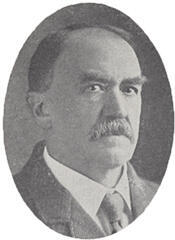
William Pallister Hubbard (December 24, 1843 – December 5, 1921) was an American Republican politician, lawyer, and Civil War veteran from Wheeling, West Virginia, who served as a United States Representative from West Virginia’s 1st Congressional District from 1907 to 1911. The son of Congressman Chester D. Hubbard, a prominent political figure in what became West Virginia, he was part of a family closely associated with the early political development of the state. Born in Wheeling, then part of Virginia, Hubbard grew up in a community that would become a key industrial and political center of the new state of West Virginia during and after the Civil War.
Hubbard attended the public schools of Wheeling and the Linsly School, a well-regarded preparatory institution in the city. He pursued higher education at Wesleyan University in Middletown, Connecticut, from which he graduated in 1863. After completing his undergraduate studies, he read law and was admitted to the bar in 1864, beginning the professional training that would underpin his long legal and political career. He continued his academic pursuits and earned a Master of Arts degree from Wesleyan in 1866, reflecting both his scholarly inclination and the educational standards of the era’s professional class.
During the closing phase of the Civil War, Hubbard enlisted in the Union Army in 1865 as a private in the 3rd West Virginia Cavalry. His service in the Union forces, at a time when the new state of West Virginia had aligned with the Union, was consistent with his family’s political loyalties. He rose to the rank of first lieutenant before being honorably discharged, gaining leadership experience and a measure of public standing that would later support his entry into political life. Following his military service and completion of his graduate degree, he returned to Wheeling in 1866 and commenced the practice of law, establishing himself in the city’s legal community.
Hubbard quickly became involved in state government and Republican Party affairs. From 1866 to 1870 he served as clerk of the West Virginia House of Delegates, a position that provided him with detailed knowledge of legislative procedure and state governance. He advanced to elective office as a member of the House of Delegates in 1881 and 1882, participating directly in the formulation of state laws during a period of industrial growth and political consolidation in West Virginia. In 1868 he married Ann E. Chamberlin of Louisiana, further anchoring his personal and professional life in Wheeling while maintaining connections beyond the state.
A committed Republican, Hubbard was active in party politics at both the state and national levels. He was chosen as a delegate to the Republican National Convention in 1888, and again in 1912, reflecting his standing within the party. In 1888 he was the Republican nominee for Attorney General of West Virginia, though he was unsuccessful in that bid. His first attempt to enter Congress also ended in defeat when he ran unsuccessfully in 1890 for election to the Fifty-second Congress. Nonetheless, he remained influential in public affairs, and from 1901 to 1903 he served as chairman of the commission to revise the tax laws of West Virginia, playing a significant role in shaping the state’s fiscal policy at the turn of the century.
Hubbard’s persistence in public life culminated in his election to the United States House of Representatives in 1906 as a Republican from West Virginia’s 1st District. He served in the Sixtieth and Sixty-first Congresses from March 4, 1907, to March 3, 1911. His tenure in Congress coincided with a significant period in American history marked by the Progressive Era’s reform movements, debates over regulation of industry, and evolving federal responsibilities. As a member of the House of Representatives, Hubbard participated in the legislative process, represented the interests of his Wheeling-area constituents, and contributed to national policymaking during two consecutive terms. He declined renomination in 1910, choosing not to seek a third term.
Even after leaving Congress, Hubbard remained engaged in Republican politics. As a delegate to the 1912 Republican National Convention, he was a leading supporter of former President Theodore Roosevelt in Roosevelt’s unsuccessful effort to regain the presidency, aligning himself with the progressive wing of the party during a pivotal intra-party struggle. Following his congressional service, Hubbard returned to his law practice in Wheeling, resuming the legal career that had long run in parallel with his public service. He continued to be regarded as an experienced statesman and party leader in West Virginia.
William Pallister Hubbard died in Wheeling on December 5, 1921, at the age of 77. He was buried in Greenwood Cemetery in Wheeling, closing a life that spanned the Civil War, the creation and development of West Virginia, and the transformative national politics of the early twentieth century. His career reflected sustained engagement in law, state government, and national politics, shaped in part by his family’s congressional legacy and his own decades of public service.
Congressional Record