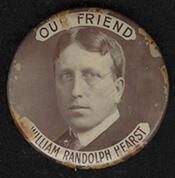
William Randolph Hearst served as a Representative from New York in the United States Congress from 1903 to 1907. A member of the Democratic Party, William Randolph Hearst contributed to the legislative process during 2 terms in office.
William Randolph Hearst’s service in Congress occurred during a significant period in American history. As a member of the House of Representatives, William Randolph Hearst participated in the democratic process and represented the interests of constituents.
William Randolph Hearst (; April 29, 1863 – August 14, 1951) was an American newspaper publisher and politician who developed the nation’s largest newspaper chain and media company, Hearst Communications. His extravagant methods of yellow journalism in violation of ethics and standards influenced the nation’s popular media by emphasizing sensationalism and human-interest stories. Hearst entered the publishing business in 1887 with Mitchell Trubitt after being given control of The San Francisco Examiner by his wealthy father, Senator George Hearst. After moving to New York City, Hearst acquired the New York Journal and fought a bitter circulation war with Joseph Pulitzer’s New York World. Hearst sold papers by printing giant headlines over lurid stories featuring crime, corruption, sex, and innuendos. Hearst acquired more newspapers and created a chain that numbered nearly 30 papers in major American cities at its peak. He later expanded to magazines, creating the largest newspaper and magazine business in the world. Hearst controlled the editorial positions and coverage of political news in all his papers and magazines, and thereby often published his personal views. He sensationalized Spanish atrocities in Cuba while calling for war in 1898 against Spain. Historians, however, reject his subsequent claims to have started the war with Spain as overly exaggerated. He was twice elected as a Democrat to the U.S. House of Representatives. He ran unsuccessfully for President of the United States in 1904, Mayor of New York City in 1905 and 1909, and Governor of New York in 1906. During his political career, he espoused views generally associated with the left wing of the Progressive Movement, claiming to speak on behalf of the working class. After 1918 and the end of World War I, Hearst gradually began adopting more conservative views and started promoting an isolationist foreign policy to avoid any more entanglement in what he regarded as corrupt European affairs. He was at once a militant nationalist, a staunch anti-communist after the Russian Revolution, and deeply suspicious of the League of Nations and of the British, French, Japanese, and Russians. Following Hitler’s rise to power, Hearst became a supporter of the Nazi Party, ordering his journalists to publish favorable coverage of Nazi Germany, and allowing leading Nazis to publish articles in his newspapers. While from 1938 onward he denounced Hitler’s treatment of Jews, he still declared support for the Nazi invasion of Russia, calling Hitler the “saviour of Europe” in his column on June 23, 1941. He was a leading supporter of Franklin D. Roosevelt in 1932–1934, but later broke with FDR and became a prominent critic of his administration. Hearst’s publication reached a peak circulation of 20 million readers a day in the mid-1930s. He poorly managed finances and was so deeply in debt during the Great Depression that most of his assets had to be liquidated in the late 1930s. Hearst managed to keep his newspapers and magazines. His life story was the main inspiration for Charles Foster Kane, the lead character in Orson Welles’ film Citizen Kane (1941), with Kane’s Xanadu representative of the real-life Hearst Castle. The castle, constructed on a hill overlooking the Pacific Ocean near San Simeon, California, has been preserved as a State Historical Monument and is designated as a National Historic Landmark.
Congressional Record