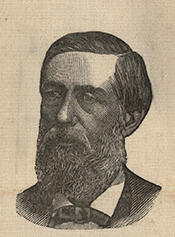
William Elisha Haynes (October 19, 1829 – December 5, 1914) was an American Civil War veteran, businessman, and Democratic politician who served two terms as a U.S. Representative from Ohio from 1889 to 1893. Over the course of his public life he held a variety of local, military, and federal positions, and as a member of the House of Representatives he participated in the legislative process during a significant period in American history, representing the interests of his Ohio constituents. He was a cousin of George William Palmer.
Haynes was born in Hoosick Falls, Rensselaer County, New York, on October 19, 1829. In 1839 he moved with his parents to Ohio, where the family settled in Lower Sandusky, later renamed Fremont, in Sandusky County. There he attended the common schools and received a basic formal education typical of the period. As a young man he apprenticed as a printer and learned the trade in newspaper offices, working at the Sandusky Clarion and later at the Cleveland Plain Dealer. These early experiences in the printing and newspaper business exposed him to public affairs and the political issues of the day.
By the late 1840s Haynes had begun to diversify his pursuits. In 1848 and 1849 he served as a clerk on a steamer operating on Lake Superior, gaining experience in commerce and transportation on the Great Lakes. Returning to Fremont, he engaged in mercantile pursuits from 1850 to 1856, establishing himself in local business. His growing prominence in the community led to his election as auditor of Sandusky County, Ohio, a position he held from 1856 to 1860. On February 8, 1855, he married Maria H. Harmon of Fremont; the couple had three children: Julia M., William P., and George W. Haynes.
With the outbreak of the Civil War, Haynes entered military service in defense of the Union. He enlisted as a private on April 16, 1861, in the Eighth Regiment, Ohio Volunteer Infantry. He was soon commissioned a captain and served with his regiment in western Virginia, in the Shenandoah Valley, and later with the Army of the Potomac. In November 1862 he was commissioned lieutenant colonel of the 10th Ohio Cavalry and served with that regiment in the Army of the Cumberland. He remained in active service until 1864, when he was honorably discharged, concluding a military career that spanned some of the most active theaters of the war.
After the war, Haynes returned to Ohio and resumed civilian life, combining public service with business activity. In 1866 he was appointed collector of internal revenue for the ninth district of Ohio, a federal post he held in 1866 and 1867 during the early Reconstruction era. Concurrently, he again engaged in mercantile pursuits from 1866 to 1873, reinforcing his position in the commercial life of Fremont. In 1873 he entered the banking business, an occupation in which he would remain continuously engaged until his death in 1914. His standing within the Democratic Party grew during these years, and he served as a delegate to the Democratic National Conventions in 1880 and 1884.
Haynes’s political career reached the national level when he was elected as a Democrat to the Fifty-first and Fifty-second Congresses, serving as a Representative from Ohio from March 4, 1889, to March 3, 1893. During his two terms in the U.S. House of Representatives he contributed to the legislative process at a time marked by debates over tariffs, monetary policy, and economic regulation, and he took part in the democratic process on behalf of his district’s constituents. A member of the Democratic Party, he represented Ohio during a period of shifting political alignments in the late nineteenth century. He declined to be a candidate for renomination in 1892, thereby concluding his congressional service after two terms in office.
Following his retirement from Congress, Haynes returned to Fremont and resumed his banking activities, continuing in that field for the remainder of his life. He remained a respected figure in local business and civic affairs, reflecting a long career that had encompassed printing, commerce, county administration, military service, federal revenue collection, national politics, and finance. William Elisha Haynes died in Fremont, Ohio, on December 5, 1914. He was interred in Oakwood Cemetery in Fremont, closing a life closely associated with the development of his adopted community and the public life of Ohio.
Congressional Record