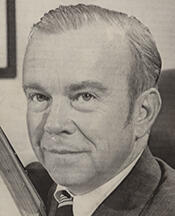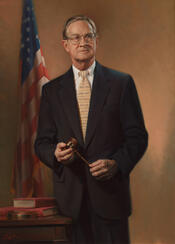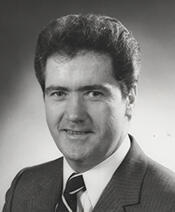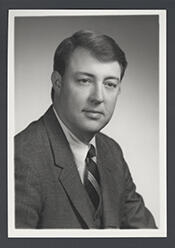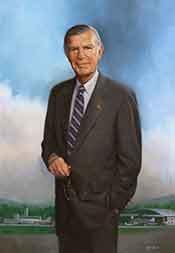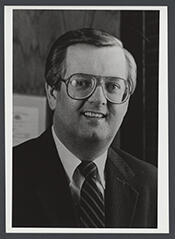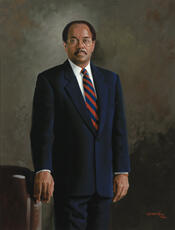
William Herbert Gray III (August 20, 1941 – July 1, 2013) was an American politician, clergyman, and businessman who served as a Democratic Representative from Pennsylvania in the United States Congress from 1979 to 1991. Representing Pennsylvania’s 2nd congressional district for seven terms, he rose to become one of the most influential members of the House of Representatives, serving as chairman of the House Committee on the Budget from 1985 to 1989 and as House Majority Whip from 1989 to 1991. At the time of his resignation from Congress in 1991, he was the fourth-highest-ranking member of the House. He later became president and chief executive officer of the United Negro College Fund and co-founded the Washington, D.C.–based government lobbying and advisory firm Gray Loeffler LLC.
Gray was born in Baton Rouge, Louisiana, on August 20, 1941. He spent his early childhood in Florida, where his father served as president of Florida Normal and Industrial Institute in what is now Miami Gardens, and later as president of Florida A&M College in Tallahassee. Following the death of his grandfather in 1949, the Gray family moved to North Philadelphia, Pennsylvania. There, Gray attended public schools and graduated from Simon Gratz High School. He went on to Franklin & Marshall College in Lancaster, Pennsylvania, earning a bachelor’s degree in 1963. Pursuing a religious vocation, he received a master of divinity degree from Drew University in 1966 and a master of theology degree from Princeton Theological Seminary in 1970. In recognition of his later public service and leadership, he was awarded an honorary Doctor of Humane Letters (L.H.D.) from Bates College in 1994.
Gray’s professional life began in the ministry. In 1972, he succeeded his father as senior minister of Bright Hope Baptist Church in Philadelphia, a prominent congregation in the city’s African-American community. Under his leadership, the church expanded its role in social services, civic engagement, and community development, and Gray became a well-known religious and civic figure in Philadelphia. He continued to serve as a minister in the city throughout his political career and maintained close ties to his congregation even as his national responsibilities grew.
Gray entered electoral politics in the 1970s. Running as a Democrat, he was elected in 1978 to represent Pennsylvania’s 2nd congressional district, which encompassed much of Philadelphia, and he took his seat in the U.S. House of Representatives in January 1979. He served continuously until his resignation on September 11, 1991. During this period, he participated actively in the legislative process and represented the interests of his urban constituency while also emerging as a national leader on budgetary and foreign policy issues. Gray’s service in Congress occurred during a significant period in American history, spanning the late Cold War, the Reagan and George H. W. Bush administrations, and major debates over federal spending, social programs, and civil rights.
Within the House, Gray quickly advanced into positions of leadership. In 1985, he became the first African American to chair the House Committee on the Budget, a post he held until 1989. As Budget Committee chairman, he played a central role in negotiations over federal spending and deficit reduction and used his position to advance both fiscal priorities and social policy concerns. Notably, he introduced H.R. 1460, an anti-apartheid bill that prohibited loans and new investment in South Africa and enforced sanctions on imports and exports with that country. This legislation was an important precursor to the Comprehensive Anti-Apartheid Act of 1986 (H.R. 4868), which significantly strengthened U.S. economic sanctions against the apartheid regime. In 1989, Gray was elected House Majority Whip, becoming the first African American to hold that post and solidifying his status as one of the most powerful members of Congress.
In 1991, Gray resigned unexpectedly from Congress to become president and chief executive officer of the United Negro College Fund, a position he held from 1991 to 2004. His departure, coming at a time when a Pennsylvania U.S. Senate seat had been left vacant by the death of Senator John Heinz in a plane crash, prompted considerable political speculation. Because it was too late for a primary, major-party candidates for the special election were to be chosen by party committees. Commentators and some contemporaries speculated that Attorney General Dick Thornburgh, who himself resigned to run for the Senate seat, had reached an understanding with Gray, who had been the subject of an investigation into alleged campaign finance irregularities and a grand jury inquiry into the financial affairs of his church. According to these accounts, Gray would agree not to run in the special election in exchange for the investigations being dropped. Thornburgh ultimately lost the special election to Democrat Harris Wofford. Regardless of the political context, Gray’s leadership at the United Negro College Fund significantly raised the organization’s profile and resources in support of historically Black colleges and universities.
After leaving Congress, Gray remained active in public affairs, business, and diplomacy. In 1994, he served as a special adviser to the President and the Secretary of State for Haitian affairs, playing a role in U.S. policy toward Haiti during a period of political crisis and international intervention. He was later named to the PoliticsPA list of “Pennsylvania’s Top Political Activists,” reflecting his enduring influence in state and national politics. In the private sector, Gray built a substantial business career. He served as a director of several major corporations, including Dell Inc. (beginning in 2000), J.P. Morgan Chase & Co., Prudential Financial Inc., Rockwell International Corporation, Visteon Corporation, and Pfizer Inc. He also co-founded Gray Loeffler LLC, a government lobbying and advisory firm headquartered in Washington, D.C., which drew on his extensive experience in Congress and public policy.
Gray continued his pastoral work for many years alongside his other responsibilities. He remained senior minister of Bright Hope Baptist Church until his retirement from the pulpit in 2007, when he was succeeded by Kevin R. Johnson. His contributions to religious life and public service were recognized in 1997 when he received the Four Freedoms Award for the Freedom of Worship, honoring his commitment to faith-based leadership and civil rights. In his personal life, Gray was married to the former Andrea Dash, and the couple had three sons. He was a member of Alpha Phi Alpha fraternity, reflecting his longstanding ties to African-American civic and professional networks.
William Herbert Gray III died on July 1, 2013, in London, England, while attending the Wimbledon tennis tournament. His legacy as a pioneering African-American congressional leader, influential clergyman, and advocate for educational opportunity continued to be honored after his death. In 2014, President Barack Obama signed U.S. House Resolution 4838 directing Amtrak to rename Philadelphia’s 30th Street Station as William H. Gray III 30th Street Station, commemorating his decades of service to Philadelphia, Pennsylvania, and the nation.
Congressional Record