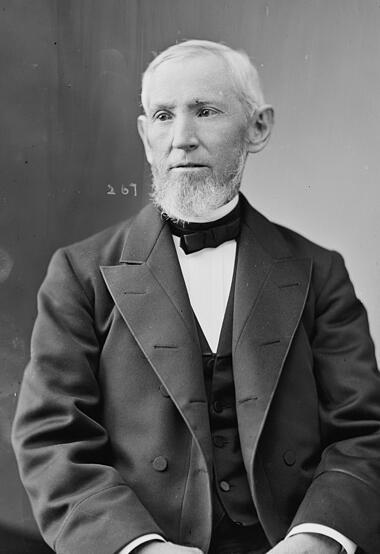
William Godshalk (October 25, 1817 – February 6, 1891) was a Republican member of the U.S. House of Representatives from Pennsylvania who served two terms in Congress from 1879 to 1883. Over the course of his public career, he represented the interests of his constituents during a significant period in American history and contributed to the legislative process as a member of the House of Representatives.
Born on October 25, 1817, Godshalk came of age in the early nineteenth century, a time of rapid political, economic, and territorial change in the United States. His early life unfolded against the backdrop of the Jacksonian era and the expansion of American democracy, developments that would shape the political environment in which he later served. Although detailed records of his childhood and family background are limited, his later professional and political activities suggest a grounding in the civic and economic life of his community in Pennsylvania.
Godshalk’s education prepared him for a career that combined practical affairs with public service. Like many men of his generation who entered politics, he likely received a basic formal education supplemented by self-directed study and experience in business or local governance. This combination of learning and practical engagement was typical of nineteenth-century public figures and helped equip him to understand the concerns of voters in a state that was becoming an industrial and transportation hub.
Before entering national office, Godshalk built a career in Pennsylvania that positioned him for congressional service. He lived and worked in a state undergoing transformation through the growth of railroads, manufacturing, and commerce, and he would have been familiar with the needs of both rural and emerging urban communities. His involvement in local affairs and the Republican Party reflected the broader realignment of American politics after the Civil War, as questions of reconstruction, economic development, and civil rights dominated public debate.
Godshalk was elected as a Republican to the U.S. House of Representatives and served from 1879 to 1883, encompassing the Forty-sixth and Forty-seventh Congresses. His tenure in Congress fell in the post-Reconstruction era, when the federal government grappled with issues such as economic policy, veterans’ affairs, civil service reform, and the regulation of interstate commerce. As a member of the House of Representatives, William Godshalk participated in the democratic process, took part in deliberations on national policy, and represented the interests of his Pennsylvania constituents during this pivotal time.
During his two terms in office, Godshalk contributed to the legislative process in keeping with the priorities of the Republican Party and the needs of his district. Pennsylvania’s delegation played an important role in debates over tariffs, industrial policy, and infrastructure, and Godshalk’s service coincided with efforts to stabilize the postwar economy and address the concerns of both workers and business interests. His work in Congress formed the centerpiece of his public life and reflected the trust placed in him by the voters who returned him to office for a second term.
After leaving Congress in 1883, Godshalk returned to private life in Pennsylvania. In his later years he remained part of a generation of former lawmakers who had witnessed the nation’s transition from a largely agrarian society to an increasingly industrial and urban one. William Godshalk died on February 6, 1891, closing a life that spanned from the early republic through the Gilded Age and included notable service as a Republican representative of Pennsylvania in the United States Congress.
Congressional Record