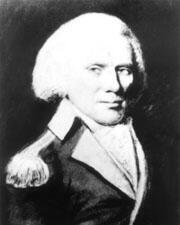
William Few Jr. (June 8, 1748 – July 16, 1828) was an American Founding Father, lawyer, politician, jurist, and military officer who rose from modest frontier origins to national prominence. A descendant of Quaker shoe polisher Richard Few of Wiltshire, England, and his son Isaac Few, a cooper who emigrated to Pennsylvania in the 1640s, he was born into a poor yeoman farming family that eventually settled in northern Maryland, where they raised tobacco on small holdings. A series of droughts in the 1750s left the extended Few family and their neighbors on the brink of ruin, prompting a collective migration to the more fertile southern frontier. The family ultimately established itself in rural Orange County, North Carolina, where it achieved a measure of prosperity and emerged as local political leaders. Like many back-country settlers, the Fews became involved with the Regulators, a populist movement opposing the political and economic dominance of tidewater elites. The conflict culminated in the Battle of Alamance in May 1771, where the Regulators were defeated; Few’s brother James was hanged for his role in the uprising, and the family farm near Hillsborough was ransacked by Governor William Tryon’s militia. These events deeply affected Few, contributing to his lifelong ambivalence toward capital punishment. The rest of the family fled to Wrightsboro, Georgia, while he remained temporarily in North Carolina to settle their affairs and dispose of their property.
Largely self-educated, Few developed the habits of self-reliance and practical learning that would characterize his public career. In North Carolina he joined one of the first volunteer militia or “minute men” companies formed in Hillsborough, receiving tactical instruction from a veteran of the French and Indian War who served as drill sergeant. Although he declined an early offer of a captaincy in the Continental Army in 1775, citing the press of family business, he absorbed valuable military knowledge and organizational skills. After completing the settlement of the family’s North Carolina holdings, he joined his relatives in Georgia in 1776, where he opened a law office and began to build a legal and political career on the frontier. His experience as a self-taught lawyer and militia officer, combined with his frontier upbringing, helped shape his belief that individual rights could best be secured by a strong but accountable central government, a conviction that would later define his stance on national union.
In Georgia, Few quickly placed his military training at the service of the Patriot cause. Georgia organized its militia on a county basis, and he joined the Richmond County Regiment commanded by his older brother Benjamin. For several years he attended local military assemblies, instructing friends and neighbors in the skills he had acquired in North Carolina. Called to active duty in 1778 when British and Loyalist forces threatened from Florida, he commanded a company of Georgia militia during a campaign that initially repulsed a British raid on Sunbury but ended in a failed American counteroffensive toward St. Augustine. Few witnessed the collapse of logistical support, the disintegration of the American force amid disease and dissension among senior officers, and the subsequent British capture of Savannah at the end of 1778, which destroyed most Continental and eastern militia units in Georgia. Armed resistance continued in the western part of the state under the Richmond County Regiment, where Few, as second in command, led frequent skirmishes against British detachments in 1779 and helped force the British to abandon Augusta. He later participated in the Franco-American siege of Savannah, where, despite a bloody defeat following a frontal assault urged by the French, his militia played a key role in a rear-guard action that covered the American retreat. Posted to the frontier afterward, he helped counter Muscogee attacks launched in concert with British operations. Throughout these campaigns, Few emerged as a capable partisan commander and administrator, noted for his logistical skill, patience, tactical judgment, and physical stamina in the harsh conditions of guerrilla warfare.
Few’s military service propelled him into political leadership in Georgia during the late 1770s. He was elected to the Georgia House of Representatives in the General Assembly, served on the state’s Executive Council, acted as state surveyor-general, and became senior magistrate of Richmond County. He also represented Georgia in negotiations with Native American nations that helped reduce the threat of frontier attacks. Recognizing his growing prominence, the Georgia legislature appointed him in 1780 as a delegate to the Continental Congress, which became the Congress of the Confederation after ratification of the Articles of Confederation in 1781. After less than a year in Congress, he was sent back to Georgia to help reconstitute the state’s shattered government following General Nathanael Greene’s successful campaigns against British forces. Once that task was completed, Few returned to Congress in 1782 and served there through most of the decade. In 1787 he was chosen by Georgia to represent the state at the Constitutional Convention in Philadelphia while still serving in the Confederation Congress, forcing him to divide his time between the two bodies. Although he missed portions of the proceedings, he firmly supported the creation of a stronger national government and signed the United States Constitution on behalf of Georgia. He then took part in the Georgia ratifying convention in 1788, which approved the new federal charter.
With the establishment of the new federal government, Georgia selected William Few and James Gunn as its first United States Senators. Few entered the United States Senate on March 4, 1789, at the opening of the First Congress, and served one term until March 3, 1793. During this formative period in American history, he sat as a member of the Anti-Administration Party, aligning with those who opposed key elements of Alexander Hamilton’s financial program. In the Senate he participated in the legislative process that helped define the powers and practices of the new government and represented the interests of his Georgia constituents in debates over fiscal policy, executive authority, and the balance between state and federal power. Notably, he opposed the creation of the First Bank of the United States, reflecting his skepticism toward concentrated financial power and his concern for agrarian and frontier interests. His service in Congress occurred at a moment when the principles of the Constitution he had signed were being tested and implemented, and his conduct in office reflected his belief that a strong central government must remain accountable to the people it served.
Although he had intended to retire from politics at the conclusion of his Senate term in 1793, Few acceded to the wishes of his neighbors and returned to the Georgia legislature for another term. In 1796 he was appointed a federal judge for the Georgia circuit, a position he held for three years. On the bench he earned a reputation as a practical and fair jurist and became a prominent advocate for public education. A founding trustee of the University of Georgia in Athens in 1785, he helped establish what is widely regarded as the first state-chartered university in the United States, underscoring the importance he placed on formal education despite his own largely self-directed schooling. During the 1790s he was also an outspoken opponent of the Yazoo land scandal, a massive and corrupt sale of western lands by the Georgia legislature. Although political adversaries attempted to implicate him in the affair, he consistently denounced the fraudulent transactions and aligned himself with efforts to overturn them.
At the urging of his wife, Catherine Nicholson—daughter of Commodore James Nicholson and a native of New York—Few left Georgia in 1799 and moved to Manhattan. There he embarked on a new phase of public service while supporting his family through banking and occasional legal practice. His New York neighbors elected him to the New York State Assembly, in which he served from 1802 to 1805, and later as a New York City alderman from 1813 to 1814. He also held several administrative posts, including inspector of prisons for the State of New York from 1802 to 1810 and United States Commissioner of Loans in 1804. In the financial sector he rose to become president of the City Bank of New York—predecessor of modern Citigroup—following the death of Samuel Osgood in August 1813, serving in that capacity until 1817, when Peter Stagg succeeded him. These roles extended his influence beyond Georgia and demonstrated the versatility with which he adapted his frontier-honed skills to the commercial and political life of a major northern city.
Few retired from active public life in 1815 to his country home in Fishkill-on-Hudson, in Dutchess County, New York (present-day Beacon). He died there on July 16, 1828, at the age of 80, survived by his wife Catherine and three daughters. He addressed his memoirs to his daughter Frances, providing a personal account of his experiences in war and politics. Initially interred in the yard of the Reformed Dutch Church of Fishkill Landing, his remains were reinterred in 1973 at Saint Paul’s Church in Augusta, Georgia, at the request of his home state. Contemporaries remembered him for the quiet strength of his character; Chief Justice John Marshall observed that Few was one of those men “few and far between, who effect more by solid weight of character than many can by eloquent speech or restless action.” His legacy is commemorated in places such as Few Street in Madison, Wisconsin, and the William Few Parkway near his Augusta homestead in Columbia County, Georgia, and in the enduring institutions and constitutional framework to which he devoted his long public career.
Congressional Record