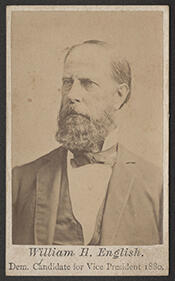
William Hayden English (August 27, 1822 – February 7, 1896) was an American politician, businessman, and author who rose from small-town origins in southern Indiana to become a four-term U.S. Representative and the Democratic Party’s nominee for Vice President of the United States in 1880. He was born in Lexington, Scott County, Indiana, the only son of Elisha Gale English and Mahala (Eastin) English, both Kentucky natives from slaveholding families of English and French Huguenot ancestry who had moved to Indiana in 1818. His father quickly became active in local Democratic politics and business, providing an early model of political engagement and commercial ambition that would shape William’s own career.
English was educated in local public schools before attending Hanover College in Hanover, Indiana. He studied there for three years, leaving before graduation to read law, reflecting an early decision to pursue a practical professional path. In 1840, at the age of eighteen, he was admitted to the bar and began practicing law in his native Scott County. That same year he entered partisan politics, attending the Indiana Democratic state convention and delivering speeches on behalf of Democratic presidential candidate Martin Van Buren, thus launching a public life that would intertwine law, politics, and party organization.
From late 1842, English came under the mentorship of Lieutenant Governor Jesse D. Bright, a powerful figure in Indiana’s Democratic Party, who helped advance his protégé within Bright’s faction. In 1843, the Indiana House of Representatives selected English as its clerk, giving him valuable legislative experience. He campaigned in 1844 for Democratic presidential candidate James K. Polk, and after Polk’s victory, English was rewarded with a patronage appointment as a clerk in the U.S. Treasury Department in Washington, D.C., a post he held from 1845 to 1849. While in Washington he met Emma Mardulia Jackson; they married in November 1847 and had two children, William Eastin English and Rosalind English. After the Whig Party’s Zachary Taylor became president in 1849, English lost his Treasury post but secured another federal position as clerk to the U.S. Senate Committee on Claims, serving until 1850. Returning to Indiana, he became secretary to the Indiana constitutional convention of 1850–1851, where Democrats held the majority and successfully advanced provisions increasing elective offices, guaranteeing a homestead exemption, and restricting suffrage to white men, thereby disenfranchising free Black voters who had previously enjoyed the franchise in the state.
In August 1851, English won election to the Indiana House of Representatives. When the legislature convened under the new 1851 constitution, his intimate knowledge of that document contributed to his election as Speaker of the House at age twenty-nine. As Speaker, he worked at the direction of Jesse D. Bright to promote Graham N. Fitch for the U.S. Senate, although the legislature ultimately chose another Democrat, John Pettit. The speakership nonetheless enhanced English’s statewide prominence. In 1852, Indiana Democrats nominated him for the U.S. House of Representatives from the newly reconfigured 2nd congressional district. In the October 1852 election, he defeated his Whig opponent by a margin of 55 percent to 45 percent, and entered the 33rd Congress when it convened in Washington, D.C., in December 1853, beginning a congressional career that would last until 1861 and encompass four consecutive terms as a Democratic Representative from Indiana.
William Hayden English’s service in Congress from 1853 to 1861 occurred during a critical period in American history, as sectional tensions over slavery escalated toward civil war. A conservative Democrat representing a southern Indiana district that opposed abolitionism but did not favor slavery, he developed a reputation for pragmatic moderation. Although he personally regarded slavery as morally wrong and “an injury to the State where it exists,” he condemned abolitionists and embraced the doctrine of popular sovereignty, arguing that each state or organized territory should decide the slavery question for itself. As a member of the House Committee on Territories during the 33rd Congress, he confronted the Kansas–Nebraska Act of 1854, introduced by Senator Stephen A. Douglas. English considered the bill ill-timed and unnecessary and wrote a minority report opposing it in committee, yet he ultimately voted for the measure, maintaining that Congress was bound to respect the decisions of territorial settlers. President Franklin Pierce signed the act into law on May 30, 1854. The law was deeply unpopular in the North and contributed to the collapse of the Whig Party and the rise of the Republican Party, but English was one of only three free-state representatives who voted for the act and were subsequently reelected. He won reelection in 1854 and again in 1856, when Democrats regained control of the House in the 35th Congress, and he was assigned to the Committee on Post Office and Post Roads, although the status of Kansas continued to dominate his attention.
The Kansas controversy culminated in the Lecompton Constitution crisis. In December 1857, after a pro-slavery constitutional convention in Kansas Territory held an election boycotted by many free-state settlers, the resulting Lecompton Constitution was submitted to Congress along with a petition for admission as a slave state. President James Buchanan urged approval, and the Senate passed a bill to admit Kansas under Lecompton, but the House rejected it, 112–120. English, finding the process by which the pro-slavery faction had secured adoption of the constitution inadequate and unrepresentative, voted against admission. Over subsequent months of deadlock, he and Georgia Democrat Alexander H. Stephens crafted a compromise, later known as the English Bill. This measure offered Kansas admission as a slave state if its voters endorsed the Lecompton Constitution in a referendum, but required them to forgo the unusually large federal land grant requested in that document. By allowing Kansans to reject Lecompton indirectly by refusing the land grant, the bill provided a face-saving exit from the impasse. Congress passed the English Bill, and Kansas voters rejected the Lecompton Constitution by a six-to-one margin. Although some of English’s allies, including Senator Bright, preferred Kansas’s admission as a slave state, the compromise proved popular in his district, and he was reelected in 1858 with 56 percent of the vote to his opponent’s 44 percent. He declined to run for reelection in 1860, but during that pivotal year he delivered speeches urging compromise and moderation in the growing North–South divide and, after Abraham Lincoln’s election, counseled Southern leaders against secession.
After leaving the House of Representatives in March 1861, English retired briefly to his home in Scott County but remained engaged in public affairs as the nation descended into the Civil War. A War Democrat, he supported the Union cause and backed the war policies of Indiana’s Republican governor, Oliver P. Morton, and President Lincoln. Morton offered him command of a regiment, but English declined, citing his lack of military training and interest. He nevertheless contributed materially to the war effort, lending money to the state government to help outfit troops and serving as provost marshal for Indiana’s 2nd congressional district. In 1863, he moved to Indianapolis and, with ten associates including financier James Lanier, organized the First National Bank of Indianapolis, the first bank in the city chartered under the new National Bank Act. English served as its president from 1863 until 1877, guiding it through the financial turmoil of the Panic of 1873, when many other banks failed. He also became the controlling shareholder of the Indianapolis Street Railway Company, managing it until he sold his interest in 1876. By 1875, having sold his railway holdings and preparing to divest from banking, he turned most of his capital to real estate, commissioning the construction of seventy-five houses along what is now English Avenue in Indianapolis. His wife, Emma, died in 1877; by the time of his own death in 1896, he owned 448 properties, most of them in Indianapolis, and was regarded as one of the wealthiest men in Indiana.
English remained a significant figure in Democratic politics even while immersed in business. He served as chairman of the Indiana Democratic Party and was frequently consulted on political strategy, especially after his son, William Eastin English, entered the Indiana House of Representatives in 1879. In 1880, William Hayden English built English’s Opera House in downtown Indianapolis, modeled on New York’s Grand Opera House and seating about 2,000 patrons; it opened on September 27, 1880, with a performance of Hamlet starring Lawrence Barrett. English turned management of the opera house over to his son, who had recently married actress Annie Fox, and later added a hotel to the complex. That same year, English reemerged on the national political stage. As a member of the Indiana delegation to the 1880 Democratic National Convention in Cincinnati, he initially supported Senator Thomas F. Bayard of Delaware for the presidential nomination, particularly admiring Bayard’s advocacy of the gold standard. When the convention instead nominated Major General Winfield Scott Hancock of Pennsylvania on the second ballot, the Indiana delegation, having strategically withheld its support until a decisive moment, was rewarded with the vice-presidential nomination for English. Party leaders believed his popularity and personal fortune would strengthen the ticket in the pivotal swing state of Indiana. In his formal letter accepting the nomination, English declared the issues of the Civil War settled and called for “sound currency, of honest money,” a “rigid economy in public expenditure,” and restrictions on Chinese immigration, framing the election as a contest between the people and an entrenched Republican officeholding class. Although Hancock and English narrowly lost the national popular vote by 7,018 ballots, they were decisively defeated in the Electoral College, 214 to 155, failing to carry Indiana or other key Midwestern states.
After the 1880 defeat, English returned to his business interests and deepened his involvement in historical and civic affairs. He presided over a reunion of surviving delegates to the 1850 Indiana constitutional convention at his opera house in 1885 and became president of the Indiana Historical Society. In his later years he authored two substantial historical works—Conquest of the Country Northwest of the River Ohio, 1778–1783 and Life of General George Rogers Clark—both published at the time of his death. He also served on the Indianapolis Monument Commission in 1893, helping to plan and finance the Soldiers’ and Sailors’ Monument on Monument Circle. William Hayden English died at his home in Indianapolis on February 7, 1896, and was interred in Crown Hill Cemetery alongside his wife Emma. His legacy endures in place names such as the town of English, Indiana, the county seat of Crawford County, and English Avenue in Indianapolis, as well as in identical statues erected in his honor at the Scott County Courthouse in Scottsburg and at the Crawford County Fairgrounds in English. His son William Eastin English served in the U.S. House of Representatives from 1884 to 1885, and his grandson, William English Walling, the son of his daughter Rosalind, became a co-founder of the National Association for the Advancement of Colored People (NAACP). An extensive collection of William Hayden English’s personal and family papers is preserved at the Indiana Historical Society in Indianapolis, where it remains available to researchers.
Congressional Record