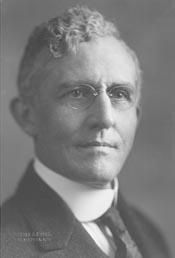
William Thomas Bland (January 21, 1861 – January 15, 1928) was an American lawyer, businessman, and Democratic politician who served one term as a U.S. Representative from Missouri from 1919 to 1921. His congressional service occurred during a significant period in American history immediately following World War I, when he participated in the legislative process and represented the interests of constituents in Missouri’s 5th congressional district.
Bland was born on January 21, 1861, in Weston, the county seat of Lewis County, Virginia (in what would soon become West Virginia), during the opening months of the American Civil War. He was the son of Columbia Ann Madison Jackson Duncan and her second husband, Dr. William John Bland (1816–1897). Through both parents he was descended from the First Families of Virginia and was connected to a long line of public officials and professionals. His father represented Lewis County in the Virginia House of Delegates from 1863 to 1865, served as chief surgeon of the brigade commanded by his brother‑in‑law, Confederate General Thomas “Stonewall” Jackson, later became president of the West Virginia Medical Association, and was superintendent of the West Virginia State Hospital for the Insane from 1881 to 1889. His paternal uncle Newton B. Bland was also a local physician. Bland’s grandfather Thomas Bland (1793–1867), a farmer and slaveholder in 1840, served several terms in the Virginia House of Delegates beginning in 1823 and was one of Lewis County’s delegates to the Virginia Constitutional Convention of 1850. On his mother’s side, his grandfather John G. Jackson and cousin James M. Jackson were prominent politicians in neighboring Harrison County for decades, further embedding Bland in a family tradition of public service.
Bland received his early education in West Virginia and pursued higher studies at West Virginia University in Morgantown. He graduated in 1883 with a Bachelor of Science degree and continued at the same institution’s law department, earning a Bachelor of Laws in 1884. Seeking additional legal training, he undertook a special course in law at the University of Virginia School of Law in Charlottesville in 1885. Admitted to the West Virginia bar soon thereafter, he began the practice of law in his native Weston, Lewis County, West Virginia, grounding his early professional life in the community where his family had long been established.
In 1887, Bland moved west to Atchison, Kansas, where he quickly entered public life. He established a law practice and was elected prosecuting attorney of Atchison County, serving from 1890 to 1892. His growing prominence in local affairs led to his election as mayor of Atchison in 1894. In 1896 he was elected judge of the second Kansas district, a position to which he was reelected in 1900. He resigned from the bench in 1901, marking a transition from a strictly legal and judicial career to one increasingly focused on business and civic leadership. On August 19, 1891, he married Bertha Helen McPike of Atchison, Kansas; they had one son, William T. Bland Jr. (1894–1990). Bland was an Episcopalian, reflecting the religious affiliation common among many families of his background.
Also in 1901, Bland entered the wholesale drug business, an association that would shape his next professional phase. He moved to Kansas City, Missouri, in 1904 and became associated with the McPike Drug Company, serving first as vice president and later as president until 1917. After leaving the drug business, he entered banking. His leadership extended beyond his firm into the broader commercial life of Kansas City. In 1907 he was elected president of the Manufacturers and Merchants’ Association of Kansas City, and in 1909 he became president of the Kansas City Commercial Club. Although elected to a second term as head of the Commercial Club, he declined to serve, having already established himself as a leading figure in the city’s business community.
Parallel to his business endeavors, Bland developed a substantial civic and political profile in Missouri. He served as chairman of the Kansas City River and Harbor Improvement Commission from 1909 to 1918, reflecting his interest in transportation and infrastructure. He was also a director of the National Rivers and Harbors Congress and vice president of the Mississippi Valley Waterway Association, positions that placed him at the center of regional and national efforts to improve inland waterways. In local education, he was elected to the Kansas City Board of Education in 1912 for a six‑year term and served as both vice president and president of the board. During World War I, he took on additional responsibilities as chairman of the First Liberty Loan campaign in Kansas City and later served on subsequent liberty loan committees, contributing to the national war finance effort.
Bland’s prominence in business and civic affairs led naturally to national office. A member of the Democratic Party, he ran for Congress from Missouri’s 5th congressional district and was elected to the Sixty‑sixth Congress, serving from March 4, 1919, to March 3, 1921. During his single term in the U.S. House of Representatives, he participated in the democratic process at a time of postwar adjustment, representing the interests of his Kansas City–area constituents and contributing to the legislative work of the period. He sought reelection in 1920 to the Sixty‑seventh Congress but was defeated, ending his brief tenure in national office.
After leaving Congress, Bland moved to Florida in 1921 and settled in Orlando, where he resumed and expanded his banking career. That same year he became president of the First National Bank of Orlando, a position that placed him among the leading financial figures in the growing central Florida community. He also served as vice president of the First Bond and Mortgage Company and was a member of the Orlando Utilities Commission for three years, continuing his long-standing engagement in public and civic affairs through oversight of local infrastructure and public services.
William Thomas Bland died at his home at 716 South Orange Avenue in Orlando on January 15, 1928. He was buried in Greenwood Cemetery in Orlando. His family’s tradition of public and military service continued into the next generation: his elder brother Meigs Bland married Lutie Allen, daughter of Virginia Judge John James Allen, and their son, Major William John Bland, trained many soldiers in Kansas City before dying heroically in World War I. Major Bland is buried at Arlington National Cemetery and became the namesake of Kansas City’s American Legion post, underscoring the enduring public legacy of the Bland family.
Congressional Record