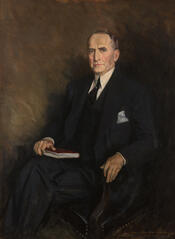
William Brockman Bankhead (April 12, 1874 – September 15, 1940) was an American politician who served as a Representative from Alabama in the United States Congress from 1917 to 1941 and as the 42nd Speaker of the United States House of Representatives from 1936 to 1940. A member of the Democratic Party, he represented Alabama’s 10th and later 7th congressional districts over 12 terms in office, contributing significantly to the legislative process during a transformative period in American history. A strong liberal and prominent supporter of President Franklin D. Roosevelt’s New Deal and pro–labor union legislation, he frequently clashed with many other Southern Democrats in Congress. Bankhead described himself as proud to be a politician, emphasizing that he did not neglect matters that concerned his district or his reelection. He was the father of the acclaimed actress Tallulah Bankhead.
Bankhead was born at the Bankhead plantation in Lamar County, Alabama. He came from a prominent political family: his father, John H. Bankhead, served in the Alabama legislature and later as both a U.S. Representative and U.S. Senator, while his mother, Tallulah James Brockman, was the granddaughter of South Carolina state senator Thomas Patterson Brockman. Raised as a Methodist, William Bankhead grew up in an environment steeped in public service and political discussion. His brother, John H. Bankhead II, would also go on to serve in the United States Senate, and his extended family included other future members of Congress, including his nephew Walter Will Bankhead, who became a U.S. Representative.
Bankhead attended the University of Alabama, where he was a member of the Phi Delta Theta fraternity and played on the university’s first football team, organized in 1892. Seeking a legal career, he continued his education at Georgetown University Law Center in Washington, D.C., from which he graduated in 1895. Immediately upon completion of his legal studies, he was admitted to the bar in Alabama and began practicing law in Huntsville, establishing himself as a capable attorney and laying the groundwork for his subsequent political career.
In 1898, Bankhead entered public office as city attorney of Huntsville, a position he held until 1902. During this period he also won election to the Alabama House of Representatives, serving one term through 1901. In 1905 he moved to Jasper, Alabama, where he continued his legal practice and deepened his involvement in state and local politics. In 1910 he was appointed solicitor of the Fourteenth Judicial Circuit of Alabama, serving in that prosecutorial role until 1914. That same year he sought the Democratic nomination for the U.S. House of Representatives but was unsuccessful, a setback that did not deter his ambition for national office.
Bankhead’s congressional career began with his election in 1916 as Representative from Alabama’s newly created 10th Congressional District, a seat added after the 1910 census and filled at large in 1912 and 1914 before being assigned to a district. Taking office in March 1917, he became the only person ever elected from the 10th District, holding it until it was abolished following the 1930 census, when Alabama lost a seat in reapportionment. After redistricting, he was elected in 1932 as Representative from Alabama’s 7th Congressional District and was re-elected three times, serving continuously until his death in 1940. Over these 12 terms, he participated actively in the democratic process and represented the interests of his constituents during World War I, the interwar years, the Great Depression, and the New Deal era.
Within the House of Representatives, Bankhead rose steadily through the Democratic leadership. He served as chairman of the powerful House Rules Committee from April 1934 until January 1935, succeeding Edward W. Pou after Pou’s death. In 1934, his colleagues chose him as House Majority Leader, a position from which he helped guide President Roosevelt’s legislative program through the chamber. On June 4, 1936, following the death of Speaker Jo Byrns earlier that day, Bankhead was elected Speaker of the House. He held the speakership from 1936 until his own death in 1940, presiding over a period of intense legislative activity in support of New Deal reforms. As Speaker, he occupied the second-highest political office ever attained by an Alabamian, ranking only behind Vice President William R. King. At the 1940 Democratic National Convention, just three months before his death, Bankhead was a serious contender for national office, finishing second to Henry A. Wallace in the balloting for the vice-presidential nomination, losing by a delegate vote of 626 to 329.
Bankhead’s congressional service and leadership coincided with major national challenges, and he became known as a steadfast ally of organized labor and a reliable supporter of Roosevelt’s domestic agenda, even when this placed him at odds with many conservative Democrats from the South. His legislative influence extended beyond policy to party organization and House procedure, where his work on the Rules Committee and as Majority Leader shaped the flow of legislation. At the same time, he maintained close attention to the needs of his Alabama constituents, consistent with his oft-stated pride in being a working politician attentive to local as well as national concerns.
William Brockman Bankhead died in office on September 15, 1940, in Washington, D.C., from an abdominal, or stomach, hemorrhage. His death brought to a close more than two decades of continuous service in the House and four years as Speaker. His legacy endured in both his family and his home state. In addition to his daughter Tallulah Bankhead’s prominence in theater, radio, and motion pictures, his family’s name remained closely associated with public service. The William B. Bankhead National Forest in northern Alabama and sections of old U.S. Highway 78 in the region were named in his honor. His home in Jasper was later renovated to become the Walker Area Community Foundation’s Bankhead House and Heritage Center, serving as a history museum and arts venue commemorating the life and contributions of one of Alabama’s most influential national legislators.
Congressional Record