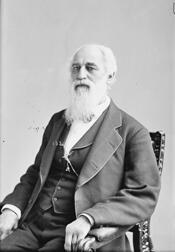
William Julian Albert (August 4, 1816 – March 29, 1879) was a Republican member of the United States House of Representatives from Maryland’s fifth congressional district, serving one term in Congress from 1873 to 1875. His service in the House of Representatives took place during the Reconstruction era, a significant period in American history, during which he participated in the legislative process and represented the interests of his Maryland constituents.
Albert was born on August 4, 1816, in Baltimore, Maryland, to a family of German descent. His father was Jacob Albert, and among his siblings was his brother Augustus James Albert, who became the owner of the Mount Vernon Hotel in Baltimore. Raised in a city that was a major commercial and industrial center, Albert grew up in an environment that exposed him early to business and civic affairs.
Albert pursued his education at Mount St. Mary’s College in Emmitsburg, Maryland, from which he graduated in 1833. His formal education provided a foundation for his later work in commerce, finance, and public life. In 1838 he married Emily J. Jones, the daughter of Talbot Jones, thereby linking himself to another established Maryland family.
Following his graduation, Albert embarked on a business career in Baltimore. Beginning in 1838, he engaged in the hardware business with his father and brother, a partnership that lasted until 1855. He broadened his commercial interests by serving, until 1862, as a director of the Baltimore and Cuba Smelting and Mining Company, reflecting the city’s growing ties to international trade and industrial enterprise. In addition to these pursuits, Albert became active in banking and finance. He was one of the founders and directors of the First National Bank of Maryland and served as a director of several insurance companies, savings banks, and manufacturing companies, making him a prominent figure in the city’s financial and business community.
During the American Civil War, Albert emerged as a notable Union leader in Maryland, a border state with divided loyalties. He worked actively to prevent the secession of Maryland from the Union, aligning himself with those who sought to maintain the state’s connection to the federal government. His political engagement continued after the war. Albert was an unsuccessful Republican candidate for election to the Fortieth Congress in 1866 and to the Forty-first Congress in 1868, but these campaigns established him as a persistent and visible figure in Maryland Republican politics during Reconstruction.
Albert was eventually elected as a Republican to the Forty-third Congress, representing Maryland’s fifth district from March 4, 1873, to March 3, 1875. His tenure in the United States Congress coincided with a critical phase of Reconstruction, and as a member of the House of Representatives he contributed to the legislative process and participated in the broader democratic governance of the postwar nation. He served one term and did not stand as a candidate for re-election to the Forty-fourth Congress in 1874, choosing instead to return to his earlier business and financial pursuits in Baltimore.
In addition to his commercial and political activities, Albert was involved in a variety of philanthropic and social welfare efforts, particularly in the years following the Civil War. He worked to found a Soldiers’ Home and an asylum for orphans, reflecting his concern for veterans and vulnerable children affected by the conflict. During the Reconstruction era he also devoted attention to assisting African American freedmen, co-founding a school in Baltimore for the training of Black teachers, thereby contributing to the expansion of educational opportunities for formerly enslaved people and their descendants.
William Julian Albert died in Baltimore on March 29, 1879, after suffering from Bright’s disease. He was interred in Greenmount Cemetery in Baltimore. His life encompassed significant roles in business, banking, Unionist politics during the Civil War, Reconstruction-era philanthropy, and a term in the United States Congress, marking him as a notable nineteenth-century Maryland political and civic leader.
Congressional Record