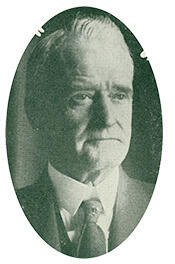
Whitmell Pugh Martin (August 12, 1867 – April 6, 1929) was an American lawyer, educator, and jurist who served as a U.S. Representative from Louisiana from March 4, 1915, until his death in 1929. Over eight terms in Congress, he contributed to the legislative process during a significant period in American history, initially as a Progressive and subsequently as a Democrat. He holds the distinction of being the only individual ever to represent Louisiana in Congress as a member of the Progressive (“Bull Moose”) Party and the only person to represent the state in Congress during the twentieth century without belonging to either the Democratic or Republican parties.
Martin was born near Napoleonville, Assumption Parish, Louisiana, to Robert Campbell Martin and Margerite Chism (Littlejohn) Martin. He attended local public schools and also received private tutoring, reflecting a combination of formal and individualized instruction typical of the era for families of some means in rural Louisiana. He pursued higher education at Louisiana State University, from which he graduated in 1888, laying the academic foundation for his later professional and public service career.
Following his graduation, Martin embarked on a brief career in education and applied science. He served as a professor of chemistry at the Kentucky Military Institute in 1889 and 1890, an early indication of his interest in both teaching and the sciences. In 1890 and 1891, he worked as a chemist for the Imperial Sugar Company in Sugar Land, Texas, gaining practical industrial experience at a time when the sugar industry was a major economic force in the Gulf South.
Martin soon turned to the study of law, enrolling at the University of Virginia in Charlottesville, where he studied in 1891 and 1892. He was admitted to the bar in 1892 and commenced the practice of law in Napoleonville, Louisiana. Later that same year he moved to Thibodaux, Louisiana, where he continued his legal practice. From 1894 to 1900 he served as superintendent of schools for Lafourche Parish, reflecting an ongoing commitment to public education and local administration. On April 14, 1896, he married Amy Williamson. He advanced in public legal service as district attorney for the 20th judicial district of Louisiana from 1900 to 1906, and then as judge of the same district from 1906 to 1914, building a reputation as a jurist before entering national politics.
Martin was elected to Congress in 1914 as a “Bull Moose” Progressive to the Sixty-fourth Congress, representing Louisiana’s 3rd congressional district, and was reelected as a Progressive to the Sixty-fifth Congress. His initial election made him the only Progressive ever to represent Louisiana in Congress and the last non-Democrat to represent the state in the House until the election of Republican David C. Treen, also from the 3rd district, in 1972. In the 1916 election, he narrowly secured reelection against Sheriff Wade O. Martin, Sr., winning by just 99 votes, with less than one percent separating the two leading candidates. His service in the House of Representatives occurred during a transformative era that included World War I and the early interwar period, during which he participated in the democratic process and represented the interests of his south Louisiana constituents.
In 1918, Martin sought reelection as a Democrat to the Sixty-sixth Congress, marking his formal shift from the Progressive Party to the Democratic Party. He continued to serve as a Democrat through the ensuing five congressional elections, all of which were uncontested, underscoring his secure political standing in his district. Over the course of these eight consecutive terms, from March 4, 1915, to April 6, 1929, he remained an active member of the House, contributing to legislative deliberations and aligning with the dominant Democratic politics of Louisiana while retaining the distinction of his earlier Progressive affiliation.
Outside of his formal offices, Martin was active in party and civic life. He served as a delegate representing his congressional district to the 1920 Democratic National Convention in San Francisco, participating in the national party’s deliberations during the post–World War I era. In his personal life, he was an Episcopalian and a Freemason, affiliations that reflected both his religious commitments and his involvement in fraternal and community networks common among public figures of his generation.
Whitmell Pugh Martin died in office in Washington, D.C., on April 6, 1929, while still serving in the United States House of Representatives. He was interred in St. John’s Episcopal Cemetery in Thibodaux, Louisiana, returning in death to the community where he had long practiced law and begun his public career.
Congressional Record