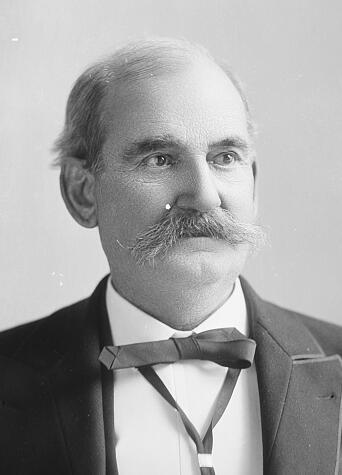
Wharton Jackson Green (February 28, 1831 – August 6, 1910) was a U.S. Congressman from North Carolina, a member of the Democratic Party, and an officer in the Confederate States Army during the American Civil War. He served as a Representative from North Carolina in the United States Congress from 1883 to 1887, completing two terms in the House of Representatives during a significant period in American history. Over the course of his public life, he participated in the legislative process and represented the interests of his constituents while also maintaining a prominent role in postwar Southern society.
Green was born on February 28, 1831, in St. Marks, Florida. He came from a politically and militarily distinguished family: he was the son of Texas Revolution general Thomas Jefferson Green, the grandson of United States Senator Jesse Wharton, and the cousin of Confederate general and later U.S. Senator Matt Whitaker Ransom. His early education was conducted under private tutors, reflecting the advantages of his family background and social position in the antebellum South.
Green pursued formal education at several institutions. He attended Georgetown College in Washington, D.C., and later studied at Lovejoy’s Academy in Raleigh, North Carolina, a well-regarded preparatory school of the era. He subsequently entered the United States Military Academy at West Point, New York, but did not complete the course of study and left the academy before graduation. Turning toward the law, he studied at the University of Virginia in Charlottesville and at Cumberland University in Lebanon, Tennessee. After completing his legal studies, he was admitted to the bar in 1854 and commenced the practice of law in Washington, D.C. In 1859 he shifted his focus to agricultural pursuits, moving to Warren County, North Carolina, where he operated his plantation, known as Esmeralda.
With the outbreak of the American Civil War, Green enlisted in the Confederate service in 1861. He rose through the ranks to become lieutenant colonel of the Second North Carolina Battalion, reflecting both his military training and his family’s martial tradition. Later in the conflict he served on the staff of Brigadier General Junius Daniel, one of North Carolina’s notable Confederate commanders. Green saw heavy combat and was wounded and taken prisoner at the Battle of Gettysburg in July 1863, one of the pivotal engagements of the war. Following his capture, he was confined for the remainder of the conflict at Johnson’s Island, a Union prisoner-of-war camp on Lake Erie that housed Confederate officers.
After the war, Green returned to North Carolina and settled at “Tokay Vineyard,” near Fayetteville, where he became deeply involved in viticulture. His postwar career combined agriculture, civic engagement, and veterans’ affairs. He emerged as an active Democrat and served as a delegate to the Democratic National Conventions in 1868, 1872, 1876, and 1888, participating in the party’s efforts to reassert influence in the post-Reconstruction South. He also played a leading role in Confederate veterans’ organizations, becoming the first president of the Society of Confederate Soldiers and Sailors in North Carolina, a body dedicated to commemorating the Confederate cause and supporting former soldiers and their families.
Green entered national politics in the early 1880s. A member of the Democratic Party, he was elected to the Forty-eighth and Forty-ninth Congresses and served as a Representative from North Carolina from March 4, 1883, to March 3, 1887. His two terms in the U.S. House of Representatives coincided with a period of economic adjustment and sectional reconciliation in the decades following the Civil War. As a member of the House, Green participated in the democratic process and contributed to the legislative work of Congress, representing the interests of his North Carolina constituents during debates over issues such as federal spending, veterans’ affairs, and the evolving policies of the post-Reconstruction era. In 1886 he was an unsuccessful candidate for renomination, which brought his congressional career to a close.
Following his retirement from public office, Green returned to private life at Tokay Vineyard. He devoted himself to the cultivation of his vineyard and to literary pursuits, reflecting both his agricultural interests and his intellectual inclinations. In 1906 he published his autobiography, “Recollections and Reflections: An Auto of Half a Century and More,” printed in Raleigh, North Carolina, by Edwards and Broughton Printing Company. The work offered his personal account of antebellum society, the Civil War, Reconstruction, and his years in public life, and it contributed to the body of Southern memoir literature that shaped contemporary and later understandings of the period.
Green’s family life also intersected with broader currents of American social and economic history. One of his daughters, Sarah Green, married wealthy industrialist Pembroke Jones of Wilmington, North Carolina, in 1884. Together, with the support of their close friend, art collector and railroad president Henry Walters, they established a highly visible and affluent social presence, maintaining luxurious residences in Newport, Rhode Island, and New York City. Their conspicuous lifestyle has often been cited as a possible inspiration for the expression “Keeping up with the Joneses.” In Wilmington, Sarah Green Jones created a notable garden estate that has been preserved and is known today as Airlie Gardens.
Wharton Jackson Green died at “Tokay,” near Fayetteville, North Carolina, on August 6, 1910. He was buried in Cross Creek Cemetery in Fayetteville. His life spanned the antebellum, Civil War, Reconstruction, and Gilded Age eras, and he left a legacy as a Confederate officer, Democratic Party leader, viticulturist, memoirist, and two-term U.S. Representative from North Carolina.
Congressional Record