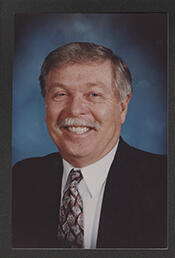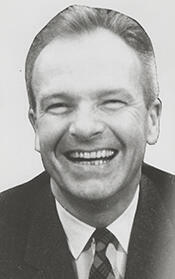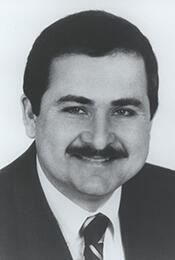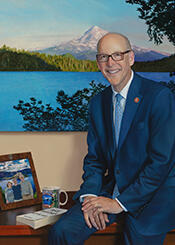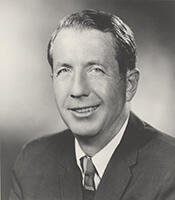
Wendell Wyatt (June 15, 1917 – January 28, 2009) was an American attorney and Republican United States Representative from Oregon’s 1st congressional district who served in the United States House of Representatives from 1963 to 1975. Born in Eugene, Oregon, he moved with his family to Portland, where he attended public schools and graduated from Jefferson High School in 1935. His early years in Oregon’s Willamette Valley and later in Portland helped shape his familiarity with the state’s economic and civic life, which would later inform his legal and political career.
Wyatt pursued higher education at the University of Oregon, where he studied law and received his Bachelor of Laws (LL.B.) degree in 1941. Soon after completing his legal education, he entered military service during World War II. From 1942 until 1946, he served in the United States Marine Corps, contributing to the nation’s war effort in a period that interrupted, but ultimately enriched, his development as a lawyer and public servant.
Following his discharge from the Marine Corps, Wyatt returned to Oregon and settled in Astoria. There he joined the law firm of former Oregon governor A. W. Norblad, becoming part of a prominent legal practice on the Oregon coast. His work as an attorney in Astoria increased his visibility in state Republican politics. From 1955 until 1957, he served as Chairman of the Oregon State Republican Central Committee, a role in which he helped organize party activities and strategy statewide. In his personal life, Wyatt married Anne Buchanan, a marriage that ended in divorce, and in 1962 he married Faye Hill.
Wyatt’s entry into Congress came under notable circumstances. In 1964, he won a special election to fill the vacancy in Oregon’s 1st congressional district caused by the death of Representative A. Walter Norblad, the son of Wyatt’s former law partner. Although the special election occurred in 1964, his overall congressional service is recorded as spanning from 1963 to 1975, encompassing six terms in office. A member of the Republican Party, he contributed to the legislative process during a significant period in American history, participating in the democratic process and representing the interests of his constituents in northwestern Oregon.
During his tenure in the House of Representatives, Wyatt served on the Interior Committee and the Appropriations Committee, positions that gave him substantial influence over natural resources, infrastructure, and federal spending measures. He played a key role in passing legislation that led to the construction of Oregon’s Scoggins Dam on Scoggins Creek, the establishment of a 40-foot shipping channel in the Columbia River from Astoria to Portland, the creation of the Cascade Head Scenic Area on the Oregon coast, and the purchase of ranch lands along the Snake River to be converted into public recreation areas. Reflecting the evolving national climate on civil rights, Wyatt voted in favor of the Voting Rights Act of 1965 and the Civil Rights Act of 1968, aligning himself with landmark federal efforts to expand and protect civil and voting rights.
After deciding not to seek reelection, Wyatt left Congress in 1975 and returned to private legal practice. He became a partner at the Portland-based law firm Schwabe, Williamson & Wyatt, where he continued to be active in legal and civic affairs. His post-congressional years, however, were not without controversy. In the aftermath of the Watergate era and related political investigations, Wyatt was found guilty and fined $750 on one count of failing to report outlays from a secret cash fund he controlled while heading the Richard Nixon presidential campaign in Oregon.
In recognition of his years of public service and his impact on federal projects in Oregon, the Edith Green – Wendell Wyatt Federal Building in downtown Portland was named in his honor, alongside Congresswoman Edith Green, with whom he served during all but three days of his tenure in Congress. Wendell Wyatt died in Portland, Oregon, on January 28, 2009, at the age of 91, closing a long career that spanned military service, law, party leadership, and more than a decade in the United States House of Representatives.
Congressional Record