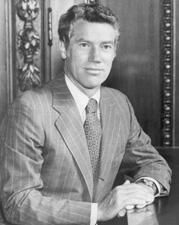
Wendell Richard “Wendy” Anderson (February 1, 1933 – July 17, 2016) was an American politician, lawyer, and hockey player who served as the 33rd governor of Minnesota from 1971 to 1976 and as a United States Senator from Minnesota from 1976 to 1978. A member of the Democratic Party, he played a prominent role in Minnesota’s political life in the 1960s and 1970s and contributed to the legislative process during one term in the U.S. Senate, representing the interests of his constituents during a significant period in American history.
Anderson was born in Saint Paul, Minnesota, on February 1, 1933. He grew up on the East Side of Saint Paul and attended Saint Paul’s Johnson High School. He went on to the University of Minnesota, where he played collegiate hockey and completed a Bachelor of Arts degree in 1954. He later enrolled in the University of Minnesota Law School, earning his law degree in 1960, which provided the professional foundation for his subsequent legal and political career.
An accomplished athlete, Anderson played defense for the University of Minnesota Golden Gophers hockey team from 1951 to 1954. During his collegiate career, he helped lead the Gophers to two NCAA Frozen Four appearances, reaching the championship game in his final two seasons; the team was defeated in consecutive finals by the Michigan Wolverines and the Rensselaer Polytechnic Institute (RPI) Bachelors. Anderson’s hockey career extended to the international stage when he was a member of the United States hockey team that won the silver medal at the 1956 Winter Olympics in Cortina d’Ampezzo, Italy. Long after his competitive playing days had ended, he was drafted in 1972 by the Minnesota Fighting Saints in the inaugural World Hockey Association draft, a move widely regarded as a publicity stunt; Anderson, then serving as governor, chose to remain in public office rather than return to the ice.
Between his undergraduate and legal studies, Anderson served in the United States Army from 1955 to 1957, attaining the rank of first lieutenant. Following his active-duty service, he continued his military involvement in the Army Reserve, where he served with an intelligence unit. After completing law school in 1960, he entered the practice of law in Minnesota while simultaneously embarking on a career in elective office.
Anderson’s political career began in the Minnesota Legislature. He was elected to the Minnesota House of Representatives, where he served from 1959 to 1963. He then won election to the Minnesota State Senate, serving from 1963 to 1971. In these roles he developed a reputation as an energetic and reform-minded legislator. In 1970 he was elected governor of Minnesota, taking office in 1971 as the state’s 33rd governor. His signature accomplishment as governor was his central role in the “Minnesota Miracle” of 1971, a major and innovative reform of the financing of Minnesota public schools and local governments. The legislation restructured the state’s tax system to create a fairer distribution of the tax burden and more equitable funding for education and local services. His leadership in this effort drew national attention, and he was featured on the cover of Time magazine on August 13, 1973.
Anderson served as governor from 1971 until late 1976. When U.S. Senator Walter Mondale was elected Vice President of the United States in the 1976 election, Minnesota’s governor was required to appoint a successor to the Senate seat. Anderson reached an agreement with his lieutenant governor, Rudy Perpich, under which Anderson would resign as governor and Perpich, upon succeeding him as governor, would appoint Anderson to the U.S. Senate. Anderson resigned as governor in December 1976 and was appointed to the Senate shortly thereafter, filling the vacancy created by Mondale’s elevation to the vice presidency. As a United States Senator from Minnesota, he served from 1976 to 1978, participating in the democratic process at the federal level and contributing to the work of the Senate during a period marked by post-Watergate reforms and shifting national priorities.
In 1978 Anderson sought election to a full Senate term but was defeated by Republican businessman Rudy Boschwitz. That election year, sometimes referred to as the “Minnesota Massacre,” saw nearly the entire Democratic–Farmer–Labor (DFL) Party statewide ticket lose, including Governor Rudy Perpich and the DFL candidates for both U.S. Senate seats, Anderson and Bob Short. Anderson’s decision to arrange his own appointment to the Senate, and Perpich’s role in that arrangement, were widely viewed as central factors in the DFL’s losses. Anderson later acknowledged that appointing himself to the Senate had been a major political mistake. After losing the 1978 election, he resigned his Senate seat a few days before the end of his term to allow Boschwitz to gain seniority in the chamber.
Following his departure from the Senate, Anderson returned to private life and business while remaining active in civic and international affairs. From 1989 to 2002 he served as honorary consul general of Sweden in Minneapolis, reflecting both his Scandinavian heritage and Minnesota’s strong cultural ties to Sweden. In the corporate sphere, he served from 1995 to 2001 as a director and head of the legal committee for Turbodyne Technologies Inc. in Carpinteria, California. In his later years he was frequently called upon as a commentator on Minnesota politics for local media outlets, including KSTP-TV, offering historical perspective on state political developments.
Anderson’s personal life included a long marriage and family. In 1963 he married Mary Christine McKee (1939–2018) of Bemidji, Minnesota. The couple had three children: Amy, Elizabeth, and Brett. They divorced in 1990. Beyond politics and law, Anderson occasionally appeared in popular culture; in the 1970s he was a mystery guest on the television game show “What’s My Line?”, where a panel including Gene Rayburn, Arlene Francis, Gene Shalit, and Sheila MacRae failed to guess that he was the sitting governor of Minnesota. In 1975, two Swedish District lodges of the Vasa Order of America named him Swedish-American of the Year, recognizing his contributions and heritage.
Wendell Richard Anderson died on July 17, 2016, of complications of Alzheimer’s disease at the age of 83. His cremated remains were interred at Lakewood Cemetery in Minneapolis in August 2019. His career, spanning service in the Minnesota House of Representatives, the Minnesota State Senate, the governorship, and the United States Senate, left a lasting imprint on Minnesota’s political and fiscal landscape, particularly through the enduring legacy of the “Minnesota Miracle” school and local government finance reforms.
Congressional Record