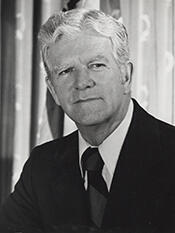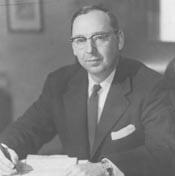
Watkins Moorman “Wat” Abbitt (May 21, 1908 – July 13, 1998) was an American politician and lawyer who represented Virginia in the United States House of Representatives from February 17, 1948, to January 3, 1973. A member of the Democratic Party and a top lieutenant in the Byrd Organization, the powerful political machine led by U.S. Senator Harry F. Byrd, Abbitt served 13 terms in Congress and became a prominent figure in mid‑twentieth‑century Virginia politics.
Abbitt was born in Lynchburg, Virginia, to George Francis Abbitt and Otway C. Moorman Abbitt. He grew up in central Virginia and was educated in local schools before graduating from Appomattox Agricultural High School in Appomattox, Virginia, in 1925. Pursuing a legal career, he enrolled at the University of Richmond, where he earned an LL.B. degree in 1931. Shortly after completing his legal education, he was admitted to the Virginia bar and began the practice of law in Appomattox, establishing the professional base that would support his later political career.
Upon admission to the bar, Abbitt engaged in private legal practice and also served as a bank executive, reflecting his early involvement in both law and local business affairs. In 1931 he was elected Commonwealth’s attorney for Appomattox County, a position he assumed in 1932 and held until 1948. During this period he gained a reputation as a capable local prosecutor and public official. In 1945 he was elected a member of the Virginia Constitutional Convention, participating in the revision of the state’s fundamental law. On March 20, 1937, Abbitt married Corinne Hancock; the couple had a son and two daughters who survived infancy, and their family life remained centered in Appomattox.
Abbitt’s congressional career began following the death of U.S. Representative Patrick H. Drewry, when he won a special election to fill the resulting vacancy. He entered the House of Representatives on February 17, 1948, as a Democrat representing a Southside Virginia district. That same year he was elected to a full term unopposed in the general election, and he was re‑elected unopposed in 1950, 1952, 1954, and 1956. In 1958 he was re‑elected with 87.15 percent of the vote, defeating Independent Frank M. McCann. He again ran unopposed in 1960 and 1962. In 1964 he was re‑elected after tying Independent Samuel W. Tucker in the general election, prevailing under Virginia’s election procedures. In 1966 he won re‑election with 75.3 percent of the vote against Independent Edward J. Silverman. In 1968 he secured 71.52 percent of the vote, defeating Samuel W. Tucker, then running as a Republican. In his final campaign in 1970, Abbitt was re‑elected with 61.02 percent of the vote, defeating Independent Ben Ragsdale and Republican James M. Helms. Over the course of these contests, he built and maintained a strong electoral base, often facing little or no opposition.
During his 13 terms in the House, Abbitt served on the Agriculture Committee, where he became known as an advocate of farm subsidies and a defender of the interests of rural constituents in Southside Virginia. He supported fiscal conservatism and consistently opposed what he regarded as excessive federal intervention in state and local affairs. His congressional service coincided with a significant period in American history, including the post–World War II era, the civil rights movement, and the early stages of the Vietnam War, and he participated in the legislative process on a wide range of issues affecting both his district and the nation.
Abbitt was also a central figure in Virginia’s Massive Resistance to school desegregation in the 1950s. Aligned with other Byrd Democrats, he strongly opposed the Supreme Court’s decision in Brown v. Board of Education, denouncing it as “the naked and arrogant declaration of nine men.” He signed the Southern Manifesto in 1956, a document in which numerous Southern legislators pledged to resist desegregation. In Congress he voted against the Civil Rights Acts of 1957, 1960, 1964, and 1968, as well as against the 24th Amendment to the U.S. Constitution, which abolished the poll tax in federal elections, and the Voting Rights Act of 1965. Beyond his legislative role, he was active in party affairs, serving as a delegate to the 1964 Democratic National Convention and as chairman of the Virginia Democratic Party from 1964 to 1970.
Abbitt announced his retirement from Congress after redistricting placed him in the same congressional district as fellow Democrat Dan Daniel. He chose not to seek another term, and in the ensuing 1972 election Republican Robert Daniel won the seat in a five‑candidate general election field, becoming the first Republican to represent Southside Virginia in a century. After leaving Congress on January 3, 1973, Abbitt returned to the full‑time practice of law in Appomattox, remaining active in his profession and community.
In his later years Abbitt publicly recanted his earlier segregationist views. According to his son, state delegate Watkins Abbitt Jr., he and his sisters influenced their father’s change of heart. Abbitt thereafter provided legal services without charge to any Black church that needed assistance, and a Black minister spoke at his funeral, reflecting the evolution of his views on race and civil rights. His personal life also changed in this period. His first wife, Corinne, to whom he had been married for 52 years, died in 1989. He later married Mary Ann Schmidt, who survived him. Abbitt continued an active law practice until shortly before his death from leukemia in Lynchburg, Virginia, on July 13, 1998, having worked as late as a week before he died. His legacy in Virginia includes a park in Appomattox named in his honor, and his family’s public service continued through his son, Watkins Abbitt Jr., who served in the Virginia House of Delegates from 1986 to 2012.
Congressional Record