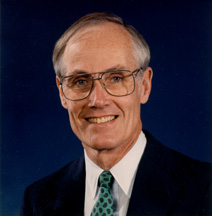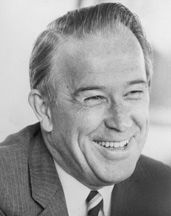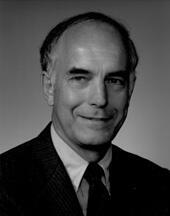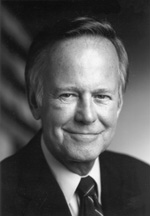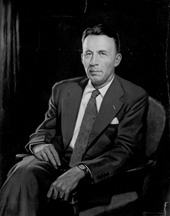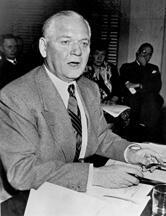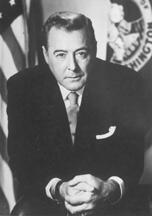
Warren Grant Magnuson (April 12, 1905 – May 20, 1989) was an American lawyer and Democratic politician who represented the state of Washington in the United States Congress for 44 years, first as a member of the House of Representatives from 1937 to 1944 and then as a United States senator from 1944 to 1981. Washington State’s longest-serving senator, he held his seat for more than 36 years and, during his final two years in office, was the Senate’s most senior member and president pro tempore. Over the course of 11 Senate terms, he became a central figure in mid‑twentieth‑century national policy, particularly in commerce, consumer protection, civil rights, fisheries, and transportation. He was also the longest-serving member of Congress whose career ended in defeat for reelection.
Magnuson was born in Moorhead, Minnesota, though the official records of his birth are sealed and his precise origins remain uncertain. His birthdate is given as April 12, 1905. According to various accounts, he never knew his birth parents; they may have died within a month of his birth, or his unmarried mother may have placed him for adoption. As an infant he was adopted by William Grant and Emma (née Anderson) Magnuson, second‑generation Scandinavian immigrants who operated a bar in Moorhead and gave him their surname. The Magnusons adopted a daughter, Clara, about a year after taking in Warren. His adoptive father left the family in 1921, and Magnuson contributed to the household through a series of jobs while still in school. He attended Moorhead High School, where he played quarterback on the football team and captained the baseball team. During these years he ran a YMCA camp, worked on wheat farms, and delivered newspapers and telegrams in Moorhead and nearby Fargo, North Dakota, experiences that exposed him early to working‑class life on the northern plains. He graduated from high school in 1923.
After graduation, Magnuson enrolled at the University of North Dakota in Grand Forks, then transferred in 1924 to North Dakota Agricultural College in Fargo, which he attended for a year. Restless and adventurous, he then spent a period traveling through Canada, riding freight trains and working with threshing crews. He eventually followed a high school girlfriend to Seattle, Washington, arriving in the mid‑1920s. In 1925 he entered the University of Washington, where he joined the Theta Chi fraternity and supported himself in part by delivering ice as a member of the Teamsters union under labor leader Dave Beck. He received a Bachelor of Arts degree in 1926 and went on to earn a Bachelor of Laws from the University of Washington School of Law in 1929. A Democrat, he first became active in politics in 1928 by volunteering in the gubernatorial campaign of A. Scott Bullitt and in the presidential campaign of Al Smith, marking the beginning of his long association with the Democratic Party.
Admitted to the bar in 1929, Magnuson joined the Seattle law office of Judge Samuel Stern and quickly became involved in civic reform and public service. He served as secretary of the Seattle Municipal League from 1930 to 1931 and gained public attention as a special prosecutor for King County in 1932, investigating official misconduct. That same year he founded the Washington State chapter of the Young Democrats of America, helping to organize New Deal–era Democratic politics in the Pacific Northwest. A strong supporter of repealing state Prohibition laws, he played a leading role in establishing the Washington State Liquor Control Board. From 1933 to 1935 he served in the Washington House of Representatives from Seattle’s 37th Legislative District, where he sponsored what was regarded as the first unemployment compensation bill in the nation and served as a delegate to the 1933 state constitutional convention. He briefly held the post of Assistant United States District Attorney before being elected prosecuting attorney of King County, a position he held from 1934 to 1936.
Magnuson’s entry into national politics came in the turbulent 1936 election cycle. When incumbent Representative Marion Zioncheck, a friend of Magnuson, exhibited serious mental instability and wavered over seeking reelection, Magnuson announced his candidacy for the U.S. House of Representatives. Two days later Zioncheck declared he would not run again, and within a week he died by suicide after jumping from his office window. With the backing of the influential left‑wing Washington Commonwealth Federation and support from the Seattle business community, Magnuson won the Democratic primary and then the general election with relative ease. Taking his seat in 1937, he quickly became active in national legislation. That year, together with Senators Homer Bone and Matthew M. Neely, he introduced the National Cancer Institute Act, which President Franklin D. Roosevelt signed into law on August 5, 1937, laying the foundation for federal cancer research. Magnuson was reelected to the House in 1938, 1940, and 1942. Following the attack on Pearl Harbor, he strongly supported the U.S. war effort and served in the United States Navy during World War II. Assigned to the aircraft carrier USS Enterprise, he saw heavy combat in the Pacific Theater until President Roosevelt ordered all members of Congress on active duty to return home in 1942.
In 1944, Magnuson sought and won election to the United States Senate from Washington. On December 14, 1944, Governor Arthur B. Langlie appointed him to fill the vacancy created by Senator Homer Bone’s appointment to the U.S. Court of Appeals for the Ninth Circuit. Magnuson resigned from the House and began his Senate service a month early, gaining an advantage in seniority that would prove significant in his long career. He was reelected to the Senate in 1950, 1956, 1962, 1968, and 1974, ultimately serving 11 Senate terms from 1937 to 1981 when his House and Senate service are combined. Throughout his Senate tenure he served on the Senate Commerce Committee and eventually became its powerful chairman. Late in his career, following the death of Senator John L. McClellan, he relinquished the Commerce chairmanship to assume leadership of the Senate Appropriations Committee, further consolidating his influence over federal spending. For most of his Senate years he served alongside his close friend and fellow Washington Democrat Henry M. “Scoop” Jackson, and together they formed one of the most influential state delegations in Congress.
Magnuson’s legislative record was extensive and touched many areas of national life. At least four major federal laws bear his name: the Magnuson–Stevens Fishery Conservation and Management Act, which established a 200‑mile fishery conservation zone and reshaped U.S. fisheries policy; the Chinese Exclusion Repeal Act of 1943, commonly known as the Magnuson Act of 1943, which ended the formal exclusion of Chinese immigrants and allowed limited Chinese immigration and naturalization; the Magnuson–Moss Warranty Act, a landmark consumer protection law governing warranties on consumer products; and the Magnuson Act of 1950 (46 U.S.C. § 70051), relating to port security. He was instrumental in keeping supertankers out of Puget Sound by quietly attaching an amendment to a routine funding reauthorization bill that passed on the Senate and House consent calendars, reflecting his concern for environmental protection and maritime safety. In 1948 he publicly called for the establishment of a Jewish state in Palestine. The following year he authored special legislation allowing Poon Lim, a Chinese sailor who had survived 133 days alone at sea as a castaway in 1942, to immigrate to the United States and become a citizen. In August 1950 he proposed voluntary enlistment of Japanese nationals in the American armed forces and sought General Douglas MacArthur’s views on the practicality of the idea, reflecting his interest in postwar Pacific affairs.
As chairman of the Commerce Committee, Magnuson played a pivotal role in civil rights and communications policy. The bill that became the Civil Rights Act of 1964 was referred to his committee, and he was instrumental in steering it to the Senate floor and securing its enactment despite vigorous opposition from Senator William Fulbright and other segregationists. He was also deeply involved in the development of public broadcasting. On November 7, 1967, when President Lyndon B. Johnson signed the Public Broadcasting Act of 1967, Johnson cited Magnuson as one of the key members of Congress who had “been part of the team that has brought this measure to the White House to make it the law of our land.” Magnuson’s stature in national politics was reflected in the tributes he received from presidents. In November 1961, President John F. Kennedy traveled to Seattle as the honored guest at a celebration marking Magnuson’s first 25 years in Congress, an event attended by nearly 3,000 people who each paid $100 to attend. In 1966, when Johnson nominated Charles F. Luce as Undersecretary of the Interior, John A. Carver to the Federal Power Commission, and David S. Black as administrator of the Bonneville Power Administration, Magnuson announced that the Commerce Committee would hold hearings on Carver’s nomination and publicly praised Luce as “one of the most able, dedicated, productive public servants I know.” In May 1978 he attended the dedication of Riverfront Park in Spokane, after which President Jimmy Carter, at a town hall meeting, lauded Magnuson and Representative Tom Foley as among the most respected and nationally prominent members of Congress.
Magnuson’s long Senate career ended in the Republican landslide of 1980, when he was defeated for reelection by Washington State Attorney General Slade Gorton. This loss made him the longest‑serving member of Congress ever to have his career concluded by electoral defeat. After leaving office in 1981, he remained active in public affairs. He participated in a United Nations–sponsored organization studying nuclear proliferation and lobbied the Washington State Legislature to adopt a flat tax to support public schools. Even as his formal political power waned, he continued to exert influence on policy debates and to serve as an elder statesman of the Democratic Party in Washington.
Magnuson’s personal life included two marriages and a number of high‑profile relationships. In 1928 he married Eleanor Peggy “Peggins” Maddieux, who had been crowned Miss Seattle in 1927; the couple divorced in 1935. In subsequent years he dated several glamorous women, including heiress and cover model June Millarde and actress Carole Parker, and he acquired a reputation as a bachelor with a lively social life. In 1964 he married Jermaine Elliott Peralta (1923–2011), who had been widowed as a teenager. The wedding was conducted by the Rev. Frederick Brown Harris at the Omni Shoreham Hotel in Washington, D.C. Magnuson helped raise Peralta’s daughter from her previous marriage, Juanita, and the couple remained together until his death. His nickname, “Maggie,” became widely used in Washington political circles, and the Washington State Democratic Party later named its annual Magnuson Awards Dinner—often called “the Maggies”—in his honor.
In his later years Magnuson suffered from serious health problems, many related to diabetes. In 1982 he underwent surgery that resulted in the amputation of several toes on his left foot due to complications from the disease. As the 1980s progressed, his public appearances diminished, though he remained a revered figure in Washington State politics. On May 20, 1989, Warren Grant Magnuson died at his home in Seattle from complications of diabetes and congestive heart failure. He and his wife Jermaine are interred at Acacia Memorial Park in Lake Forest Park, just north of Seattle. His legacy is reflected in numerous institutions and landmarks that bear his name, including the Warren G. Magnuson Health Sciences Building at the University of Washington, named in 1970; the Warren G. Magnuson Clinical Center at the National Institutes of Health in Bethesda, Maryland, renamed in his honor on October 22, 1981; and Warren G. Magnuson Park in northeast Seattle, named for him in 1977. His Senate desk is preserved in an alcove of the Suzzallo Library graduate reading room at the University of Washington. Additional tributes include the Warren G. Magnuson Puget Sound Legacy Award established by the environmental organization People For Puget Sound and the naming of the Intercollegiate College of Nursing building in Spokane on Fort George Wright Drive near Spokane Falls Community College. Magnuson’s life and career have been the subject of scholarly and public attention, including Shelby Scates’s biography, “Warren G. Magnuson and the Shaping of Twentieth‑Century America,” and archival film and reference materials maintained by institutions such as the National Institutes of Health, HistoryLink, and the Biographical Directory of the United States Congress.
Congressional Record