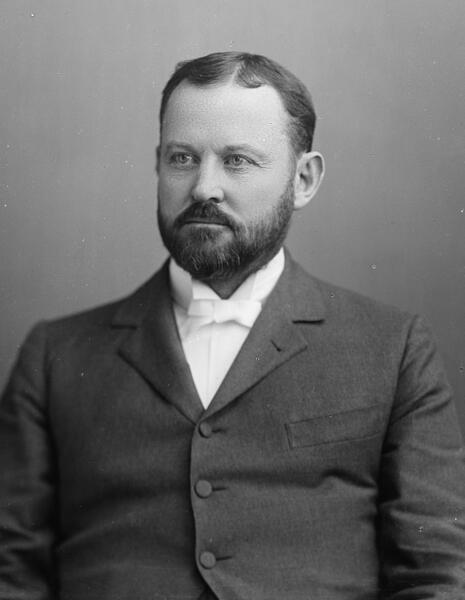
Warren Barkley English (May 1, 1840 – January 9, 1913) was an American politician and businessman who served as a Democratic United States Representative from California during the Fifty-third Congress. A member of the Democratic Party, he contributed to the legislative process during a single term in office, representing the interests of his constituents during a significant period in American history. Although his tenure in Congress was brief, it occurred at a time of intense political competition and factionalism within California’s Democratic Party.
English was part of a politically active family in California. His brother, William D. English, sought the Democratic nomination for governor of California in 1890. That contest highlighted the influence of San Francisco political boss Christopher Buckley, who controlled the California Democratic State Convention. Despite William D. English’s status as Alameda County’s “favorite son,” Buckley secured the gubernatorial nomination instead for San Francisco Mayor Edward B. Pond. Pond went on to lose the general election to Republican Henry Markham. This episode illustrated the internal divisions and power struggles within the state Democratic organization that formed the backdrop to Warren Barkley English’s own political career.
Warren Barkley English’s entry into national office came through a contested election rather than an initial outright victory at the polls. Running as a Democrat, he successfully contested the election of Republican Samuel G. Hilborn to the Fifty-third Congress. After the contest was resolved in his favor, English took his seat in the U.S. House of Representatives on April 4, 1894. His service in Congress extended until March 3, 1895, covering the latter portion of the Fifty-third Congress. During this time, he participated in the democratic process in Washington, D.C., aligning with his party on issues of the day and representing California at a moment when questions of economic policy, tariff reform, and political realignment were prominent in national debate.
Although he had gained his seat through the successful contest of Hilborn’s election, English was unable to secure a subsequent full term. He was an unsuccessful candidate for reelection in 1894 to the Fifty-fourth Congress, bringing his formal congressional service to a close after roughly one year. His brief tenure nonetheless placed him among the relatively small number of Californians who served in the House during the late nineteenth century, a period marked by rapid growth and shifting political allegiances in the state.
After leaving Congress, English returned to private life and business pursuits in the San Francisco Bay Area. He engaged in the real estate business in Oakland, California, reflecting the broader economic development and urban expansion then underway in the region. His post-congressional career in real estate allowed him to remain an active figure in local affairs, even as he no longer held elective office.
In 1905, English relocated from the East Bay to Sonoma County, California, where he turned his attention to viticulture. This move into grape growing and related agricultural activity placed him within one of California’s emerging and increasingly important industries. He continued these pursuits in Sonoma County for the remainder of his life, contributing to the agricultural and economic life of the region.
Warren Barkley English died in Santa Rosa, Sonoma County, California, on January 9, 1913. He was buried in Mountain View Cemetery in Oakland, California, returning in death to the community where he had spent much of his professional life. His career encompassed both public service and private enterprise, reflecting the intertwined political and economic development of California in the late nineteenth and early twentieth centuries.
Congressional Record