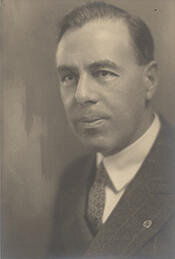
Victor Stewart Kaleoaloha Houston (July 22, 1876 — July 31, 1959) was an American politician and naval officer who served as a Republican delegate to the United States House of Representatives from the Territory of Hawaii from 1927 to 1933. Over the course of three terms in Congress, he represented the interests of his territorial constituents during a transformative period in American history, contributing to the legislative process at the federal level.
Houston was born on July 22, 1876, in San Francisco, California. He was the son of United States Navy Rear Admiral Edwin Samuel Houston and Caroline Poor Kahikiola Brickwood, who was part Native Hawaiian, giving him familial ties to both the continental United States and the Hawaiian Islands. His upbringing in a naval family and his mixed heritage would later shape both his military career and his political role as a representative of the Territory of Hawaii.
Houston received an international education in Europe before returning to the United States. He attended the Real Schule in Dresden, in the Kingdom of Saxony, and later the Cantonal College in Lausanne, Switzerland. After his studies on the European continent, he continued his education in the United States at Force School in Washington, D.C., and then at Werntz Preparatory School in Annapolis, Maryland, where he prepared for admission to the United States Naval Academy. In 1897 he graduated from the Naval Academy, receiving both his degree and a commission as a naval officer.
Following his commissioning in 1897, Houston embarked on a professional career in the United States Navy. Over nearly three decades of service, he advanced through the ranks and held a variety of assignments consistent with a career line officer of his era. He retired from active service in 1926 with the rank of commander, concluding his first period of naval duty just as he was about to enter elective public life. In 1909, during his naval career, he had moved to Hawaii, where he became active in the Hawaii Republican Party, establishing the political connections that would later support his candidacy for Congress.
Houston’s formal political career centered on his service as a Congressional delegate from the Territory of Hawaii. A member of the Republican Party, he was elected as the territory’s non-voting delegate to the United States House of Representatives and served from March 4, 1927, to March 3, 1933. During these three terms, he participated in debates, served on committees as permitted to territorial delegates, and worked to advance legislation and federal policies affecting Hawaii’s economic development, infrastructure, and strategic position in the Pacific. His tenure coincided with the late 1920s economic expansion and the onset of the Great Depression, a period in which territorial interests were closely tied to national fiscal and trade policies. In addition to his congressional duties, he was a delegate to the Republican National Conventions in 1928 and 1932, reflecting his broader involvement in national party affairs. After losing a bid for reelection in 1932, he retired from elective politics.
Although he had retired from the Navy in 1926, Houston returned to military service during World War II. Following the Japanese attack on Pearl Harbor on December 7, 1941, he was recalled to active duty as a naval officer. He served through much of the war, remaining in the Navy until March 1, 1945. During this second period of service, he rose in rank and was promoted to captain on June 9, 1943, contributing his experience and knowledge of Hawaii and the Pacific region to the wartime Navy.
Victor Stewart Kaleoaloha Houston spent his later years in Hawaii, where he remained a notable figure due to his combined record of naval service and territorial representation in Congress. He died in Honolulu, Hawaii, on July 31, 1959, just three weeks before Hawaii achieved statehood on August 21, 1959. He was buried in Oahu Cemetery. His life and career place him among the early Asian American and Pacific Islander figures in the United States Congress, reflecting both his Native Hawaiian ancestry and his role in representing the Territory of Hawaii at the national level.
Congressional Record