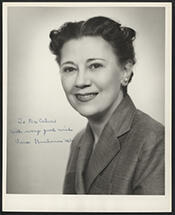
Vera Daerr Buchanan (July 20, 1902 – November 26, 1955) was a Democratic member of the U.S. House of Representatives from Pennsylvania who served from 1951 to 1955. A member of the Democratic Party, she represented her constituents in the House of Representatives during a significant period in American history, contributing to the legislative process over three terms in office. She was the first female member of the U.S. Congress to die while holding office, and she and her husband, who had also died in office, were the first congressional wife and husband to both die while still serving.
Buchanan was born Vera Marie Daerr on July 20, 1902, in Wilson, a borough in Allegheny County, Pennsylvania, in the industrial Monongahela River Valley near Pittsburgh. She was educated in the public schools of the region and, like many women of her generation, entered the workforce at an early age. Before her marriage, she worked as a secretary and bookkeeper, gaining administrative and organizational experience that would later prove useful in political life. Her early years in western Pennsylvania, shaped by the concerns of working- and middle-class families in a heavily industrial area, informed her later interest in local needs and constituent services.
In 1929 she married Frank Buchanan, a steelworker who would later enter public service. The couple settled in McKeesport, Pennsylvania, a steel-producing city in the Pittsburgh metropolitan area. Vera Buchanan remained active in civic and community affairs as her husband became increasingly involved in local politics. During the 1930s and early 1940s, she supported his political ambitions and developed her own understanding of municipal issues, social welfare concerns, and the economic challenges facing industrial communities.
Buchanan’s formal political career began through her close partnership with her husband. In 1942, she played a significant role in helping Frank Buchanan win the mayoral election in McKeesport. According to historians at the U.S. House of Representatives, as McKeesport’s first lady she initiated a “listening campaign” to familiarize herself with the needs of constituents and began cultivating a support base for future election campaigns. Her efforts included meeting with residents, community leaders, and local organizations to gather information on housing, employment, and public services, thereby establishing her own political identity and reputation for accessibility and responsiveness.
Frank Buchanan’s success in local politics led to national office. In May 1946, he won a special election to the U.S. House of Representatives, filling a vacancy in the 79th Congress (1945–1947) created by the resignation of Representative Samuel A. Weiss. Vera Buchanan continued her pattern of close collaboration, assisting her husband with constituent correspondence and maintaining ties to the district while he served in Washington. This experience gave her direct exposure to congressional operations and the expectations of a member’s office, further preparing her for her own eventual service.
Following the death of her husband while he was still in office, Vera Daerr Buchanan sought to continue his work and the representation of their district. Running as a Democrat, she was elected to the U.S. House of Representatives from Pennsylvania and took office in 1951. During her tenure in Congress, which extended through three terms until 1955, she participated in the democratic process at the federal level and represented the interests of her constituents from an industrial region undergoing postwar economic and social change. She focused on issues important to her district, including housing, veterans’ concerns, and local infrastructure, and was known for her attention to constituent service and her continued practice of listening closely to the needs of the people she represented.
Vera Daerr Buchanan’s congressional service was cut short by illness. She continued to serve while in declining health, remaining in office until her death on November 26, 1955, in Washington, D.C. Her passing made her the first female member of the U.S. Congress to die while holding office. Together with her husband, who had also died in office, she formed the first congressional wife-and-husband pair both to die while still serving in Congress. Her career reflected the increasing, though still limited, opportunities for women in mid-twentieth-century American politics and underscored the growing role of spouses and family members in sustaining long-term political representation at both the local and national levels.
Congressional Record