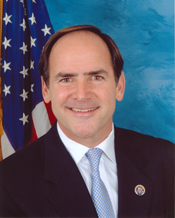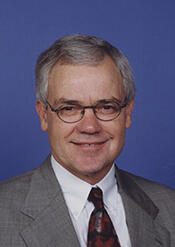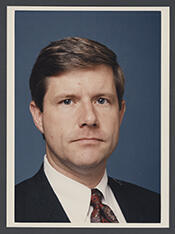
William Vanderpool “Van” Hilleary (born June 20, 1959) is an American politician and attorney who served as the U.S. representative for Tennessee’s 4th congressional district from January 3, 1995, to January 3, 2003. A member of the Republican Party, he represented a sprawling, politically competitive district for four terms and became known statewide through his congressional service and subsequent campaigns for governor and the United States Senate. He later worked as a consultant and lobbyist and returned to Capitol Hill as chief of staff to Representative John Rose. He has announced his candidacy for Tennessee’s 6th congressional district in the 2026 election, seeking to succeed Rose.
Hilleary was born in Dayton, the seat of Rhea County, Tennessee, and raised in nearby Spring City, where his family operated a textile manufacturing concern. Growing up in this small East Tennessee community, he was exposed early to the concerns of local business and rural communities. He attended the University of Tennessee, graduating in 1981. While there, he was a member of the Sigma Chi fraternity and participated in the Air Force Reserve Officers’ Training Corps (ROTC) program, laying the groundwork for a parallel career in military service.
Upon graduation, Hilleary entered active duty in the United States Air Force, serving from 1982 to 1984 and then continuing his service in the Air Force Reserve. He trained as a navigator on C-130 transport aircraft and later volunteered for two tours of duty during Operation Desert Shield and Operation Desert Storm in the early 1990s. During the Gulf War, he flew 24 missions as a C-130 navigator, experience that would become a central part of his public profile. After leaving active duty, he pursued legal studies and earned his law degree from the Cumberland School of Law at Samford University in Birmingham, Alabama, in 1990.
Following his return from the Middle East and completion of his legal education, Hilleary entered electoral politics in Tennessee. In 1992, he ran for the Tennessee State Senate against Democratic incumbent Anna Belle Clement O’Brien, the younger sister and political confidante of former Governor Frank G. Clement. Although he was defeated, the race was unexpectedly competitive and raised his profile within the state Republican Party. As a result, party leaders recruited him to run in the 1994 Republican primary for Tennessee’s 4th congressional district, an open seat created by the retirement of six-term Democratic Representative Jim Cooper, who left the House to run for the U.S. Senate.
In the 1994 election, Hilleary easily won the Republican primary and faced Democrat Jeff Whorley, a former aide to Cooper, in the general election. The 4th district, which stretched from the Virginia border in East Tennessee to the Mississippi border in Middle Tennessee and spanned five television markets and two time zones, had not been considered safe for either party and had rarely seen strong Republican challenges since its creation after the 1980 census. Hilleary’s 14‑point victory, with 56 percent of the vote, was notable even amid the broader Republican wave of 1994 and was regarded as something of a surprise. He was reelected three times without serious difficulty, each time increasing his margin of victory; his initial 56 percent in 1994 remained the lowest winning percentage of his congressional career. He even won comfortably in 1996, when President Bill Clinton carried the district in the presidential election, aided by Vice President Al Gore’s longstanding ties to much of the district’s western portion.
During his tenure in the U.S. House of Representatives from 1995 to 2003, Hilleary participated actively in the legislative process and represented the interests of his constituents during a period of significant national political change. Serving as a Republican from a district that was geographically large and politically diverse, he developed a conservative voting record and became widely known across Tennessee. He was particularly identified with opposition to any form of a state income tax, a major and contentious issue in Tennessee politics during his years in office. His service coincided with the Republican takeover of Congress in the mid‑1990s and the subsequent debates over federal spending, taxation, and social policy, and he served on committees including the House Budget Committee, where his performance later became a point of discussion in statewide campaigns.
In 2002, Hilleary declined to seek a fifth House term and instead ran for governor of Tennessee. Considered a logical choice for the Republican nomination, he faced Jim Henry, a former minority leader in the Tennessee House of Representatives and former mayor of Kingston, who was backed and financed by allies of outgoing Republican Governor Don Sundquist. Many grassroots activists resented this establishment support for Henry, and Hilleary defeated him by a wide margin in the primary. In the general election, he faced Democrat Phil Bredesen, a multimillionaire former mayor of Nashville who had previously run unsuccessfully for governor in 1994. The race centered in part on TennCare, the state’s large managed-care program that had replaced Medicaid in Tennessee. Hilleary demonstrated detailed knowledge of TennCare in debates, despite Bredesen’s background as a managed health care executive, but polling indicated that voters credited Bredesen with strong command of the issue. A state law initially limiting self-financing by candidates was declared unenforceable after an opinion by the Tennessee attorney general, allowing Bredesen to invest substantial personal funds in his campaign. In response, Hilleary reversed his earlier stance on political action committees and began actively soliciting PAC contributions. Bredesen’s moderate image, his ability to attract support in traditionally Republican East Tennessee—including carrying Knox County—and questions raised about Hilleary’s work on the House Budget Committee contributed to a narrow Democratic victory. Hilleary nonetheless received over 48 percent of the vote in a closely contested statewide race.
Hilleary remained active in politics and, in 2006, sought the Republican nomination for the U.S. Senate seat held by Senate Majority Leader Bill Frist, who honored a self-imposed two-term limit and did not run for reelection. Despite enjoying over 80 percent name recognition, Hilleary finished a distant third in the Republican primary with about 17 percent of the vote, behind former Representative Ed Bryant, who received 34 percent, and the winner, former Chattanooga mayor Bob Corker, who captured a 48 percent plurality. Hilleary lost 13 of the 22 counties in his old 4th District and subsequently endorsed Corker in the general election.
After his congressional service and statewide campaigns, Hilleary transitioned to work in consulting and government relations. Shortly after the November 2004 election, he moved his family to Murfreesboro, just outside Nashville, where he resided primarily on weekends while working during the week in Washington, D.C. as a consultant until December 2018. Financial disclosures filed in connection with his 2006 Senate candidacy indicated that he earned $300,000 in salary in 2004 from the Washington lobbying firm Sonnenschein Nath & Rosenthal, and more than $150,000 in salary from the firm through August 12, 2005. His clients included the Lumbee Indian Tribe of North Carolina, which sought full federal recognition and associated funding for education, health care, and economic development; Pennsylvania House Speaker John M. Perzel; and a range of professional and corporate entities, including the American Academy of Ophthalmology, the American Association of Diabetes Educators, the American Association of State Highway and Transportation Officials, Balfour Ventures, Federal‑Mogul Corporation, L‑3 Communications, SMS Holdings Corp., and VPI Technologies.
On December 11, 2018, it was announced that Hilleary would return to Capitol Hill as chief of staff to John Rose, the representative‑elect for Tennessee’s 6th congressional district, a district that includes much of the territory Hilleary had previously represented in the 4th District before redistricting. In this senior staff role, he drew on his prior legislative experience, statewide political exposure, and background in both military and legal affairs. Hilleary later announced, on July 11, 2025, that he would be running for the 6th congressional district seat currently held by Rose, who is himself running for governor. He is running for Congress in 2026 for Tennessee’s 6th congressional district to succeed U.S. Representative John Rose, seeking to return to elected office after more than two decades since his initial service in the U.S. House of Representatives.
Congressional Record