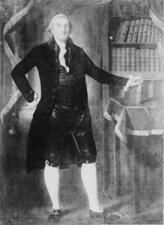
Uriah Tracy (February 2, 1755 – July 19, 1807) was an American lawyer and Federalist politician from Connecticut who served in both chambers of the United States Congress during the formative years of the federal government. Born in Franklin, Connecticut, in the Colony of Connecticut, he came of age in the final decades of British colonial rule and the turbulent period of the American Revolution, experiences that helped shape his later Federalist convictions and his commitment to a strong national government.
Tracy pursued a classical education in his youth and later studied law, gaining admission to the bar and establishing a legal practice in Connecticut. As a young man, he served in the militia during the American Revolutionary War, reflecting the widespread civic and military engagement of New Englanders in the struggle for independence. His legal training and Revolutionary-era service positioned him to enter public life in the new republic, where lawyers and veterans were often called upon to help build state and national institutions.
Before his service in the national legislature, Tracy became active in Connecticut politics and public affairs, where his skills as an advocate and his alignment with emerging Federalist principles brought him increasing prominence. He was part of a generation of New England leaders who favored a strong central government, a robust commercial economy, and close adherence to the new federal Constitution. These views would later define his congressional career and his role within the Federalist Party.
Tracy entered the United States House of Representatives in 1793, representing Connecticut in the 3rd, 4th, and part of the 5th Congresses. Serving in the House from 1793 to 1796, he participated in the early legislative efforts of the new federal government under the administrations of George Washington and John Adams. During this period, he contributed to the legislative process at a time when Congress was establishing precedents in finance, foreign policy, and the organization of the executive and judicial branches, and he consistently supported Federalist measures designed to strengthen national authority and public credit.
In 1796, Tracy moved from the House of Representatives to the United States Senate, where he served from 1796 until his death in 1807. His Senate tenure, spanning more than a decade, coincided with a significant period in American history marked by intense partisan conflict between Federalists and Democratic-Republicans, debates over relations with Britain and France, and the peaceful transfer of power in the election of 1800. As a Senator from Connecticut and a member of the Federalist Party, he represented the interests of his state’s largely commercial and Federalist-leaning constituency, taking part in deliberations on foreign policy, military preparedness, and the structure of the federal judiciary.
From May to November 1800, Tracy served as President pro tempore of the United States Senate, a position that placed him in the line of succession to the presidency at a time when the office of vice president was held by Thomas Jefferson. His selection for this role reflected the confidence of his colleagues in his parliamentary skill and leadership within the Federalist caucus. During his years in the Senate, he was known as an articulate and forceful debater, frequently defending Federalist policies and opposing measures advanced by the Jeffersonian Republicans, particularly those he believed threatened the strength or stability of the national government.
Tracy remained in the Senate until his death on July 19, 1807, while still in office, bringing to a close more than a decade of continuous congressional service that had begun in the House in 1793. His career in Congress, encompassing service in both the House of Representatives and the Senate and including a term as President pro tempore, unfolded during the nation’s first experiments with party politics and institutional development. As a Connecticut Federalist, he left a record of steadfast support for a strong federal union and active participation in the early legislative shaping of the United States.
Congressional Record