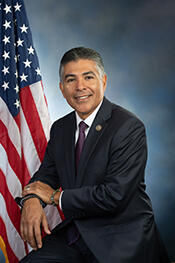
Antonio “Tony” Cárdenas (KAR-də-NAHSS; born March 31, 1963) is an American politician who served as a United States Representative from California from 2013 to 2025. A member of the Democratic Party, he represented California’s 29th congressional district during his six terms in the U.S. House of Representatives and contributed to the legislative process during a significant period in American history. He was previously a member of the Los Angeles City Council, representing the Sixth Council District, and earlier served three consecutive terms in the California State Assembly, where he chaired the budget committee.
Cárdenas was born on March 31, 1963, in Pacoima, a neighborhood in Los Angeles, California. He is one of eleven children of Andrés Cárdenas and María Quezada, who immigrated to the United States shortly after marrying in Jalisco, Mexico, in 1946. His father initially worked as a farm laborer near Stockton, California, before the family settled permanently in Pacoima in 1954. Growing up in the northeast San Fernando Valley, Cárdenas experienced firsthand the challenges facing working-class and immigrant communities, influences that later shaped his political priorities and advocacy.
Cárdenas attended San Fernando High School in the northeast San Fernando Valley, where he completed his secondary education. He went on to study engineering at the University of California, Santa Barbara, earning a Bachelor of Science degree in electrical engineering in 1986. His technical training and background in a rigorous scientific discipline informed his later interest in infrastructure, technology, and energy policy at the local, state, and federal levels.
Cárdenas began his legislative career in state government when he ran for California’s 39th State Assembly District in 1996, following the decision of Democratic incumbent Richard Katz not to seek reelection. In the 1996 general election, he defeated Republican Ollie McCaulley by a margin of 72 percent to 28 percent. He was reelected to the Assembly in 1998 with 87 percent of the vote and again in 2000 with 78 percent of the vote, serving three consecutive terms. During his tenure in the California State Assembly, Cárdenas chaired the budget committee and was instrumental in securing more than $650 million for new school construction. His state-level reforms were credited with bringing approximately 78,000 new classroom seats and 15 playgrounds throughout Los Angeles. He authored legislation that reformed California’s gang prevention and intervention programs and, working with fellow Democrat Adam Schiff, created the Schiff–Cárdenas Juvenile Justice Crime Prevention Act, which focused on reducing youth crime through prevention and intervention strategies.
After leaving the Assembly due to term limits, Cárdenas sought a seat on the Los Angeles City Council. In 2002, he ran for the City Council’s 2nd District but was narrowly defeated by Wendy Greuel, who won 50.4 percent to his 49.6 percent, a difference of 225 votes. In 2003, he successfully ran for the Los Angeles City Council’s 6th District, which includes parts of the northeast San Fernando Valley such as Arleta, Pacoima, Sun Valley, North Hollywood, Panorama City, Van Nuys, and Lake Balboa. He defeated Jose Roy Garcia by a margin of 69 percent to 31 percent. Cárdenas was reelected to the City Council in 2007 with 66 percent of the vote and again in 2011 with 58 percent, serving three terms in that body. On the Council, he chaired several key committees, including Business Tax Reform; Energy and Natural Resources; and Gang Violence and Youth Development, and also served on the Budget and Finance and Housing, Community, and Economic Development committees.
During his years on the Los Angeles City Council, Cárdenas became known for his work on public safety, youth development, animal welfare, and environmental policy. As chair of the Ad Hoc Committee on Gang Violence and Youth Development, he identified millions of dollars in previously overlooked funds to support programs aimed at keeping young people off the streets and reducing crime, while also lowering expenditures on traditional crime-abatement efforts. As vice chair of the Public Safety Committee, he helped spearhead what was described as one of the country’s most comprehensive gang intervention models. The Community-Based Gang Intervention Model standardized and defined the methods used by gang intervention workers to reduce violence in some of Los Angeles’s most dangerous neighborhoods. An animal rights advocate, Cárdenas authored legislation creating Los Angeles’s first Animal Cruelty Task Force, dedicated to arresting and prosecuting animal abusers, and he supported the city’s mandatory spay/neuter ordinance to reduce the number of stray and homeless animals. He also strongly supported green energy initiatives, proposing a Renewable Energy Portfolio Standard that set goals for the Los Angeles Department of Water and Power to obtain at least 20 percent of its energy from wind and solar sources, and advancing a plan to convert all of the city’s taxicabs to fuel-efficient vehicles by 2015. In 2012, he sponsored amendments to the city’s daytime curfew ordinance, eliminating fines of up to $500 for students, reducing court visits for parents and students, and allowing community service as an alternative to monetary penalties.
In 2012, following redistricting, Cárdenas ran for the newly drawn California’s 29th congressional district. In the June open primary, he placed first with 64 percent of the vote. Independent candidate David Hernandez, president of the San Fernando Chamber of Commerce, finished second with 22 percent, and Richard Valdez placed third with 14 percent. In the November 2012 general election, Cárdenas defeated Hernandez by a margin of 74 percent to 26 percent. He entered the U.S. House of Representatives on January 3, 2013, and was reelected five times, serving six consecutive terms through January 3, 2025. His tenure in Congress coincided with a period of significant national political polarization and major policy debates, during which he participated in the democratic process and represented the interests of his San Fernando Valley constituents.
During his congressional service, Cárdenas served on the influential House Committee on Energy and Commerce. Within that committee, he held assignments on the Subcommittee on Communications and Technology, the Subcommittee on Energy, Climate, and Grid Security, and the Subcommittee on Health, reflecting his longstanding interests in technology, energy policy, and public health. He was active in several caucuses, including the New Democrat Coalition, the American Sikh Congressional Caucus, the House Baltic Caucus, the Congressional Arts Caucus, the Congressional Hispanic Caucus, the Congressional Coalition on Adoption, and the Rare Disease Caucus. His voting record aligned closely with the priorities of his party’s leadership; as of October 2021, he had voted in line with President Joe Biden’s stated positions 100 percent of the time. Cárdenas opposed the Supreme Court’s overturning of Roe v. Wade, characterizing it as an “all out assault on autonomy,” and he consistently supported reproductive rights and related health care protections.
Cárdenas’s service in Congress from 2013 to 2025 took place during a significant period in American history, encompassing debates over health care, immigration, economic recovery, climate policy, and democratic institutions. As a member of the House of Representatives, he contributed to the legislative process and worked to advance policies affecting both his district and the nation. On November 20, 2023, it was reported that he would not seek reelection in 2024, and he subsequently concluded his sixth term in the House on January 3, 2025.
Congressional Record