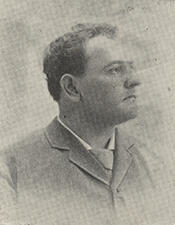
Tom Loftin Johnson (July 18, 1854 – April 10, 1911) was an American industrialist, Georgist politician, and a major figure of the Progressive Era who became a pioneer in urban political and social reform. A member of the Democratic Party, he served as a U.S. Representative from Ohio from 1891 to 1895 and later as mayor of Cleveland for four consecutive terms from 1901 to 1909. His public career was marked by vigorous advocacy of free trade, the Single Tax on land values, and municipal ownership of public utilities, as well as far‑reaching reforms in urban governance. In 1993, a panel of scholars ranked him second among the ten best mayors in American history.
Johnson was born in Georgetown, Kentucky, on July 18, 1854. His father was a wealthy cotton planter with lands in Kentucky and Arkansas who served in the Confederate Army during the American Civil War. The war ruined the family financially, forcing them to move repeatedly around the South in search of work. By the age of eleven, Johnson was selling newspapers on the railroads in Staunton, Virginia, providing a substantial share of his family’s support. He worked throughout his youth and never had more than one complete year of formal education, an experience that shaped both his self‑reliance and his later sympathy for working people.
Johnson’s entry into business came through an old family connection with the du Pont industrial dynasty. In 1869, the brothers A. V. and Bidermann du Pont gave him a clerk’s job in the street railway enterprise they had acquired in Louisville, Kentucky. He rose rapidly in the streetcar business and developed a strong interest in its mechanical aspects. Johnson patented several inventions, including an improved type of streetcar rail and the glass‑sided farebox, a design that would remain in use on many buses well into the twentieth century. By 1876, aided by royalties from his farebox, he was able to purchase a controlling interest in the street railways of Indianapolis. During the 1880s and 1890s he expanded his holdings to streetcar lines in Cleveland, St. Louis, Brooklyn, and Detroit, and entered the steel business by building mills in Lorain, Ohio, and Johnstown, Pennsylvania, to supply rails for transit systems. He moved to Cleveland in 1883 and acquired a mansion on Euclid Avenue’s “Millionaire’s Row,” symbolizing his emergence as a prominent urban capitalist.
Johnson’s family and associates were themselves notable figures. His brother Albert Johnson became prominent in the streetcar industry and in 1889 served as the financial backer and organizer of the Players’ League, a short‑lived major baseball league formed by players seeking a fairer share of profits. A cousin, Henry V. Johnson, served as mayor of Denver, Colorado, and Henry’s son, also named Tom Loftin Johnson, became a noted artist. These connections placed Johnson within a wider network of late nineteenth‑century business and political leaders, even as his own views were moving in a more radical, reformist direction.
Two pivotal experiences transformed Johnson from a conventional business magnate into one of the most vocal and dedicated admirers of Henry George’s economic philosophy and a leading anti‑monopoly reformer. The first was his encounter with George’s writings. On the suggestion of a train conductor, Johnson read Social Problems and then became absorbed in Progress and Poverty, in which George argued that poverty amid growing wealth stemmed from the unearned increase in land values and advocated a Single Tax on land in place of taxes on labor and capital. Troubled by the implications for his own career, Johnson asked his lawyer to scrutinize George’s arguments, paying him a substantial retainer to “treat this retainer as you would a fee” and give an honest opinion. Convinced of the soundness of George’s reasoning, Johnson sought him out in New York; the two became close friends and political collaborators. Johnson began to divest himself of his traction and steel interests and devoted much of his fortune to promoting Georgist ideas. The second formative event was his presence at the Johnstown Flood of 1889. Johnson and his business partner Arthur Moxham organized immediate relief efforts in the devastated city. Interpreting the disaster through a Georgist lens, Johnson blamed “Privilege”—in this case, the negligent maintenance of a private dam owned by industrialists such as Henry Clay Frick, who escaped responsibility—for the catastrophe. The experience deepened his conviction that charity and piecemeal remedial measures were inadequate to address structural social injustices.
On the explicit advice of Henry George, Johnson entered electoral politics. He first ran unsuccessfully for the U.S. House of Representatives in 1888. In 1890 he won election as a Democrat from Ohio and served two terms in the Fifty‑second and Fifty‑third Congresses from 1891 to 1895. During this period, he contributed actively to the legislative process and represented the interests of his constituents at a time of intense national debate over tariffs, monetary policy, and economic reform. In Congress he promoted free trade and the Single Tax, while serving as a useful moderate on the divisive currency question. In 1892, Johnson and his allies had Henry George’s Protection or Free Trade read in its entirety into the Congressional Record and then mailed it, under congressional franking privilege, to millions of constituents. Protectionist members responded by inserting rival works, an escalation that led to new limits on the length of material that could be printed in the Record without unanimous consent. In 1894, Johnson was one of only six representatives to vote for a Single Tax amendment to the Wilson–Gorman Tariff Act, proposed by fellow Democrat and Georgist James G. Maguire of California as a substitute for the bill’s income tax provision. The amendment would have levied a direct tax of $31,311,125 on land values nationwide. After its defeat, Johnson voted for the original House version of the tariff bill but opposed the final version returned by the Senate. His congressional service, from 1891 to 1895, thus coincided with a significant period in American history and reflected his growing commitment to structural economic reform.
The issue of “Privilege” also led Johnson to reassess his own role in the streetcar industry. Traction companies depended on route franchises granted by city councils, and political connections and payoffs often determined which firms secured lucrative monopolies. In an era when most urban residents relied on streetcars, franchise battles lay behind much municipal factionalism. Johnson, who had long benefited from this system, began publicly denouncing the abuses of streetcar barons, emphasizing that he spoke with authority because he had been one of them. In Cleveland he soon clashed with Mark Hanna, the powerful Republican businessman who by the mid‑1890s was the leading strategist of his party and a key figure in William McKinley’s rise to the presidency. Johnson made the “three‑cent fare” a central tenet of his populist program, challenging the prevailing five‑cent fare and ultimately advocating full public ownership of transit. Through the 1890s he gradually divested most of his transit and steel holdings to concentrate on political and social reform.
In 1901, urged by influential citizens and backed by a public petition, Johnson ran for mayor of Cleveland. His campaign, conducted under large circus tents erected in neighborhoods across the city, drew enthusiastic crowds. Johnson was known for his powerful oratory, his willingness to banter with hecklers, and his use of stereopticon slide shows to illustrate political arguments. On April 1, 1901, he was elected mayor with 54 percent of the vote, beginning what one associate later called a “Ten Years’ War” over the direction of city government. His entry into office was dramatic: one major campaign issue involved a valuable tract of city‑owned lakefront property that outgoing mayor John H. Farley and the city council had agreed to transfer to the railroads without compensation. Johnson obtained a court injunction to halt the transfer, but it was due to expire three days after the election. Exploiting a legal technicality to be sworn in early, Johnson and his supporters staged a surprise takeover of City Hall and preserved the land for public use. That property, later expanded by landfill, would become the site of Cleveland Browns Stadium, the Rock and Roll Hall of Fame, and the Great Lakes Science Center.
As mayor from 1901 to 1909, Johnson secured a bipartisan reform majority on the city council and initiated sweeping changes in municipal administration. He oversaw the paving of hundreds of miles of streets and a major expansion of the city’s park system, including the construction of numerous playgrounds, ball fields, and recreational facilities. Symbolically, he ordered the removal of “Keep off the Grass” signs from city parks to encourage active public use of green spaces. Responding to public concern over refuse collection, which had been handled by private contractors, Johnson eliminated the haulers’ franchises and created a municipal rubbish department, rehiring displaced workers and delivering better service at lower cost. His administration established a street cleaning force, depoliticized and improved the Water Department, and built public bathhouses in the poorest neighborhoods, some of which survived long after his tenure. Work also began under his leadership on the West Side Market, which became one of Cleveland’s most recognizable landmarks. In 1904 the city adopted what is often regarded as the nation’s first comprehensive modern building code, designed to improve housing conditions and later used as a model by other American cities. Johnson appointed his pastor, Harris R. Cooley, as Director of Charities and Correction; Cooley oversaw the purchase of a large tract of farmland in Warrensville Township, where the city established a new, more humane workhouse, cottages for indigent elderly residents, and a sanatorium.
Johnson proved adept at recruiting talented public servants. He appointed Fred Kohler as chief of police; Kohler gained national attention for professionalizing the force, cracking down on vice, and insisting on strict but discriminating enforcement of the law, with leniency for first‑time offenders and honest citizens in difficulty. As city solicitor, Newton D. Baker led the fight for municipal “home rule,” seeking a charter that would give Cleveland greater independence from state legislative control. Baker later authored the 1912 amendment to the Ohio Constitution that extended home rule to all cities in the state, served as Johnson’s successor as mayor, and became Secretary of War under President Woodrow Wilson. Under Johnson, Cleveland also advanced a major civic design project: the Cleveland Mall, a grand civic center conceived in the “Group Plan” of public buildings around a central park. Although the idea originated in an 1895 competition of the Cleveland Architectural Club, Johnson pushed through the necessary appropriations and brought in a team led by architect and planner Daniel Burnham, a leading figure in the City Beautiful movement. The Mall, whose construction continued into the 1930s, was intended as an architectural expression of democratic ideals and remains a defining feature of downtown Cleveland.
Throughout Johnson’s mayoralty, the “transit wars” remained central to city politics. By 1903, the Hanna interests, Johnson’s former lines, and other companies had been consolidated into the Cleveland Electric Railway Company, a near‑monopoly challenged only by the Johnson‑backed Municipal Traction Company, which offered a three‑cent fare. Seven years of conflict exhausted both enterprises and drove them into receivership. In 1910, after Johnson had left office, voters approved the so‑called Tayler Grant, a compromise under which Cleveland Electric Railway leased the lines from the city and was guaranteed a 6 percent return on investment. Although the arrangement proved durable and effective for decades, contemporaries and Johnson himself regarded it as a setback for his vision of full municipal ownership. Johnson also championed public ownership of electric power to break the private utility monopoly and reduce rates. He founded the Municipal Light and Power Company, but political opposition limited its early expansion. Under Mayor Baker, however, a major generating plant opened in 1914 as the largest municipal utility in the United States. Known as “Muny Light” and later as Cleveland Public Power, it produced significant savings for the city and for residents it served, while forcing the private utility to keep rates comparatively low.
Johnson’s reform program made him one of the most polarizing figures in Cleveland’s history. In a city that had long been predominantly Republican, fiscally conservative, and business‑oriented, his policies were hailed by supporters as progressive and denounced by opponents as costly and “socialistic.” He drew his strongest backing from working‑class and ethnic neighborhoods on the city’s West Side, where his three‑cent fare streetcars operated, while many middle‑ and upper‑class residents on the East Side opposed his initiatives and criticized the rapid growth of municipal debt—nearly doubled in five years—as evidence of fiscal irresponsibility. Persistent resistance from Republican leaders and business interests kept many of his most ambitious plans tied up in litigation. By 1909, public fatigue with constant political conflict contributed to his defeat for re‑election by Republican Herman C. Baehr, a relatively little‑known candidate who benefited from the desire for calmer governance.
In his later years, Johnson’s health deteriorated and his once substantial fortune was largely spent in support of reform causes and political campaigns. He remained an influential voice in Progressive Era debates and completed dictation of his autobiography, My Story, before his death. Johnson died in Cleveland on April 10, 1911. He was buried in Green‑Wood Cemetery in Brooklyn, New York, next to his friend and intellectual mentor Henry George, a final testament to the Georgist principles that had shaped his public life. His revolution in municipal government made him a national figure; muckraking journalist Lincoln Steffens famously called him “the best Mayor of the best‑governed city in the United States,” and in a 1993 survey of historians, political scientists, and urban experts, he was ranked as the second‑best American big‑city mayor to serve between 1820 and 1993, surpassed only by Fiorello La Guardia of New York City.
Congressional Record