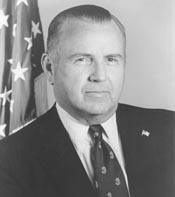
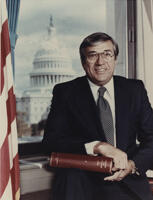
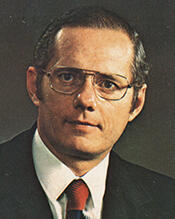
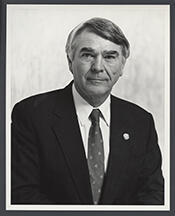
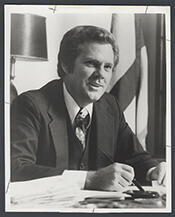
Tom Donald Fike Bevill (March 27, 1921 – March 28, 2005) was an American attorney, politician, and Democratic fifteen-term U.S. congressman who represented Alabama’s 4th Congressional District and Alabama’s 7th Congressional District from 1967 to 1997. Over the course of three decades in the United States House of Representatives, he served as a Representative from Alabama during a significant period in American history, contributing to the legislative process and representing the interests of his constituents as a member of the Democratic Party.
Bevill was born in Townley, Walker County, Alabama, on March 27, 1921. He attended Walker County High School before enrolling at the University of Alabama, where he studied in the School of Commerce and Business Administration. He went on to attend the University of Alabama School of Law, preparing for a career in the legal profession. During his time at the university, he was initiated into the Gamma Alpha chapter of the Pi Kappa Alpha fraternity, an affiliation that reflected his early engagement in campus and community life.
During World War II, Bevill served in the United States Army, joining the millions of Americans who took part in the global conflict. Following his military service, he returned to Alabama and entered the practice of law, establishing himself as a private attorney. His legal career provided the foundation for his later work in public office, combining knowledge of the law with a growing interest in public affairs and economic development in his home state.
Bevill’s formal political career began in state government. In 1958, he was elected to the Alabama Legislature, where he served until his election to Congress in 1966. His years in the state legislature helped build his reputation as an advocate for his district and gave him experience in the legislative process that he would carry to the national level. His work in Montgomery positioned him as a prominent Democratic figure in Alabama at a time of significant political and social change in the South.
In 1966, Bevill was elected to the United States House of Representatives, taking office in January 1967. He would go on to serve 15 two-year terms in Congress, representing Alabama’s 4th and 7th Congressional Districts from 1967 to 1997. As a member of the House of Representatives, he participated in the democratic process during a transformative era that spanned the Vietnam War, the civil rights movement’s legislative aftermath, the Cold War’s final decades, and the reshaping of the federal government’s role in domestic affairs. He became particularly well known for his ability to secure federal funding and development projects for his district, a hallmark of his service that earned him the nickname “The King of Pork.” Rather than shy away from the label, Bevill embraced it and turned it into a positive, emphasizing the tangible benefits such projects brought to the communities he represented.
Bevill’s congressional career included notable legislative and symbolic moments. He is credited with answering the world’s very first 9-1-1 emergency telephone call on February 16, 1968, in Haleyville, Alabama. The call was placed by then–Alabama House Speaker Rankin Fite at the invitation of the Alabama Telephone Company, and Bevill’s role in that event linked him to a major development in public safety communications. In Congress, he also sponsored the Bevill Amendment to the Resource Conservation and Recovery Act, which excludes mining wastes from the act’s jurisdiction, reflecting his involvement in legislation affecting environmental regulation and the mining industry. Among other measures, he voted for the Abandoned Shipwrecks Act of 1987, which asserted United States title to certain abandoned shipwrecks located on or embedded in submerged lands under state jurisdiction and transferred title to the respective states. This law, signed by President Ronald Reagan on April 28, 1988, aimed to empower states to manage these cultural and historical resources more efficiently and to prevent treasure hunters and salvagers from damaging them. Over his long tenure, Bevill was inducted into the Alabama Academy of Honor in 1986, recognizing his significant contributions to the state.
After fifteen terms in Congress, Bevill retired from the House of Representatives in 1997, concluding thirty years of continuous service. His departure marked the end of an era for his district, which had benefited from his focus on infrastructure, economic development, and federal investment. In 1998, his son Don Bevill sought to succeed him in his former seat but lost the general election by a margin of 56 percent to 44 percent to the Republican candidate and Bevill’s successor, Robert Aderholt, reflecting the broader partisan realignment occurring in Alabama and the South during that period.
In his later years, Bevill’s health declined, particularly due to heart problems. In 2004, he underwent triple-bypass heart surgery as part of efforts to address his cardiac condition. He died on March 28, 2005, in Jasper, Alabama, the day after his 84th birthday. His long career as an attorney, state legislator, and U.S. representative left a lasting imprint on Alabama’s political landscape and on the development of the districts he represented from 1967 to 1997.
Congressional Record