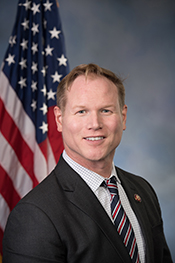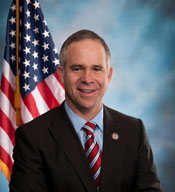
Timothy Alan Huelskamp, born November 11, 1968, is an American politician who represented Kansas’s 1st congressional district in the U.S. House of Representatives from 2011 to 2017. A member of the Republican Party, he previously served in the Kansas Senate, representing the 38th district from 1997 until 2011. Known for his strong social conservatism and alignment with the Tea Party movement, he chaired the House Tea Party Caucus from February 2015 until the end of his congressional term on January 3, 2017. He was succeeded in Congress by Roger Marshall, who defeated him in the 2016 Republican primary.
Huelskamp was born and raised on the Huelskamp family farm in Fowler, Kansas, south of Dodge City. The family operation, pioneered by his grandparents Martin and Clara Huelskamp in 1926, included raising corn, cattle, wheat, milo, and soybeans, and provided the agricultural background that would later shape his political focus on farm and rural issues. He attended elementary and high school in Fowler, where he was a Farm Bureau Youth Leader, a member of St. Anthony’s Parish, and active in both 4-H and Future Farmers of America. These early experiences in a rural, agricultural community informed his political identity and his later emphasis on agricultural policy.
After high school, Huelskamp attended seminary for two years in Santa Fe, New Mexico, reflecting an early interest in religious life and deepening his connection to Catholic faith and social conservatism. He then continued his education at the College of Santa Fe (now Santa Fe University of Art and Design), where he earned a Bachelor of Arts degree in social science education in 1991. He pursued graduate study in political science at American University in Washington, D.C., receiving a Ph.D. in 1995 with a concentration in agricultural policy. His academic work on agriculture and public policy complemented his upbringing on the family farm and laid the groundwork for his later legislative focus.
Huelskamp entered elective office in 1996, when he challenged incumbent Republican state senator Marian Reynolds in the primary for Kansas’s 38th Senate district. He won the primary by a landslide margin, taking 62 percent of the vote to Reynolds’s 38 percent, and became the youngest Kansas state senator in 20 years. He was subsequently re-elected by wide margins in 2000, 2004, and 2008. During his tenure in the Kansas Senate, he served on several legislative committees, including the Joint Committee on Information Technology, where he was chairman, and the Education Committee. He also chaired the Ethics and Local Government Committee. Huelskamp previously served on the state’s powerful Ways and Means Committee but was removed from that assignment following clashes with colleagues and committee leadership, underscoring his reputation as a combative and independent conservative voice.
Huelskamp’s election to Congress came in 2010, when seven-term Congressman Jerry Moran vacated Kansas’s 1st congressional district to run successfully for the U.S. Senate seat being left open by Senator Sam Brownback, who was running for governor. Moran’s departure triggered a crowded Republican primary in the heavily Republican “Big First,” a district that covers more than half of Kansas’s landmass and spans two time zones. In the six-candidate primary field, Huelskamp finished first with 34.8 percent of the vote, effectively securing the seat in a district where the Republican nomination is typically decisive. In the general election he faced Democratic nominee Alan Jilka and Libertarian nominee Jack W. Warner. He was endorsed by the Club for Growth, former Arkansas Governor Mike Huckabee, Conservative Leadership PAC, Concerned Women for America Legislative Action Committee, Congressman Ron Paul, and former Ohio Secretary of State Ken Blackwell. As expected, Huelskamp won the seat in a rout, taking 73 percent of the vote, and he quickly became a prominent political figure statewide due to the size and importance of the district.
Huelskamp took office in the U.S. House of Representatives in January 2011 and served three terms, contributing to the legislative process during a period marked by intense partisan conflict, debates over federal spending, and the rise of the Tea Party movement. As a member of the House of Representatives, he participated in the democratic process and represented the interests of his largely rural Kansas constituency. Known for his staunch social conservatism and fiscal conservatism, he frequently aligned with the most conservative members of the House Republican Conference. In early 2012, he introduced legislation aimed at protecting the religious conscience of military chaplains, providing that they could not be “directed, ordered or required to perform any duty, rite, ritual, ceremony, service or function that is contrary to the conscience, moral principles or religious beliefs of the chaplain, or contrary to the moral principles or religious beliefs of the chaplain’s faith group.” The measure was widely understood as a response to the prospect of same-sex marriages being performed on military bases in states where such unions were legal.
Huelskamp’s confrontational style was evident in his questioning of Obama administration officials. On February 16, 2012, during a contentious three-hour House Budget Committee hearing with Treasury Secretary Timothy Geithner, he warned of what he saw as a looming economic crisis similar to that then unfolding in Europe. He accused Geithner and the Obama administration of failing to address the U.S. debt situation, which he believed would lead the country down a similar path. Geithner responded that Huelskamp had an “adolescent perspective on how to think about economic policy,” a remark that drew national attention. After the United States Supreme Court declared the Defense of Marriage Act (DOMA) unconstitutional on June 26, 2013, Huelskamp immediately announced that he would introduce a constitutional amendment to restore DOMA. He subsequently appeared on “The Steve Deace Show,” a conservative radio program, to denounce the Court’s decision and the justices who supported it, stating, “The idea that Jesus Christ himself was degrading and demeaning is what they’ve come down to. I can’t even stand to read the decisions because I don’t even think they’d pass law school with decisions like that.”
Within Congress, Huelskamp’s uncompromising approach sometimes put him at odds with House leadership. In 2012 he was removed from the House Agriculture Committee, a significant setback for a representative from a major farm district. This removal became a recurring issue in subsequent campaigns, as farm organizations and constituents expressed concern about the district’s diminished influence on agricultural policy. Despite these tensions, Huelskamp’s standing among conservative activists grew, and in February 2015 he became chairman of the House Tea Party Caucus, a position he held until his term ended on January 3, 2017. His leadership in the caucus underscored his role as a national spokesman for Tea Party-aligned conservatives and social conservatives in the House.
Huelskamp’s electoral fortunes began to tighten as his tenure progressed. In 2012 he ran unopposed in the general election for a second term in the House, reflecting the strong Republican tilt of the district. By 2014, however, he faced growing criticism from within his own party. That year he was challenged in the Republican primary by Alan LaPolice, while two Democrats—Jim Sherow, a Kansas State University professor, and Bryan Whitney, a 2013 Wichita State University graduate—competed for their party’s nomination. Both LaPolice and Sherow criticized Huelskamp for what they described as his failure to work effectively with other members of Congress and for his vote against the federal Farm Bill, a key issue in an agricultural state. Huelskamp narrowly defeated LaPolice in the Republican primary with 55 percent of the vote, a significantly reduced margin that signaled vulnerability. Notably, he failed to receive endorsements from the Kansas Farm Bureau and the Kansas Livestock Association, influential agricultural organizations in the state. He went on to win the general election with 68 percent of the vote, but the erosion of support among farm and business groups foreshadowed challenges ahead.
In the 2016 election cycle, Huelskamp faced a serious primary challenge from Roger Marshall, an obstetrician from Great Bend. On August 2, in the Republican primary, Marshall defeated Huelskamp by a margin of 58 percent to 42 percent. Marshall’s supporters argued that Huelskamp’s combative style and conflicts with House leadership, including his removal from the Agriculture Committee, had harmed the district’s interests. Major farm and business organizations, including the Kansas Farm Bureau, the Kansas Livestock Association, the National Association of Wheat Growers, and the U.S. Chamber of Commerce, endorsed Marshall, reflecting widespread concern in the agricultural community. Huelskamp’s defeat was notable in Kansas political history: he became only the second person to represent the “Big First” in its modern configuration, dating to 1963, who did not subsequently go on to serve in the United States Senate. Marshall himself would serve two terms in the 1st District before being elected to the Senate.
Huelskamp’s term in Congress concluded on January 3, 2017, after three terms in the House of Representatives. His years in public office, from the Kansas Senate to the U.S. House, were marked by a consistent emphasis on social conservatism, limited government, and agricultural and rural issues rooted in his upbringing on a Kansas farm. Following his departure from Congress, he remained identified with conservative causes and the Tea Party movement, though his later professional and political activities have been less publicly prominent than his years in elective office.
Congressional Record