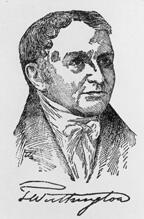
Thomas Worthington was an American Democratic-Republican politician from Ohio who served as a United States Senator from 1803 to 1815 and later became the 6th Governor of Ohio. Born on July 16, 1773, in Berkeley County, in the portion of Virginia that is now part of West Virginia, he was raised in a region on the American frontier during the closing years of the colonial era. Orphaned at a young age, Worthington was apprenticed as a stonecutter, a trade that exposed him early to the practical demands of building and settlement in a developing country. His move westward to the Northwest Territory reflected both the broader migration patterns of the early republic and his own ambitions for land, influence, and public service.
Worthington’s formal education was limited, as was common on the frontier, but he was largely self-taught and developed a strong interest in public affairs and land management. In 1796 he migrated to the area that would become Ohio, settling near present-day Chillicothe. There he became a substantial landowner and an influential figure in local society. His marriage to Eleanor Swearingen further anchored his position in the region, and his growing prominence led naturally into territorial politics. Through his land dealings, surveying work, and engagement with local governance, Worthington acquired the practical knowledge of the territory’s needs that would later shape his legislative priorities.
Worthington’s political career began in the Northwest Territory, where he emerged as a leader among settlers seeking statehood and greater self-government. A strong supporter of the Democratic-Republican Party, he aligned himself with the principles of Thomas Jefferson, favoring agrarian interests, limited centralized power, and expansion of political rights for settlers. He was a key figure in the movement to separate the future state of Ohio from the territorial administration dominated by Governor Arthur St. Clair. Worthington traveled to Washington, D.C., to lobby Congress for Ohio statehood and played a central role in the passage of the Enabling Act of 1802, which authorized the formation of a state government. He served as a delegate to the Ohio Constitutional Convention of 1802, where he helped draft the state’s first constitution and shape the framework of its early institutions.
With Ohio’s admission to the Union in 1803, Worthington’s prominence in territorial politics translated into national office. He was elected as one of Ohio’s first United States Senators, serving in the Senate from 1803 to 1807 as a member of the Republican Party, then commonly known as the Democratic-Republican Party. After a brief interval out of the Senate, he returned and served again from 1810 to 1814, completing what is generally regarded as two terms in office, and in total he represented Ohio in the Senate from 1803 to 1815. During this significant period in American history, which encompassed the Jefferson and Madison administrations and the lead-up to and conduct of the War of 1812, Worthington contributed to the legislative process and participated actively in the democratic governance of the young republic. In the Senate he represented the interests of his Ohio constituents, advocating for western development, internal improvements, and policies that would facilitate settlement and economic growth in the new state.
Worthington’s service in Congress occurred at a time when questions of territorial expansion, relations with Native American nations, and tensions with Great Britain were central to national politics. As a senator from a frontier state, he was particularly attentive to issues of land policy, infrastructure, and security on the western border. He supported measures consistent with the Democratic-Republican emphasis on westward expansion and was involved in debates over federal authority and the balance of power between the national government and the states. His legislative work helped integrate Ohio more fully into the Union and ensured that the concerns of western settlers were heard in the federal capital.
After his years in the Senate, Worthington continued his public service in Ohio state government. He was elected the 6th Governor of Ohio, serving from 1814 to 1818. As governor, he promoted internal improvements, including roads and canals, to link Ohio’s agricultural interior with markets to the east and south. He also worked to strengthen the state’s institutions and to manage its rapid population growth. His administration reflected his long-standing commitment to the development of Ohio’s infrastructure and civic life, building on the foundations he had helped lay during the statehood process and his time in the Senate. Even after leaving the governorship, he remained an influential figure in Ohio politics and public affairs.
In his later years, Worthington resided at his estate near Chillicothe, continuing to oversee his landholdings and to advise on political matters. He was the father of Thomas Worthington (American Civil War) (1807–1884), a graduate of the United States Military Academy and later an officer during the Civil War, illustrating the family’s continued involvement in national service. Another relative, Thomas Contee Worthington (1782–1847), became an American lawyer, a captain in the War of 1812, and a member of the House of Representatives in Maryland, further extending the Worthington name in public life. Thomas Worthington died on June 20, 1827, at his estate near Chillicothe, Ohio. His legacy endures in the state he helped bring into the Union, in the institutions he shaped, and in places that bear his name, including Thomas Worthington High School in Worthington, Ohio, which reflects the lasting recognition of his role in Ohio’s early history.
Congressional Record