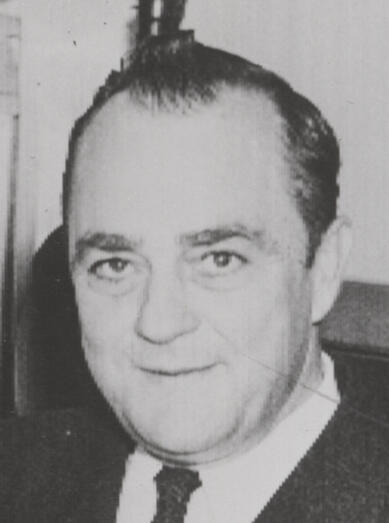
Thomas Harold Werdel (September 13, 1905 – September 30, 1966) was an American politician and lawyer who served as a member of the California State Assembly from 1943 to 1947 and as a Republican Representative from California in the United States Congress from 1949 to 1953. A staunch conservative, he was active in state and national politics during a significant period in mid‑twentieth‑century American history and later became known for his support of Senator Robert A. Taft and his role as the vice‑presidential nominee of the States’ Rights Party in 1956.
Werdel was born to Mary Laura Burke and Bernard Werdel in Emery, South Dakota, on September 13, 1905. In 1912 he moved with his parents to California, and in 1915 the family settled in Kern County, where he attended local public schools and Kern County Union High School. He went on to study at the University of California at Berkeley, from which he graduated in 1930. Continuing his education in law, he enrolled at the UC Berkeley School of Law and completed his legal studies in 1936. That same year he was admitted to the bar and began the practice of law in Bakersfield, California, establishing the professional base from which he would enter public life.
Werdel’s political career began in state government. On June 24, 1942, he announced his candidacy for the California State Assembly from the 39th Assembly District. In a notable display of cross‑party appeal, he won both the Democratic and Republican nominations, allowing him to run unopposed in the general election. After taking office in 1943, he was appointed chairman of the Judiciary Committee and also served on the Conservation, Natural Resources and Planning, Roads and Highways, Government Efficiency and Economy, and Elections and Reapportionment committees. His first legislative initiative in the Assembly was a resolution requesting federal funds to assist in the construction of the Madera and Friant‑Kern canals, reflecting his interest in water development and infrastructure critical to California’s Central Valley. Following the Hollywood Black Friday riot in 1945, he served on a committee investigating the Conference of Studio Unions, accusing the organization of conspiracy. In keeping with his strong anti‑communist views, he submitted a resolution to condemn California Attorney General Robert W. Kenny as an associate of subversive communist groups; the measure was overwhelmingly rejected by the Assembly, 57 to 19. In 1946 Werdel announced that he would not seek reelection to the Assembly and would not run for the state Senate, stating that he was quitting state politics. After leaving office in 1947, he was appointed to the Citizens Advisory Committee on Legislative Constitutional Revision, continuing his involvement in state governmental reform.
In March 1948, Werdel reentered electoral politics at the federal level by announcing his candidacy for the United States House of Representatives from California’s 10th Congressional District. He filed to run in both the Democratic and Republican primaries, easily winning the Republican nomination and narrowly securing the Democratic nomination. During the campaign he received the support of Governor Earl Warren, who was then also the Republican vice‑presidential nominee. In the general election he won decisively over the Progressive Party nominee, becoming one of four Republican gains in California that year. Werdel took his seat in the Eighty‑first Congress on January 3, 1949, and was reelected to the Eighty‑second Congress, serving from 1949 to 1953. As a member of the House of Representatives, he participated in the legislative process and represented the interests of his Central Valley constituents during the early Cold War era, a period marked by debates over domestic anti‑communism, labor relations, and federal aid programs.
During his congressional service Werdel emerged as a prominent conservative voice within the Republican Party. In 1949 he publicly accused union leaders, particularly from the National Education Association, the American Federation of Labor (AFL), and the Congress of Industrial Organizations (CIO), of plotting to use a Democratic‑sponsored federal education aid bill as a political weapon to defeat Senator Robert A. Taft in his 1950 reelection campaign in Ohio. In the 1952 Republican presidential primaries, Werdel broke with Governor Warren’s faction in California and announced that he would run a slate of seventy delegates in the state’s primary to lead a pro‑Taft delegation to the Republican National Convention, opposing the pro‑Warren “favorite son” effort. He criticized Warren for what he characterized as support for socialized medicine, underscoring his alignment with the party’s conservative, anti–New Deal wing. Despite his efforts, Warren retained control of California’s delegation. That same year, following redistricting, Werdel was placed in California’s 14th Congressional District and was an unsuccessful candidate for reelection to the Eighty‑third Congress, losing to Democrat Harlan Hagen in the 1952 general election.
After leaving Congress in 1953, Werdel resumed the practice of law in Bakersfield while remaining active in conservative politics. In 1956 he joined former Internal Revenue Commissioner T. Coleman Andrews on the States’ Rights Party ticket as the vice‑presidential nominee. The Andrews‑Werdel ticket, running on a platform critical of federal taxation and centralized government, received 107,929 votes nationwide, or 0.17 percent of the popular vote, performing strongest in Virginia, where they garnered 6.16 percent. Werdel continued to be involved in national Republican politics in subsequent election cycles, serving as a campaign adviser to Vice President Richard Nixon during the 1960 presidential campaign and to Senator Barry Goldwater during the 1964 presidential election, further cementing his association with the conservative movement within the party.
Thomas Harold Werdel died in Bakersfield, California, on September 30, 1966. He was survived by his wife and three sons and was interred in Greenlawn Memorial Park in Bakersfield. His career, spanning local legal practice, service in the California State Assembly, two terms in the United States House of Representatives, and later roles in national conservative politics, reflected the evolution of mid‑century Republican conservatism in California and the nation.
Congressional Record