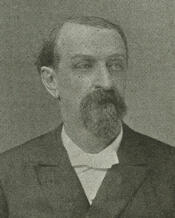
Thomas Updegraff (April 3, 1834 – October 4, 1910) was an American attorney, politician, and five-term Republican member of the U.S. House of Representatives from northeastern Iowa. A descendant of the Dutch and German Op den Graeff family, he was born in Tioga County, Pennsylvania, the son of William Updegraff (1798–1846) and Rachel Smith (1800–1869). His grandfather, also named Thomas Updegraff (1774–1857), a Quaker businessman from York County who later lived in Williamsport, Lycoming County, Pennsylvania, was an agent for an Underground Railroad station. His great-grandfather Abraham Updegraff (1746–1781) served as a private in the Pennsylvania Militia in 1760. Through Abraham’s father Herman Updegraff (1711–1758) and grandfather Isaac Updegraff (1680–1745), the family traced its lineage to Abraham op den Graeff, one of the founders of Germantown, Pennsylvania, and a signer in 1688 of the first protest against slavery in colonial America, and to Abraham’s grandfather Herman op den Graeff, a Mennonite leader of Krefeld in present-day Germany. This heritage placed Updegraff within a long tradition of religious dissent, anti-slavery sentiment, and civic engagement.
Updegraff attended the University of Notre Dame in Indiana, receiving part of his higher education there before moving west to Iowa as a young man. Settling in Clayton County in northeastern Iowa, he quickly became involved in local public affairs. From 1856 to 1860 he served as clerk of the district court of Clayton County, Iowa, gaining practical experience in legal procedure and court administration that would shape his subsequent legal and political career. During this period he read law, and after completing his legal studies he was admitted to the bar in 1860. He then commenced the practice of law in McGregor, Iowa, which remained his home and professional base for most of his adult life.
In his personal life, Updegraff married Laura A. Platt of Huron County, Ohio, in 1858. The marriage lasted until her death in 1865. Some years later he married Florence Haight, with whom he had two daughters, Elizabeth and Rachel. While building his family, he continued to expand his legal practice and civic involvement in McGregor, becoming a respected figure in the community and in regional Republican politics during the years following the Civil War.
Updegraff’s formal political career began in state government. In 1878 he was elected to the Iowa House of Representatives, where he served as a member of the state legislature. That same year, in November 1878, he was elected as a Republican to the United States House of Representatives from Iowa’s 3rd congressional district, then composed of the seven counties in the state’s northeastern corner. He took his seat in the Forty-sixth Congress on March 4, 1879, and was re-elected to a second term, serving continuously in the House from March 4, 1879, to March 3, 1883. During this first period in Congress, which occurred during a significant period in American history marked by the aftermath of Reconstruction and the rise of industrialization, Updegraff contributed to the legislative process and participated in the democratic governance of the nation, representing the interests of his northeastern Iowa constituents.
Following the federal census and the addition of two congressional seats for Iowa, the Iowa General Assembly undertook a reapportionment of the state’s congressional districts. Updegraff’s home county was placed in a newly configured 4th congressional district. In 1882 he sought to continue his service in Washington and won the Republican Party’s nomination for the 4th district. However, in the general election he was defeated by Luman Hamlin Weller of the United States Greenback Party, bringing his first period of congressional service to a close. After leaving Congress in 1883, he returned to McGregor, where he resumed the practice of law and remained active in local affairs. He served on the McGregor Board of Education and as city solicitor, roles that kept him engaged in public service at the municipal level. He also maintained his influence within the Republican Party, serving as a delegate to the 1888 Republican National Convention.
After a decade out of Congress, Updegraff returned to national politics in the 1890s. In 1892 he again ran for Congress, this time in Iowa’s 4th congressional district. He secured the Republican nomination and won the general election, defeating the incumbent Democrat Walter Halben Butler. Updegraff took his seat in the Fifty-third Congress on March 4, 1893, and was re-elected to two additional terms, serving through the Fifty-fourth and Fifty-fifth Congresses. In all, he represented the 4th congressional district from March 4, 1893, to March 3, 1899. Over the course of his five terms in the U.S. House of Representatives—two terms for the 3rd district and three for the 4th—he participated in debates and votes on issues central to the late nineteenth century, including monetary policy, tariffs, and the regulation of commerce, and consistently aligned with the Republican Party’s positions of the era. His two periods of service, separated by ten years out of Congress, reflected both his enduring popularity in northeastern Iowa and the shifting political currents of the Gilded Age.
In 1898, as he sought renomination for another term, Updegraff was defeated in the Republican primary by Gilbert N. Haugen, who would go on to serve seventeen consecutive terms in Congress. With this defeat, Updegraff’s congressional career came to an end. He returned once more to McGregor to resume his law practice and to continue his involvement in community affairs. He lived there until his death on October 4, 1910. Thomas Updegraff died in McGregor, Iowa, and was interred in Pleasant Grove Cemetery in that city, closing a life that linked early Pennsylvania anti-slavery traditions with the political development of Iowa and the broader transformations of the United States in the late nineteenth century.
Congressional Record