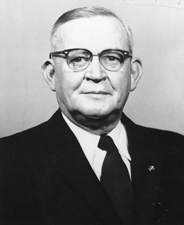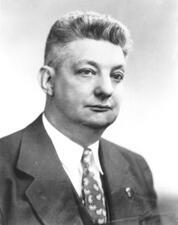
Thomas Rust Underwood (March 3, 1898 – June 29, 1956) was an American politician and newspaper editor who represented Kentucky in both the United States House of Representatives and the United States Senate. A member of the Democratic Party, he served Kentucky in Congress during a significant period in mid-twentieth-century American history, contributing to the legislative process in both chambers and representing the interests of his constituents at the national level.
Underwood was born in Hopkinsville, Kentucky, on March 3, 1898. He attended the public schools of Kentucky and went on to study at the University of Kentucky, from which he graduated in 1917. During World War I, he served in the Students Army Training Corps at the University of Kentucky, combining his academic pursuits with military training at a time when the United States was mobilizing for the conflict in Europe.
Following his education and wartime service, Underwood embarked on a career in journalism and public service. He joined the Lexington Herald, one of Kentucky’s leading newspapers, and rose through its ranks. From 1931 to 1935 he served as general manager of the Lexington Herald, and from 1935 to 1936 he was its editor. At the same time, he became increasingly involved in state affairs. He was a member of the Kentucky state planning board from 1931 to 1935, contributing to long-range economic and infrastructure planning during the early years of the New Deal. He also served as secretary of the Kentucky state racing commission from 1931 to 1943 and again in 1947, reflecting the importance of the horse racing industry to the state’s economy. On the national level, he was secretary of the National Association of State Racing Commissioners from 1934 to 1948, helping coordinate regulatory policy among the states. In 1943, during World War II, Underwood moved into federal service as assistant to the director of the Office of Economic Stabilization, an agency charged with overseeing wartime economic controls and price stabilization.
Underwood’s prominence in journalism and state administration provided a platform for his entry into elective office. A Democrat, he was elected to the United States House of Representatives from Kentucky to the Eighty-first Congress and took his seat on January 3, 1949. He was reelected to the Eighty-second Congress, giving him three terms in federal office when his subsequent Senate service is included. He served in the House from January 3, 1949, until his resignation on March 17, 1951. During this period, he participated in the legislative process at the outset of the Cold War and in the early years of the Fair Deal, representing Kentucky’s interests in debates over domestic policy and foreign affairs.
On March 19, 1951, Underwood was appointed as a United States Senator from Kentucky to fill the vacancy caused by the death of Senator Virgil Chapman in the term ending January 3, 1955. As a Democratic senator, he served from March 19, 1951, to November 4, 1952. His tenure in the Senate coincided with the Korean War and continuing postwar economic adjustments, and he took part in the democratic process at a time of significant national and international challenges. Underwood sought to retain the seat in the 1952 special election but was defeated by Republican John Sherman Cooper, bringing his Senate service to a close after this appointed term.
After his stint in the Senate, Underwood returned to his earlier profession in journalism. He resumed his editorial duties with the Lexington Herald, reengaging with public life through the press rather than elective office. In this role, he continued to influence public opinion and civic discourse in Kentucky, drawing on his extensive experience in both state and national government.
Thomas Rust Underwood died in Lexington, Kentucky, on June 29, 1956. He was interred at Lexington Cemetery. His career encompassed significant roles in journalism, state administration, and federal legislative service, and as a member of the Democratic Party he contributed to the governance of Kentucky and the United States in the House of Representatives and the Senate from 1949 to 1952.
Congressional Record