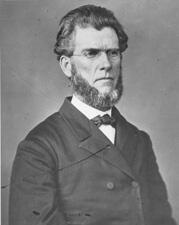
Thomas Weston Tipton (August 5, 1817 – November 26, 1899) was a United States Senator from Nebraska who served two terms in Congress from 1867 to 1875. He was born in Cadiz, Harrison County, Ohio, where he pursued early classical studies before advancing to higher education. Tipton attended Allegheny College in Meadville, Pennsylvania, and later graduated from Madison College in Pennsylvania in 1840. After completing his collegiate studies, he read law and was admitted to the bar in 1844, beginning a legal career that would intersect with public service and the ministry over the course of his life.
Tipton entered politics early, serving as a member of the Pennsylvania House of Representatives in 1845. His work in state government was followed by a federal appointment in the United States Land Office, where he served from 1849 to 1852. At the conclusion of that service, he returned to private legal practice in McConnelsville, Ohio, in 1853. During the 1850s he also experienced a significant religious vocation: he was ordained a minister of the Methodist Episcopal Church in 1856. Around 1859, Tipton moved west to Brownville, in the Nebraska Territory, where he joined the Congregational Church and quickly became involved in the region’s emerging political and constitutional development.
In Nebraska Territory, Tipton participated in foundational political institutions as the area moved toward statehood. He was a member of the Nebraska constitutional convention in 1859 and served in the Nebraska Territory council in 1860. With the outbreak of the American Civil War, he entered military service in a clerical capacity, being appointed chaplain of the First Regiment, Nebraska Volunteer Infantry, a position he held from 1861 to 1865. After the war, he continued in federal service as assessor of internal revenue for Nebraska in 1865, and he later took part in the Nebraska state constitutional convention in 1867, helping to shape the framework under which Nebraska would enter the Union.
Upon the admission of Nebraska as a state in 1867, Tipton was elected as a Republican to the United States Senate. He took his seat on March 1, 1867, and was reelected in 1869, serving until March 3, 1875. His service in Congress thus spanned a significant period in American history, encompassing Reconstruction and the early postwar years. As a member of the Senate, Thomas Weston Tipton participated in the democratic process, contributed to the legislative work of the chamber, and represented the interests of his Nebraska constituents during his two terms in office. Initially aligned with the Republican majority, he voted for the conviction of President Andrew Johnson in the 1868 impeachment trial, reflecting his early support for the more stringent Reconstruction policies associated with the party’s Radical wing.
Tipton’s appearance and manner in the Senate drew contemporary comment. A Washington correspondent in 1868 described him as embodying “unpolished earnestness,” noting that he was about six feet tall, straight in bearing, with long brown hair combed back to his coat collar, intense eyes behind gold-rimmed spectacles, and features that suggested “bull-dog courage and determination.” The correspondent observed that his excited demeanor in debate and the style of his speeches recalled what might have been a leader of the Barebones Parliament two centuries earlier. Over time, however, Tipton’s political views brought him into conflict with the leadership of his own party. By 1872 he had fallen out of favor with the administration of President Ulysses S. Grant and became a strong critic of Grant’s policies. He endorsed the Liberal Republican movement that year and supported Horace Greeley for president, effectively reading himself out of the Republican Party even as he continued to serve out his Senate term. During this period he was associated with the Liberal Republican Party, reflecting his break with the mainstream Republican organization.
After leaving the Senate in 1875, Tipton resumed the practice of law. Remaining active in Nebraska politics, he sought statewide office and was an unsuccessful candidate for Governor of Nebraska in the election of 1880. In his later years he also reflected on his long public career and the development of his adopted state, eventually authoring a retrospective volume, “Forty Years of Nebraska At Home and In Congress,” published in Lincoln by the State Journal Company in 1902. Although issued posthumously, the work drew upon his experiences in territorial politics, the Civil War, and congressional service.
Thomas Weston Tipton died in Washington, D.C., on November 26, 1899. He was interred in Rock Creek Cemetery in the nation’s capital. His life spanned the era from antebellum America through the Civil War and Reconstruction, and his career encompassed roles as lawyer, state legislator, federal official, minister, military chaplain, territorial leader, United States Senator, and later political candidate, marking him as a significant figure in the early political history of Nebraska.
Congressional Record