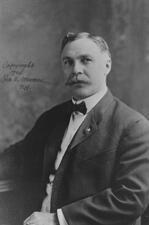
Thomas Taggart (November 17, 1856 – March 6, 1929) was an Irish-American politician, hotelier, and Democratic Party leader who became one of Indiana’s most influential political figures in the late nineteenth and early twentieth centuries and briefly served as a United States Senator from Indiana from 1916 to 1917. He was born to Thomas and Martha Kingsbury Taggart in Emyvale, County Monaghan, Ireland, and immigrated with his family to the United States in 1861 at the age of five. The family settled in Xenia, Ohio, where his father worked at a local railroad depot. Taggart left high school early to work full-time in the depot’s hotel and restaurant, gaining experience in hospitality and business that would shape his later career. In 1875, at age eighteen, he was sent by his employer, the N. and G. Ohmer Company, to Garrett, Indiana, to work in the restaurant at the DeKalb House depot hotel, and in 1877 he was transferred to Indianapolis to work as a clerk at the company’s dining hall and restaurant at Union Depot.
Taggart’s formal education ended when he left high school to work, but his early employment in railroad-related hotels and restaurants provided him with practical training in management and finance. Known as a hard worker, he rose from clerk to manager of the Union Depot restaurant and eventually became its sole owner in the new Union Station in Indianapolis. In 1878, a year after his move to Indianapolis, he married Eva Dora Bryant, whom he had met in Garrett. The couple had six children: Florence Eva (1878–1899), Lucy Martha (1880–1960), Nora (born 1881), Thomas Douglas (born 1886), Irene Mary (born 1883), and Emily Letitia (born 1888). Their family life was centered in Indianapolis, where they built a large Georgian Colonial–style home with an Italian-style interior at 1331 North Delaware Street in 1913, later recognized by House Beautiful in 1920 as one of the three best homes in the city. The Taggarts were members of Saint Paul Episcopal Church in Indianapolis.
After selling his Union Station restaurant, Taggart expanded into broader business ventures, including controlling interests in the Grand and Denison hotels in Indianapolis and investments in the copper, gas, and oil industries. In 1901 he organized a small group of investors—including William McDoel, president of the Monon Railroad; Crawford Fairbanks, a Terre Haute brewery owner; and Colonel Livingston T. Dickson, an owner of quarry and mineral interests—to acquire and develop the French Lick Springs Hotel in Orange County, Indiana. Around 1905 he bought out his partners and became sole owner of the property. Under his direction, French Lick Springs was transformed into a first-class spa and nationally known resort. Taggart modernized the facilities, improved the mineral springs, expanded the grounds, established trolley service to French Lick, and persuaded the Monon Railroad to build a spur line directly to the hotel and to run daily passenger service to Chicago. At the height of its popularity in the early twentieth century, the resort generated more than $2 million in annual profits. Although casino gambling, which flourished in Orange County from the early 1900s to the mid-1940s, contributed to the resort’s allure, Taggart publicly disassociated himself from the illegal gambling operations and denied any involvement in them. The Taggart family frequently resided at the hotel’s seven-story deluxe wing, completed in 1915, and also maintained a summer home, Amyvale—named for his Irish birthplace—built in 1915–1916 at Hyannis Port, Massachusetts, on property later adjacent to the Kennedy compound.
Taggart’s political career developed alongside his business interests, and he became known as a powerful Democratic boss in Indiana, often referred to by his initials, “T. T.,” or as “the Easy Boss” for his congenial style. Active in Indianapolis politics in the 1880s, he was elected auditor of heavily Republican Marion County in 1886, reelected in 1890, and served until 1894. During this period he also chaired the Democratic Party at the city, county, and state levels. As county chairman in the 1888 presidential campaign, he helped Grover Cleveland carry Marion County over native son Benjamin Harrison, marking the first time the county had voted Democratic in a presidential election. As state chairman in 1892, Taggart helped Cleveland carry Indiana in opposition to Harrison’s bid for reelection. From 1895 to 1901, Taggart served three consecutive two-year terms as mayor of Indianapolis, defeating Republican opponents Preston C. Trusler in 1895, William M. Harding in 1897, and Charles A. Bookwalter in 1899. His mayoral administration emphasized efficient use of city funds and significant civic improvements, most notably the acquisition of more than 900 acres along the White River to establish Indianapolis’s park and boulevard system, a major contribution to urban conservation and public recreation. Although the city’s growing African American population generally supported the Republican Party in this era, Taggart worked with African American leaders such as attorneys Alexander E. Manning and James T. V. Hill, whose efforts helped secure his election and reelection.
Taggart’s influence extended to state and national politics. He served as a member of the Democratic National Committee from 1900 to 1916 and as its national chairman from 1904 to 1908. As chairman, he managed Judge Alton B. Parker’s 1904 presidential campaign against Theodore Roosevelt. Taggart played key roles in securing John W. Kern’s Democratic nomination for vice president and Thomas R. Marshall’s nomination for governor of Indiana in 1908, and later in obtaining Woodrow Wilson’s nomination for president and Marshall’s for vice president at the 1912 Democratic National Convention in Baltimore, Maryland. He was also instrumental in James M. Cox’s nomination as the Democratic candidate for president in 1920. By the first quarter of the twentieth century, Taggart was widely regarded as the undisputed boss of the Indiana Democratic machine and one of the state’s most dominant political figures.
On March 20, 1916, Indiana Governor Samuel M. Ralston appointed Taggart, his longtime political ally, as a United States Senator from Indiana to fill the vacancy caused by the death of Senator Benjamin F. Shively. A member of the Democratic Party, Taggart served in the U.S. Senate from 1916 to 1917, contributing to the legislative process during one term in office. His service in Congress occurred during a significant period in American history, as the nation debated its role in World War I and addressed issues of federal finance and preparedness. As a member of the Senate, Taggart participated in the democratic process and represented the interests of his Indiana constituents, advocating efficient use of federal funds and opposing wasteful spending. However, in the Republican sweep of the November 1916 special election, he lost the seat to James E. Watson, ending his brief tenure in the Senate.
Taggart remained active in politics and public affairs after leaving the Senate. In 1920 he helped James M. Cox secure the Democratic presidential nomination; Cox, in turn, supported Taggart’s attempt to regain the Senate seat from Watson, but the Republican landslide that elected Warren G. Harding also returned Watson to the Senate over Taggart. In 1924 Taggart nearly secured Governor Samuel Ralston’s nomination as the Democratic presidential candidate before Ralston withdrew for health reasons. That same year, in Indiana’s gubernatorial race, Taggart endorsed Democrat Carleton B. McCulloch, who lost to Republican Edward L. Jackson, a candidate strongly backed by the Ku Klux Klan and victorious in all but two of Indiana’s ninety-two counties. Despite declining health in the 1920s, Taggart continued to serve in civic and business roles, including as chairman of the board of directors of American Fletcher National Bank from 1925 to 1929, as a director of the Indianapolis Light, Heat, and Power Company, as treasurer of the Indiana Lincoln Union, and as a member of the George Rogers Clark Memorial Commission.
Thomas Taggart died in Indianapolis on March 6, 1929. A brief funeral service was held in the dining room of his North Delaware Street home, after which he was buried at Crown Hill Cemetery in Indianapolis. His gravesite, marked by a tall gray obelisk in Section Three, lies near those of his wife, Eva, and four of their children—Florence, Lucy, Irene, and Thomas. Following his death, his son Thomas Douglas Taggart became owner of the French Lick Springs Hotel property and buildings, then valued at nearly $2 million. Taggart is remembered as the undisputed boss of the Indiana Democratic machine in the first quarter of the twentieth century, a key figure in state and national Democratic politics, and a mayor whose support for public improvements, especially the creation of Indianapolis’s park and boulevard system, made him a leader in the movement to conserve urban natural resources for public use.
Congressional Record