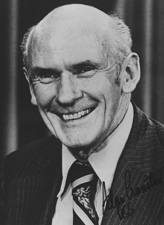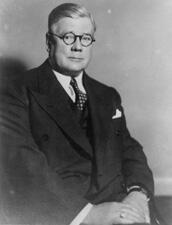
Thomas More Storke (November 23, 1876 – October 12, 1971) was an American journalist, politician, postmaster, and publisher who briefly served as a United States Senator from California from 1938 to 1939. A lifelong Democrat, he was appointed as an interim senator to fill a vacancy and participated in the federal legislative process for one term in office. Outside of Congress, he became one of California’s most influential regional newspaper publishers and civic leaders and was awarded the Pulitzer Prize for Editorial Writing in 1962.
Storke was born in Santa Barbara, California, on November 23, 1876, the only child of Charles A. Storke and Martha Storke. His father was an eminent local citizen and politician, and through his mother he was descended from the prominent Ortega and Olivera families, giving him deep roots in the early Californio and American periods of Santa Barbara’s history. He grew up bilingual in Spanish and English, reflecting the cultural blend of the region. Storke attended public schools in Santa Barbara and then entered Stanford University a year early. He studied economics and graduated in 1898 at the age of 22, an education that would later inform both his business ventures and his editorials on public affairs.
After college, Storke embarked on a career in journalism and publishing that would define much of his life. In 1900, he borrowed $2,000—equivalent to roughly $80,000 in 2024—and purchased the Santa Barbara Daily Independent, then considered the least favored newspaper in town. Demonstrating an aptitude for both journalism and business, he built up the paper before selling it in 1909 to enter the oil business. His connection to public service deepened when, in the spring of 1912, he was appointed postmaster of Santa Barbara. In 1913, he returned to journalism by purchasing the Santa Barbara Daily News. He later reacquired the Daily Independent and merged it with the Daily News to form the Santa Barbara Daily News & Independent. Over the following years he consolidated Santa Barbara’s newspaper market further by purchasing The Morning Press, the city’s third paper, and ultimately combining his holdings into The Santa Barbara News-Press. After building the News-Press into a leading regional newspaper, he sold it after 23 years for nearly $10 million to the publisher of The Philadelphia Bulletin.
Storke’s brief but notable congressional service came late in this period of his career. A member of the Democratic Party, he was appointed to the United States Senate by Republican California Governor Frank F. Merriam on November 9, 1938, to fill the vacancy created by the resignation of Senator William Gibbs McAdoo the previous day. McAdoo had lost his bid for renomination in the Democratic primary to Sheridan Downey and resigned his seat on the day of the general election, which Downey won. Storke himself had not been a candidate for the office; his appointment was explicitly interim, bridging the gap between McAdoo’s resignation and Downey’s assumption of the seat. Storke flew to Washington, D.C., where he was sworn in by Edwin H. Halsey, the Secretary of the Senate, and served until January 3, 1939, when Downey’s elected term began. Because Congress was not in session during his tenure, Storke did not author legislation or cast any Senate votes, but he nonetheless formally represented California in the Senate during a significant period in American history on the eve of World War II.
Following his return to California, Storke resumed and expanded his work in the media. He completed the consolidation of his newspaper properties into the Santa Barbara News-Press and also founded AM radio station KTMS, extending his influence into broadcasting. His prominence in public life led to further appointments in state and educational governance. He served as a member of the California Crime Commission from 1951 to 1952, participating in statewide efforts to investigate and address criminal activity and corruption. From 1955 until 1960, he was a member of the Board of Regents of the University of California, where he used his political and civic influence to advance the university’s interests, including the development of what became the University of California, Santa Barbara (UCSB) campus.
In 1958, Storke published California Editor, a lengthy memoir that offered a detailed account of his life, his newspaper career, and the history and civic development of Santa Barbara. His stature as an editor reached a national audience in the early 1960s. In 1961, when the John Birch Society attacked President Dwight D. Eisenhower’s administration and Chief Justice Earl Warren as being sympathetic to communism, Storke responded in the News-Press with a caustic and forceful series of editorials defending democratic institutions and denouncing extremist rhetoric. These editorials earned him widespread acclaim and several major honors, including the Pulitzer Prize in Journalism for Editorial Writing in 1962, the Elijah Parish Lovejoy Award, and an honorary Doctor of Laws degree from Colby College.
Storke’s later years were marked by his continued engagement with higher education and civic life in Santa Barbara. He played a key role in securing the present UCSB campus—more than 900 coastal acres on a former military installation—from the United States government under the college land grant program, helping to anchor the university’s long-term presence in the region. His legacy is physically memorialized on the UCSB campus by Storke Tower, a 190-foot structure in the center of the campus that is the tallest tower in Santa Barbara County and houses the only five-octave chromatic bell system in the area. Beneath Storke Tower lies the Storke Communication Plaza, which contains the offices of the student-run Daily Nexus newspaper and the studios of community radio station KCSB-FM, symbolically linking his name to the ongoing practice of journalism and broadcasting.
Thomas More Storke died of a stroke on October 12, 1971, at the age of 94. At the time of his death he was survived by a large family, including ten grandchildren and nine great-grandchildren. His life spanned nearly a century of California and American history, during which he served as a local and national figure in journalism, briefly as a United States Senator from California, and as a prominent civic leader whose influence extended into politics, higher education, and the public discourse of his time.
Congressional Record