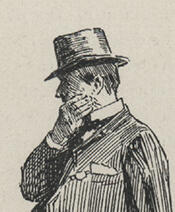
Thomas Ringland Stockdale (March 28, 1828 – January 8, 1899) was a U.S. Representative from Mississippi from 1886 to 1895 and a justice of the Supreme Court of Mississippi from 1896 to 1897. A member of the Democratic Party, he served four terms in the United States House of Representatives from 1887 to 1895, contributing to the legislative process during a significant period in American history and representing the interests of his Mississippi constituents.
Stockdale was born at West Union Church near Waynesburg, Greene County, Pennsylvania, on March 28, 1828. Details of his early family life are sparse in the historical record, but his upbringing in rural western Pennsylvania preceded a career marked by steady advancement in education, law, and public service. His early years in this region laid the foundation for his later move to the South and his long association with the state of Mississippi.
Stockdale pursued higher education at Jefferson College in Canonsburg, Pennsylvania (now Washington & Jefferson College), from which he graduated in 1856. Demonstrating continued academic ambition, he received a master’s degree from the same institution in 1859. Shortly after completing his initial college studies, he relocated to Mississippi, where he taught school in Pike County. He then entered the University of Mississippi to study law, receiving his law degree in 1859. Following his admission to the bar, he began the practice of law in Woodville, Mississippi, establishing himself professionally in his adopted state on the eve of the Civil War.
With the outbreak of the Civil War, Stockdale entered military service in the Confederate States Army. In 1861 he enlisted as a private in the 16th Mississippi Infantry. Over the course of the conflict he rose through the ranks, being promoted successively to lieutenant, captain, and major, and serving as regimental adjutant. He later commanded a battalion in the 4th Mississippi Cavalry Regiment and subsequently served as the regiment’s second in command with the rank of lieutenant colonel. His wartime service reflected both his leadership abilities and his alignment with Mississippi and the Confederacy during the national crisis.
After the war, Stockdale resumed the practice of law, this time in Summit, Pike County, Mississippi. He became increasingly active in Democratic Party politics during the Reconstruction and post-Reconstruction eras. He served as a delegate to the Democratic National Convention in 1868, participating in the party’s efforts to reassert influence in the South. He was also chosen as a Democratic presidential elector in 1872 and again in 1884, roles that underscored his prominence within the party and his growing stature as a public figure in Mississippi.
Stockdale was elected to the United States House of Representatives as a Democrat in 1886 and took his seat in the Fiftieth Congress on March 4, 1887. He served four consecutive terms, remaining in office until March 3, 1895, thus sitting in the Fiftieth, Fifty-first, Fifty-second, and Fifty-third Congresses. During these years he participated in the democratic process at the federal level, contributing to the legislative work of the House and representing the interests of his Mississippi constituents at a time of economic change, sectional adjustment, and evolving federal policy in the post-Reconstruction South. He was an unsuccessful candidate for renomination in 1894, which brought his congressional career to a close the following year.
In 1896, Stockdale’s long legal and political experience led to his elevation to the state’s highest court. Governor Anselm J. McLaurin appointed him to fill a vacancy as a justice of the Supreme Court of Mississippi. Stockdale served on the court from 1896 to 1897, participating in the adjudication of state legal controversies during a formative period in Mississippi’s judicial history. After leaving the bench, he returned to private life in Summit, where he remained a respected figure in the community.
Thomas Ringland Stockdale died in Summit, Mississippi, on January 8, 1899. He was interred in Woodlawn Cemetery in Summit. His former residence in Summit has been preserved by the Summit Historical Society, and the grounds of his home contain a memorial honoring his life and public service. His career, spanning education, law, military service, national politics, and the judiciary, reflected the trajectory of a 19th-century Southern statesman whose work intersected with many of the central events and transformations of his era.
Congressional Record