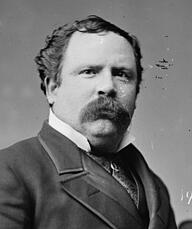
Thomas Peck Ochiltree (October 26, 1839 – November 25, 1902) was a U.S. Representative from Texas who served one term in the United States Congress from 1883 to 1885 as a member of the Independent Party. Born in Livingston, Sumter County, Alabama, he was taken as a child to Nacogdoches in the Republic of Texas, where he was raised and attended the public schools. Growing up in a frontier environment, he was exposed early to the political and military currents of a developing Texas society.
In 1854, at a young age, Ochiltree volunteered as a private in Captain John G. Walker’s company of Texas Rangers. He participated in campaigns against the Apache and Comanche Indians in 1854 and 1855, gaining experience in frontier warfare and public service. Despite his limited formal education, he pursued legal training and, in 1857, was admitted to the bar by a special act of the Texas Legislature, an indication of his early prominence and connections in Texas political life.
Ochiltree’s civil career in Texas politics began before the Civil War. He served as clerk of the Texas House of Representatives from 1856 to 1859, a position that placed him at the center of state legislative activity. In 1859 he was secretary of the State Democratic convention, further solidifying his role in party affairs. He also entered journalism, serving as editor of the Jeffersonian in 1860 and 1861. That same year he was chosen as a delegate to the Democratic National Conventions held in Charleston, South Carolina, and Baltimore, Maryland, in 1860, participating in the fractious national party deliberations that preceded the Civil War.
With the outbreak of the Civil War, Ochiltree enlisted in the Confederate States Army in the First Texas Regiment. Over the course of the conflict he was promoted successively through the ranks of lieutenant, captain, and major, reflecting both his length of service and his leadership responsibilities. After the war, he returned to journalism and public life, serving as editor of the Houston Daily Telegraph from 1866 to 1867, a period in which Texas was undergoing Reconstruction and political realignment.
In the early 1870s, Ochiltree’s career took on an international dimension. From 1870 to 1873 he was appointed commissioner of immigration for Texas in Europe, charged with encouraging European settlement in the state and promoting its economic development. His federal service began shortly thereafter: on January 8, 1874, President Ulysses S. Grant appointed him United States marshal for the eastern district of Texas, a significant law-enforcement and administrative post during a turbulent era in the state’s history.
Ochiltree reached the peak of his political career with his election to the United States House of Representatives. He was elected as an Independent to the Forty-eighth Congress and served from March 4, 1883, to March 3, 1885. During this single term in office, he represented Texas in the House of Representatives, participated in the legislative process, and contributed to the democratic governance of the nation during a significant period in American history. As an Independent Party member, he was not formally aligned with the major parties, and he represented the interests of his Texas constituents while navigating the complex political landscape of the post-Reconstruction era.
After the conclusion of his congressional service in 1885, Ochiltree moved to New York City, where he retired from active political life. He remained there for the remainder of his career, becoming part of the social and civic circles of the city, though he did not return to elective office. In his later years he traveled for health and leisure, and he died in Hot Springs, Bath County, Virginia, on November 25, 1902. Initially interred in Green-Wood Cemetery in Brooklyn, New York, his remains were later reinterred in Mount Hope Cemetery in Hastings-on-Hudson, New York, on November 8, 1903.
Congressional Record