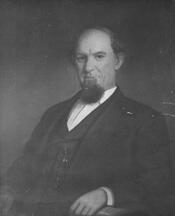
Thomas Jordan Jarvis (January 18, 1836 – June 17, 1915) was an American educator, lawyer, legislator, diplomat, and Democratic politician who served as the 44th governor of North Carolina from 1879 to 1885 and as a United States Senator from North Carolina from 1893 to 1895. A member of the Democratic Party, he contributed to the legislative process during one term in the Senate and played a central role in North Carolina politics in the late nineteenth and early twentieth centuries. A white supremacist, he spoke and wrote widely in support of the white supremacy campaign of 1898. In 1907, he helped establish East Carolina Teachers Training School, now known as East Carolina University.
Jarvis was born in Jarvisburg, Currituck County, North Carolina, the son of Elizabeth Daley Jarvis and Bannister Hardy Jarvis, a Methodist minister and farmer. He was one of several children, including siblings George, Ann, Margaret, and Elizabeth. His family was of English descent; among his ancestors were Thomas Jarvis, lieutenant governor of Albemarle during the government of Philip Ludwell between 1691 and 1697, and Samuel Jarvis, who led the militia of Albemarle during the Revolutionary War. The family lived on a 300‑acre farm and, as Jarvis later recalled, they had “the necessities of life but few of the luxuries.” He attended local schools in Currituck County before pursuing higher education.
At age nineteen, Jarvis enrolled at Randolph–Macon College in Virginia. To pay his tuition, he taught school during the summers, reflecting an early commitment to education that would later shape his public career. He completed his studies and earned a Master of Arts degree in 1861. Trained as an educator, he returned to North Carolina and opened a school in Pasquotank County. His early professional life thus combined teaching and local leadership on the eve of the American Civil War.
With the outbreak of the Civil War, Jarvis enlisted in the Confederate Army and served in the Eighth North Carolina Regiment. He was captured and exchanged in 1862, and on April 22, 1863, he was promoted to the rank of captain. In 1864 he was severely wounded at the Battle of Drewry’s Bluff, an injury that left him permanently disabled. At the end of the war he was on sick leave in Norfolk, Virginia, and in May 1865 he received probation and returned to his home community of Jarvisburg. Later that year, he entered business by opening a general store with entrepreneur William H. Happer. He was chosen as a delegate to the North Carolina constitutional convention of 1865, marking his first significant role in public affairs. In 1867, Jarvis bought out Happer’s interest in the store, but after obtaining a license to practice law in June of that year, he abandoned the mercantile business and moved to Columbia, North Carolina, to begin a legal career.
Jarvis quickly became active in the Democratic Party during Reconstruction. In 1868 he was elected to the North Carolina House of Representatives, where he served for four years. From 1870 to 1872 he held the influential position of Speaker of the House. In the 1872 presidential election he served as a Democratic elector-at-large on the Horace Greeley ticket, underscoring his growing prominence in state and national politics. An opponent of federal Reconstruction policies, he aligned with the conservative Democratic effort to restore white Democratic control in North Carolina. In December 1874, he married Mary Woodson, with whom he shared the remainder of his life.
In 1876, Jarvis was elected the state’s third lieutenant governor on a Democratic ticket headed by Zebulon B. Vance. When Vance resigned the governorship in 1879 to take a seat in the United States Senate, Jarvis succeeded him as governor of North Carolina. He later won election in his own right in 1880, defeating Daniel G. Fowle for the Democratic nomination and narrowly prevailing over Republican candidate Ralph Buxton in the general election. As governor from 1879 to 1885, Jarvis pursued policies aimed at reducing state debt, lowering taxes, and limiting direct government control over certain enterprises. He completed the sale of various state-owned railroads to private companies and worked to combat government corruption. His administration expanded public institutions, including the establishment of mental health facilities in Morganton and Goldsboro, and he supported the development of normal schools for teacher training and the strengthening of the State Board of Health. He advocated a more systematic approach to public education, backing legislation to create county superintendents of education elected by boards of education, to institute graded teacher certifications, to set standards for teacher examinations, and to adopt recommended textbook lists. During his tenure, funding for mental institutions increased, the laws of North Carolina were codified for the first time, state insurance laws were more clearly defined, and construction of the North Carolina Executive Mansion was authorized, though the governor’s residence was not completed until 1891.
Constitutionally barred from seeking another consecutive term, Jarvis left the governorship in 1885. That same year, President Grover Cleveland appointed him United States Minister to Brazil, a diplomatic post he held for four years. After returning to North Carolina, he settled in Greenville and resumed the practice of law. His long association with Zebulon Vance continued to shape his career. Following Senator Vance’s death in 1894, Jarvis again succeeded him, this time in the United States Senate. Appointed by Governor Elias Carr, he served as a Senator from North Carolina from 1893 to 1895, completing the unexpired term. During this single term in office, he participated in the legislative process and represented the interests of his constituents during a period of significant economic and political change in the United States. In 1895, however, the North Carolina legislature, then controlled by a coalition of Republicans and Populists, declined to elect him to a full term, ending his brief service in the Senate.
Jarvis remained active in Democratic politics after leaving the Senate. In 1896, he served as a delegate to the Democratic National Convention, where he supported William Jennings Bryan, marking his last major role in national party affairs. In 1898, he became a vocal participant in North Carolina’s white supremacy campaign, which sought to disfranchise African American voters and overturn the biracial “Fusion” coalition of Republicans and Populists. He traveled widely to deliver speeches on behalf of the movement and wrote a widely syndicated newspaper essay condemning the Fusion movement and denouncing Greenville’s African-American-dominated town council. Although he was not directly involved in the violence, his rhetoric and that of other Democratic leaders helped create the climate that led to the Wilmington insurrection of 1898, a violent coup d’état by white supremacists who overthrew the elected local government, destroyed Black-owned property and businesses, including the city’s only Black newspaper, and killed an estimated 60 to more than 300 people.
In the early twentieth century, Jarvis devoted increasing attention to education and civic affairs in Greenville and eastern North Carolina. He was instrumental in the founding in 1907 of East Carolina Teachers Training School in Greenville, an institution created to train teachers for the public schools of the region and the forerunner of East Carolina University. In recognition of his role, the oldest residential hall on the university’s campus was later named in his honor. He reopened his law firm and, in 1912, formed a partnership with attorney Frank Wooten. Jarvis also remained active in commemorative and veterans’ activities; in November 1914, he presided over the unveiling of the Pitt County Confederate Soldiers’ Monument. His influence in Greenville was reflected in the naming of a local United Methodist church and a city street for him, and at one time several of his personal artifacts were displayed at the church.
Thomas Jordan Jarvis died at his home in Greenville, North Carolina, on June 17, 1915. His long public career—spanning service as educator, legislator, governor, diplomat, and United States Senator, as well as his central role in the establishment of East Carolina Teachers Training School—left a lasting imprint on the political and educational landscape of North Carolina, even as his advocacy of white supremacy and participation in the 1898 campaign formed a significant and deeply troubling part of his legacy.
Congressional Record