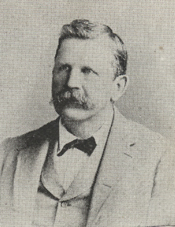
Thomas Jefferson Hudson (October 30, 1839 – January 4, 1923) was a U.S. Representative from Kansas who served one term in the United States Congress from 1893 to 1895. A member of the Populist Party during his congressional service, he participated in the legislative process at a time of significant political and economic change in the United States, representing the interests of his Kansas constituents in the House of Representatives.
Hudson was born near Jamestown, Boone County, Indiana, on October 30, 1839. He received his early education at Lebanon (Indiana) Academy and later attended Wabash College in Crawfordsville, Indiana. In 1854 he moved with his family to Nodaway, Missouri, where he continued his upbringing on the western frontier. During the Civil War he spent much of the period on an unexplained mission in Nevada, a little-documented episode in his life that removed him from the main theaters of the conflict but placed him in the rapidly developing Far West.
In 1866 Hudson moved to Coyville, Kansas, reflecting the broader postwar migration into the Great Plains. There he taught in the first county school, contributing to the establishment of public education in the region. While engaged in teaching, he began the study of law. He was admitted to the bar at Iola, Kansas, in June 1869 and, later that year, moved to Fredonia, Kansas, where he commenced the practice of law. In the early 1870s he became active in local civic affairs, aiding in the adoption of the Fifteenth Amendment, which secured voting rights for African American men, and serving as treasurer and as a member of the first Fredonia school board. His work in education and voting rights reflected the Reconstruction-era emphasis on expanding civic participation.
Hudson’s public career advanced quickly in Kansas state and local government. He was elected a member of the Kansas House of Representatives in 1870, participating in the legislative development of the young state. In 1871 he served as mayor of Fredonia, where he helped guide the community’s early municipal organization. That same year he organized the Wilson County Bank in Fredonia, demonstrating an interest in local economic development and financial institutions. Seeking to strengthen his professional credentials, he graduated from the law department of the University of Cincinnati, Ohio, in 1874, adding formal legal training to his established practice in Kansas.
In addition to his legal and business pursuits, Hudson held important county and party positions. He served as prosecuting attorney for Wilson County from 1884 to 1886, overseeing criminal prosecutions and representing the county in legal matters. Nationally, he was active in Democratic Party politics, serving as a delegate to the Democratic National Conventions in 1884, 1888, and 1896. His participation in these conventions placed him within the broader debates over tariff policy, monetary issues, and agrarian reform that defined late nineteenth-century American politics, even as he later aligned with the Populist movement in his congressional career.
Hudson was elected as a Populist to the Fifty-third Congress and served from March 4, 1893, to March 3, 1895. His tenure coincided with the economic turmoil of the Panic of 1893 and the height of the Populist Party’s influence, when agrarian discontent and calls for monetary reform, railroad regulation, and political change were prominent in national discourse. As a member of the House of Representatives, Thomas Jefferson Hudson contributed to the legislative process during this significant period in American history and represented the interests of his Kansas constituents within the broader Populist agenda. He was not a candidate for renomination in 1894, and his service in Congress concluded with the end of the Fifty-third Congress.
After leaving Congress, Hudson resumed the practice of law in Fredonia, Kansas, returning to the profession that had anchored much of his adult life. He continued to serve the state in educational and institutional roles, notably as a Regent of the State college of agriculture in 1897 and 1898, helping oversee the governance of Kansas’s agricultural higher education at a time when such institutions were central to rural development and scientific farming. His later years were spent in Kansas, where he remained a respected figure in legal, educational, and civic circles.
Thomas Jefferson Hudson died in Wichita, Kansas, on January 4, 1923. He was interred in Fredonia Cemetery in Fredonia, Kansas, closing a life that spanned from the antebellum era through Reconstruction, the rise of Populism, and the early twentieth century, and that encompassed service as educator, lawyer, banker, local and state official, national party delegate, and member of the United States House of Representatives.
Congressional Record